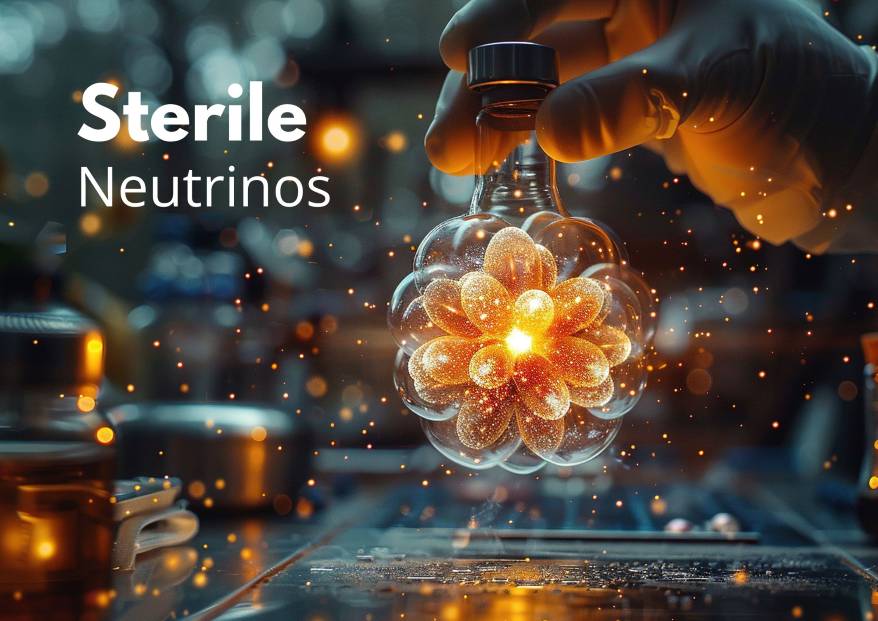
This finding rules out the long-held theory of sterile neutrinos as an explanation for these surprising signals. It is a major step forward because it removes an option scientists had been considering for around 30…
MicroBooNE Rules Out Sterile Neutrinos, Shaping Future Particle Physics Research
Neutrinos are some of the most mysterious particles in the universe. They are incredibly tiny and hard to detect, yet they exist in massive numbers all around us. Scientists have spent decades trying to understand these particles better. Recently, a major experiment called MicroBooNE delivered new results that shake up what we thought we knew about neutrinos.
The Standard Model of particle physics describes fundamental particles and forces well but doesn’t answer every question. One big puzzle involves neutrinos, which come in three flavors: electron, muon, and tau neutrinos. These particles can change from one flavor to another as they travel, a process called oscillation. This discovery showed that neutrinos must have mass, though the Standard Model originally said they did not.
Decades ago, some experiments found strange results. They saw more electron neutrinos than expected when studying muon neutrinos over distances. This unexpected result led scientists to propose a new type of neutrino, the sterile neutrino. Unlike known neutrinos, sterile neutrinos would not interact through any force except gravity.
The Role of the MicroBooNE Experiment
Fermilab’s Micro Booster Neutrino Experiment was developed with the intention of conducting a thorough examination of this concept. Beginning in 2015 and continuing until 2021, it utilized a specialized detector that was filled with liquid argon in order to investigate the possibility that muon neutrinos could transform into electron neutrinos under certain circumstances.
In the event that sterile neutrinos were possible, their presence would result in the appearance of more electron neutrinos in a manner that could be carefully measured by scientists. On the other hand, the data from MicroBooNE did not demonstrate this tendency.
What This Means for Physics
This finding rules out the long-held theory of sterile neutrinos as an explanation for these surprising signals. It is a major step forward because it removes an option scientists had been considering for around 30 years.
David Caratelli, an assistant physics professor at UC Santa Barbara involved in the experiment, remarked that these results help narrow down future research paths by eliminating weak theories and focusing on more promising ones.
The Future of Neutrino Research and Beyond
This breakthrough drives scientists toward discovering other explanations behind past anomalies and deeper questions about particle physics itself, such as why there is more matter than antimatter or how dark matter interacts with ordinary matter.
MicroBooNE Next Steps With Bigger Experiments
The research community looks ahead to even larger experiments like the Deep Underground Neutrino Experiment (DUNE). Planned deep underground in South Dakota, this detector will be much bigger than MicroBooNE, about the size of a football field.
DUNE aims to study vast numbers of high-energy neutrinos beamed from Fermilab across 800 miles underground. It can measure oscillations with greater accuracy and explore more phenomena linked with these ghost-like particles.
Laying Foundations for Future Discoveries
Researchers working on DUNE and other initiatives of a similar nature around the world will get valuable insights from the lessons acquired at MicroBooNE regarding how to evaluate massive data sets using sensitive equipment. It is possible that these studies will discover fresh and interesting insights regarding the fundamental components of our cosmos.
Additionally, to stay updated with the latest developments in STEM research, visit ENTECH Online. Basically, this is our digital magazine for science, technology, engineering, and mathematics. Further, at ENTECH Online, you’ll find a wealth of information.
Reference
Ashkenazi, A., Barr, G., Bateman, J., Rodrigues, O. B., Berkman, S., Bhat, A., Bhattacharya, M., Bolton, T., Camilleri, L., Caratelli, D., Chen, Y., Conrad, J. M., Diurba, R., Duffy, K., Eberly, B., Ereditato, A., Furmanski, A. P., Gao, F., Garcia-Gamez, D., . . . Yang, T. (2025). Search for light sterile neutrinos with two neutrino beams at MicroBooNE. Nature, 648(8092), 64–69. https://doi.org/10.1038/s41586-025-09757-7
- Author
- Latest Posts

I’m a web developer and science writer with a Master’s degree in Computer Applications (MCA) from Pune University.
I work in tech, building websites and staying updated with the latest developments. I also love writing about physics, chemistry, technology, robotics, mathematics, and breakthrough innovations. My passion is breaking down complex scientific topics into simple, easy-to-understand stories.
My goal is to help everyone stay informed about the exciting changes happening in science and technology. I believe understanding science shouldn’t be complicated—it should be accessible to all.