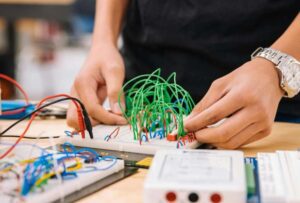
Responsible innovation is about building tools that make human life better rather than replacing human contact.
Understanding AI, IoT, and the Responsibility of Innovation
Estimated reading time: 5 minutes
We are living through a time where coffee makers chat with smartphones and cars handle most of the driving on the highway. It feels a bit like we wandered onto a movie set from the future, but this is just a normal Monday for most of us. Two specific technologies are driving this massive shift: Artificial Intelligence (AI) and the Internet of Things (IoT). While you might hear these terms tossed around constantly in business meetings or tech blogs, they are actually straightforward concepts that are reshaping how we live, work, and connect with our surroundings.
However, having all this new capability brings a serious need for caution. As we welcome smart gadgets and complex algorithms into our living rooms and offices, a big question arises: are we doing it the right way? Are we doing responsible innovation?
AI, IoT and Responsible Innovation: Linking Smart Gadgets with Thinking Machines
To really get a handle on where we are headed, we should look at the tools in our hands. You can think of the Internet of Things (IoT) as a digital nervous system for the planet. It is made up of billions of physical objects, like smart thermostats, fitness bands on our wrists, and sensors on factory machines, all hooked up to the internet to gather and share information.
If IoT acts as the nervous system, then Artificial Intelligence acts as the brain. AI takes the mountain of data that IoT devices collect and actually makes sense of it. Without AI, a smart doorbell is basically just a camera that annoys you with alerts every time the wind blows. Add AI to the mix, and that same doorbell learns to spot your face, tell the difference between a stray dog and the mail carrier, and only buzzes your phone when it is actually important.
When these two forces combine, the result is powerful. We get traffic lights that change timing instantly to clear up jams, hospitals that track patient health from miles away, and power grids that balance themselves to stop blackouts before they start. This mix makes life smoother, but it also opens the door to some tricky situations.
Why Responsible Innovation Matters Now
New inventions are exciting. It is always fun to see what the latest tech can do. But running full speed ahead without checking the map can land us in trouble. For most people, privacy is the number one worry. When a watch tracks your heartbeat, a fridge logs your groceries, and a speaker records your voice commands, a lot of very personal details end up floating around in the cloud.
Security is another huge piece of this puzzle. If someone breaks into your laptop, it is a major hassle. But if a bad actor hacks into a connected car or a medical implant, the danger becomes physical. Manufacturers are feeling the heat to make sure safety isn’t just a bonus feature but is baked into the core of every new device.
Then we have the problem of bias. AI systems learn by studying data provided by people, and people aren’t perfect. If the training data has a slant, the AI’s decisions will have a slant too. This can impact who gets a loan approved or whose resume gets picked for a job. This is exactly why the ethical use of AI is such a massive topic right now. We have to be sure the systems running in the background of our lives are fair, open, and answerable to someone.
AI, IoT and Responsible Innovation: Keeping the Human Touch
It is easy to get bogged down in specs and features, forgetting that tech exists to help people, not the other way around. Responsible innovation is about building tools that make human life better rather than replacing human contact.
Take elder care as an example. IoT sensors can notice if someone falls, and AI can spot health trends before they turn into emergencies. This helps seniors stay in their own homes longer. Yet, these gadgets should be there to help human caregivers do a better job, not to take the place of a friendly face or a caring conversation. The aim should always be to boost what people can do.
We also have a job to do as buyers. When we ask questions about where our data goes and buy from brands that care about safety and morals, we push the industry to do better. We aren’t just sitting back and watching; we are helping decide how this technology grows up.
AI, IoT and Responsible Innovation: What Comes Next?
The partnership between AI and IoT is really just getting started. The changes coming in the next ten years will likely make today’s tech look simple. As we step into that future, keeping our focus on responsibility is non-negotiable.
Technology is just a tool. Like a hammer or a wrench, its impact depends entirely on how we use it. By putting safety, fairness, and human values first, we can ensure the smart future we are building works for everyone. We have a chance to make a world that isn’t just more advanced, but also safer and fairer for all of us.
Additionally, to stay updated with the latest developments in STEM research, visit ENTECH Online. Basically, this is our digital magazine for science, technology, engineering, and mathematics. Further, at ENTECH Online, you’ll find a wealth of information.
- Author
- Latest Posts

A driven and dedicated IT professional specializing in web development and research. Backed by a strong academic foundation and extensive hands-on experience at Coneixement INDIA, I consistently deliver innovative, high-quality digital solutions that enhance user experience and drive measurable business growth.
With a passion for continuous learning and advancing my technical expertise, I am eager to take on new challenges in dynamic, larger organizations where I can contribute to transformative projects, optimize digital strategies at scale, and help elevate the company’s online presence. My commitment to excellence, combined with a results-oriented approach, makes me a valuable asset ready to support business objectives and future-proof digital initiatives in competitive markets.