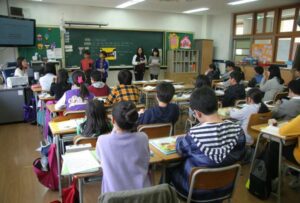
These tools highlight how AI can handle routine work, personalize instruction, and foster a richer learning experience
AI Productivity Tools: Enhancing Student Outcomes and Eliminating Teacher Burnout

Estimated reading time: 7 minutes
Teachers grade 150 essays while students wait days for feedback. Parents want progress updates, but teachers barely have time to breathe between classes. Students stuck on homework at 9 PM have nobody to ask for help. These problems aren’t new, but the solutions finally are. The best AI productivity tools transform education by tackling specific pain points. They don’t replace teachers; they eliminate the repetitive tasks that prevent teachers from actually teaching. When implemented correctly, both educators and students win.
Real AI Productivity Tools Making Real Differences
Here is a list of the best AI productivity tools that are making a real difference:
- Gradescope has become essential for teachers drowning in assessments. Upload student work, and the platform groups similar answers together. Grade one response, apply feedback to all similar ones. What took 10 hours now takes two. Math teachers report grading entire class sets of tests in the time it used to take for five papers.
The magic happens through intelligent clustering. When 20 students make the same algebraic error, Gradescope recognizes the pattern. Teachers address the misconception once, and every affected student receives targeted feedback. This isn’t just faster, it’s better teaching.
- Grammarly functions as a 24/7 writing coach that never gets tired. Students receive instant feedback on essays, catching everything from comma splices to weak thesis statements. But here’s what matters: students actually revise their work because feedback arrives while they’re still engaged with the writing.
English teachers using Grammarly report dramatic improvements in first-draft quality. Students arrive at peer review sessions with cleaner drafts, allowing focus on higher-level concerns like argument development and evidence selection. The mechanical issues that once dominated writing conferences have disappeared.
Also Read: ChatGPT 5 Impact on Education: Personalized Learning for All
AI Productivity Tools for Students Change the Learning Game

Here is a list of top AI tools for students that are making the learning game stronger than ever.
Photomath
Photomath solves the age-old homework crisis. Student photographs a problem. The app shows step-by-step solutions. But unlike answer keys, it explains why each step works. Students learn methodology, not just answers.
Duolingo
Duolingo proves that AI tools for students can compete with expensive tutors. The app remembers everything: which words you struggle with, when you last practiced, and how you learn best. It adjusts difficulty moment by moment, keeping users in the optimal challenge zone where learning happens fastest.
Quillbot
Quillbot helps students paraphrase and summarize effectively—critical academic skills often undertaught. Students paste their rambling first drafts and receive tighter, clearer versions. They see how professional writing looks and learn to recognize wordiness in their work.
ScribeSense
ScribeSense streamlines grading by automatically reading and scoring handwritten or printed student work. Teachers receive organized analytics showing common errors and overall trends, reducing time spent on manual assessments while giving faster feedback to students.
Edpuzzle
Edpuzzle transforms ordinary videos into interactive lessons. Teachers can embed quizzes and voice notes into YouTube or self-uploaded videos, track student progress, and identify misconceptions instantly. This tool enhances engagement while saving preparation time.
Labster
Labster offers immersive virtual science labs that let students safely experiment with real-world scenarios in biology, chemistry, and physics. These simulations deepen conceptual understanding and give teachers detailed performance data without setup or cleanup.
Wolfram Alpha
Wolfram Alpha acts as a computational knowledge engine for both teachers and students. Students use it to explore complex math and science concepts step by step, while teachers generate problem sets or verify answers instantly—making lessons both deeper and more efficient.
Otter AI
Otter.ai records and transcribes live lessons or meetings in real time. It creates searchable transcripts, enabling students to review material later and teachers to share accurate notes with absent learners or parents—improving accessibility and saving time.
MagicSchool AI
MagicSchool AI is designed specifically for educators. It helps generate lesson plans, assessments, rubrics, and parent communications using simple prompts. Teachers report saving hours weekly while maintaining creativity and personalization in instruction.
Together, these tools highlight how AI can handle routine work, personalize instruction, and foster a richer learning experience. The result is a classroom where teachers spend less time on logistics and more time teaching, while students receive faster, more meaningful feedback.
Also Read: Embrace the Messiness of STEM Learning!
AI Productivity Tools: Implementation That Actually Works
Roosevelt Middle School’s math department couldn’t keep up with grading. They tested Gradescope with one brave teacher. She tracked everything: time saved, student outcomes, parent feedback. After one month, she’d reclaimed eight hours weekly. Her students received feedback within 24 hours instead of a week. Test scores improved because students could correct misconceptions before the next lesson built on them.
Word spread organically. Other math teachers requested access. Then, science teachers noticed and wanted similar tools for lab reports. Within a semester, the entire school had adopted various AI grading tools. The key? Starting with one willing teacher solving one specific problem.
Westmont High took a different approach with writing support. They purchased school-wide Grammarly licenses but made usage optional. Teachers who embraced it saw immediate results. Their students’ essays required less basic correction, allowing deeper engagement with ideas during conferences.
The English department chair noticed something interesting: students using Grammarly began recognizing patterns in their errors. They’d say things like “I always mess up semicolons” and actively seek instruction. The AI Chatbot created teachable moments rather than replacing instruction.
Avoiding Common Pitfalls
Schools fail with AI when they dump technology on teachers without support. Many elementary schools bought expensive adaptive learning software, then wondered why teachers didn’t use it. They’d skipped the crucial step: showing teachers how the tool would save time rather than add another obligation.
- Professional development must connect tools to existing pain points. Don’t demonstrate features; solve problems. Show the history teacher spending Sundays grading how Gradescope returns their weekends. Demonstrate to the math teacher with struggling students how Khan Academy identifies and fills knowledge gaps.
- Student training matters equally. Many assume digital natives understand any technology intuitively. Wrong. Students need explicit instruction on using AI tools for learning, not just entertainment. They need to understand why the tool helps, not just how it works.
- Privacy concerns require transparent communication. Parents worry about data collection and screen time. Address these concerns head-on. Explain what data gets collected, how it’s protected, and how it benefits their child. Show concrete examples of improved learning outcomes.
Measurable Results from Real Schools

Baldwin Elementary integrated Khan Academy for math intervention. Previously, struggling students got pulled from class for remedial instruction, missing new content and falling further behind. Now they practice at Khan Academy during independent work time, receiving personalized support without missing lessons.
Results after one semester:
- The achievement gap between top and bottom performers decreased by 30%
- Students requiring intensive intervention dropped from 45 to 12
- Math anxiety surveys showed significant improvement
- Teacher job satisfaction increased markedly
Riverside High’s English department adopted a suite of writing tools: Grammarly for grammar, Quillbot for paraphrasing, and Turnitin for plagiarism checking. They didn’t reduce writing assignments; they increased them. With grading support, teachers could assign more frequent, shorter pieces that built skills progressively.
AI Productivity Tools: The Bottom Line
Schools already using AI tools report consistent benefits: improved student outcomes, reduced teacher burnout, and increased parent satisfaction. The technology exists, works reliably, and certainly becomes more affordable daily.
The question isn’t whether to adopt AI in education, but how quickly you can implement it thoughtfully. Every week of delay means teachers lose another weekend to grading. Students struggle without support. Achievement gaps persist despite available solutions.
Start small. Solve one problem. Measure results. Build momentum.
The transformation doesn’t require revolutionary change, rather just a willingness to use tools that address specific, solvable challenges. The best AI productivity tools for education are already here, proven, and waiting. The only decision is when to begin.
Additionally, to stay updated with the latest developments in STEM research, visit ENTECH Online. Basically, this is our digital magazine for science, technology, engineering, and mathematics. Further, at ENTECH Online, you’ll find a wealth of information.
References:
- Brynjolfsson, E., Li, D., & Raymond, L. (2025). Generative AI at work. The Quarterly Journal of Economics, 140(2), 889–942. https://doi.org/10.1093/qje/qjae044
- Tan, X., Cheng, G., & Ling, M. H. (2024). Artificial intelligence in teaching and teacher professional development: A systematic review. Computers and Education Artificial Intelligence, 8, 100355. https://doi.org/10.1016/j.caeai.2024.100355
- Author
- Latest Posts

I’m a freelance marketing professional helping businesses grow through creative, data-driven strategies. I specialize in digital marketing, content creation, and brand development, delivering tailored solutions that drive engagement, trust, and results.