AI-powered thermostats adapt to changing human comfort needs better than traditional systems.
AI Smart Thermostat That Learn Your Comfort Preferences
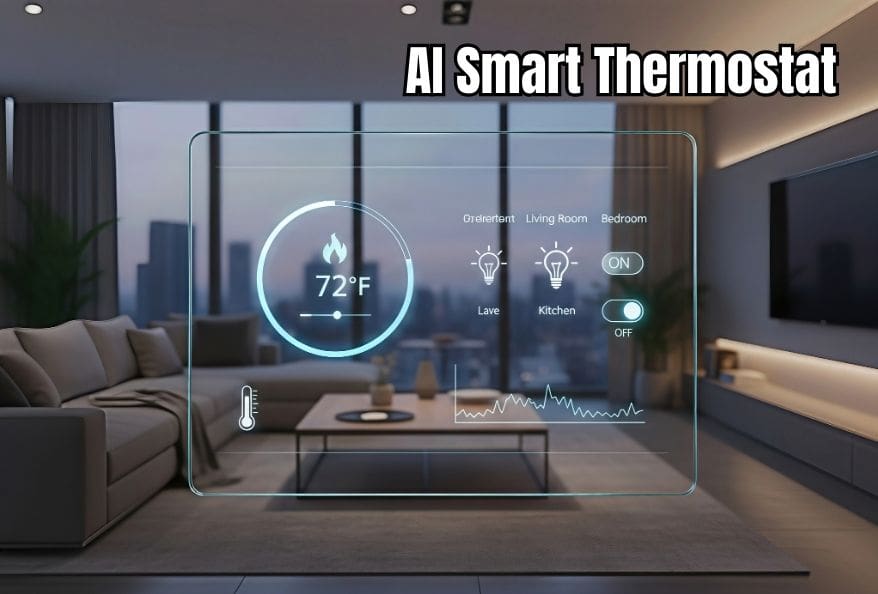
Have you ever fought with your AI smart thermostat or wished you had one? One minute you feel cold, and the next you feel too warm. Traditional thermostats lack intelligence because they react only to air temperature. They cannot tell whether you are home, asleep, or awake. As a result, they waste energy and increase costs while harming the planet. Researchers now show that an AI smart thermostat powered by Artificial Intelligence can solve this problem.
The Problem with Traditional Thermostat Systems
Old thermostats follow simple instructions. For example, you set a number, and the system turns heating or cooling on or off. However, humans behave differently. Throughout the day, we change clothes, follow flexible routines, and adjust comfort preferences. Because of this difference, manual temperature control often frustrates users.
People frequently forget to change thermostat settings before leaving home. Consequently, empty houses consume energy, fuel usage increases, and comfort levels drop.
Imagine a cold winter morning. You wake up feeling chilly, walk to the thermostat, increase the temperature, and wait. In contrast, an AI-powered thermostat learns your routine and warms the room before you wake up. This demand for adaptability drives researchers to design behavior-aware heating systems.
Collecting Data for AI Smart Thermostats
Researchers tested this idea in residential buildings in Halifax, Canada, where winters remain severe. They used Internet of Things (IoT) devices that collect real-time data through connected sensors. The team installed 2,080 sensors across 370 zones.
Over two years, the system recorded indoor temperature, humidity, and window activity. This process generated millions of data points. After gathering enough data, researchers trained models designed specifically for Smart home temperature control prediction.
Teaching Machines to Predict Comfort
The researchers asked a clear question: could a computer predict a user’s preferred thermostat setting? To answer it, they applied machine learning techniques and compared Gradient Boosted Trees (GBT) with Deep Learning (DL).
GBT acts like an advanced decision tree, while Deep Learning uses layered neural networks inspired by the human brain. Before training, the team cleaned the dataset to remove errors and gaps. Despite real-life unpredictability, the AI smart thermostat models learned patterns related to time, behavior, and environmental conditions.
AI Smart Thermostat Performance Comparison
Deep Learning delivered stronger results. It reduced prediction errors and improved accuracy by about 9 percent. Although the improvement seems small, it significantly enhances both comfort and energy efficiency.
The Deep Learning-based AI smart thermostat captured complex relationships. It considered humidity, outdoor weather, and daily routines at the same time. Simple rule-based systems failed to match this level of understanding.
Why AI Smart Thermostats Matter for the Planet
Comfort represents only one benefit. Buildings consume large amounts of energy, and heating and cooling account for most of it. Smarter control systems cut unnecessary energy use.
When an AI smart thermostat detects that occupants leave, it lowers heating automatically. When it senses their return, it prepares the space in advance. This approach reduces waste, lowers carbon emissions, and supports climate goals. Smart homes therefore contribute directly to sustainable living.
Privacy and Trust in Smart Thermostat Systems
Privacy remains a key concern in AI-driven systems. In this study, researchers removed all personal identifiers, and the AI-powered thermostat processed numerical data only. Responsible data handling and transparency help build user trust.
Strong design choices and clear policies protect users while preserving benefits. A smart home becomes a reliable partner that saves money and energy.
The Future of AI Smart Thermostats
Homes continue to evolve from passive spaces into intelligent assistants. Manual thermostats will likely disappear over time. Soon, adjusting temperature by hand may feel unnecessary.
This research proves that an AI smart thermostat can learn human habits and predict comfort accurately. Ultimately, this technology creates living spaces that remain efficient, comfortable, and environmentally responsible.
Additionally, to stay updated with the latest developments in STEM research, visit ENTECH Online. Basically, this is our digital magazine for science, technology, engineering, and mathematics. Further, at ENTECH Online, you’ll find a wealth of information.
Reference:
- Mosleh, N., Hamidi, F., Jahromi, A. A., Abootalebi Ahad, H., & Atiqur Rahman, M. (2026). Adaptive thermostat setpoint prediction using IoT and machine learning in smart buildings. Automation, 7(1), 29. https://doi.org/10.3390/automation7010029
- Author
- Latest Posts

Kottauppari Venkat Raghava
I am an Information Technology graduate (B.Tech) and a technology writer specialising in artificial intelligence, robotics, automation, and space technologies. I analyse complex scientific research and convert it into clear, practical insights for students, tech enthusiasts, and professionals. My work bridges the gap between academic research and real-world understanding by simplifying findings from peer-reviewed journals into engaging, easy-to-follow content. Alongside my writing, I have hands-on experience developing real-world projects, showcased on my GitHub, including an Expense Tracker web application for managing and visualising spending, and a Simple Video Summariser that generates concise insights from video content using automation techniques. I also produce research-driven articles on topics such as AI-powered corrosion detection, deep learning in engineering, and advanced automation systems. I follow a research-driven approach, ensuring every article is grounded in verified sources, industry knowledge, and practical applications. My goal is to make advanced technology accessible and meaningful, helping readers stay informed about innovations shaping the future.


