Scientists have retrieved intact RNA from a 40,000-year-old woolly mammoth, offering new insights into ancient gene activity. This breakthrough marks a major leap in paleogenomics, expanding the frontier of molecular studies on extinct species.
Ancient RNA Unlocks Woolly Mammoth Biology and Gene Activity
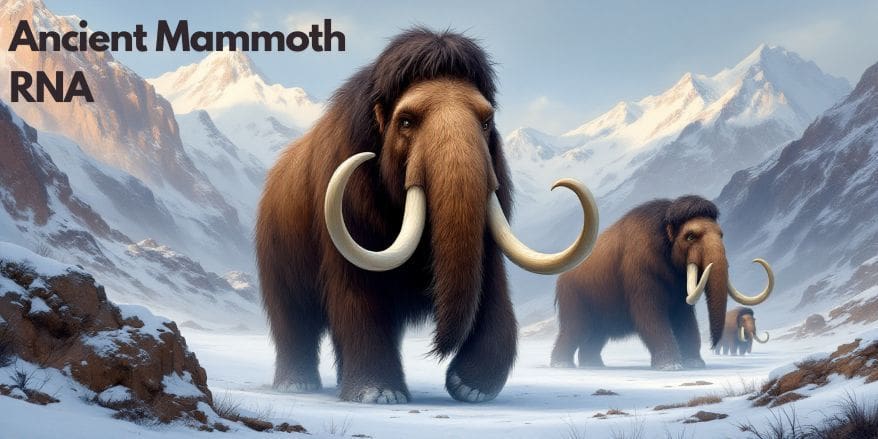
In a major advance for paleogenomics, researchers have successfully extracted ancient RNA from woolly mammoth tissues preserved for nearly40,000 years. Unlike DNA, which only reveals genetic blueprints, RNA offers clues to the animal’s actual gene activity and tissue-specific functions. The discovery provides a rare glimpse into the molecular biology and adaptive strategies of an extinct Ice Age species, advancing our understanding of woolly mammoth RNA biology
Preserved Ancient RNA Sheds Light on Mammoth Biology
Scientists have successfully extracted ancient RNA molecules from woolly mammoth tissues. These samples come from the Late Pleistocene era, dating back nearly 40,000 years. The discovery is remarkable because RNA usually degrades quickly after death.
This ancient RNA provides new information beyond what DNA studies offer. While ancient DNA helps reconstruct genomes, it cannot reveal gene expression or tissue-specific functions. However, RNA carries such information as it reflects active cellular processes.
Also Read https://entechonline.com/the-origin-of-life-understanding-stability-of-early-rna-molecules/
Tissue-Specific Expression- Woolly Mammoth RNA Biology
The preserved RNA enabled scientists to identify distinct gene expression patterns in mammoth tissues. For example, muscle-specific genes showed clear activity profiles. These findings suggest that important biological functions and regulatory mechanisms stayed intact for thousands of years.
This research also led to discovering new noncoding RNAs and microRNA candidates in the woolly mammoth genome. Such molecules play essential roles in gene regulation and cellular metabolism. Therefore, studying them helps piece together the mammoth’s physiology and adaptation strategies.
Woolly Mammoth RNA Biology: Methodology and Authenticity
To protect against contamination and bias, researchers performed careful quality checks throughout the project. They used metagenomic and metatranscriptomic techniques to confirm the origin of ancient RNA sequences accurately. Besides, stringent criteria ensured reliable mapping and sequencing depth for degraded samples.
This method sets standards for future studies trying to extract transcriptional data from extinct species or ancient specimens preserved under various conditions.
The survival of tissue-specific RNA expression profiles offers unique insights into extinct species’ biology.
The Significance of This Ancient RNA Study
This research widens the scope of paleogenomics by adding transcriptomic data to genomic and proteomic analyses. It enables scientists to examine gene regulation, developmental changes, environmental responses, and metabolic states in long-extinct animals such as woolly mammoths.
Additionally, this approach opens possibilities for studying other Pleistocene remains with preserved soft tissues or even permafrost samples across various species.
A Window Into Extinct Paleofauna’s Life Processes
The preservation of ancient RNA shows many potential pursuits for science education and future career paths in molecular biology, paleogenetics, bioinformatics, ecology researchers among young STEM enthusiasts. It encourages questions about how long molecular data can survive under natural conditions.
Additionally, to stay updated with the latest developments in STEM research, visit ENTECH Online. Basically, this is our digital magazine for science, technology, engineering, and mathematics. Also, at ENTECH Online, you’ll find a wealth of information.
Reference
- Mármol-Sánchez, E., Fromm, B., Oskolkov, N., Pochon, Z., Dehasque, M., Aslanzadeh, M., Bozlak, E., Brown, K., Van Der Valk, T., Kalogeropoulos, P., Chacón-Duque, J. C., Biryukova, I., Heintzman, P. D., Furugård, C., Plotnikov, V., Protopopov, A., Andersson, B., Ersmark, E., Peterson, K. J., . . . Dalén, L. (2025). Ancient RNA expression profiles from the extinct woolly mammoth. Cell. https://doi.org/10.1016/j.cell.2025.10.025
- Author
- Latest Posts

Ashwini Kshirsagar holds a graduate degree in Chemistry and a postgraduate degree in Environmental Science from Shivaji University, Kolhapur. With a strong foundation in scientific principles and a creative flair, she blends her expertise in environmental science with skills in technical writing, graphic design, and video editing. Proficient in Adobe software, Ashwini excels at transforming complex scientific concepts into clear, engaging, and visually compelling content. Her unique ability to merge science and storytelling allows her to create impactful communication materials that are both informative and accessible to a wide audience.