Explore how Antarctic Ice Stratification impacts our climate and discover exciting STEM career opportunities in polar research.
Antarctic Ice Stratification: How Melting Ice Caps the Ocean
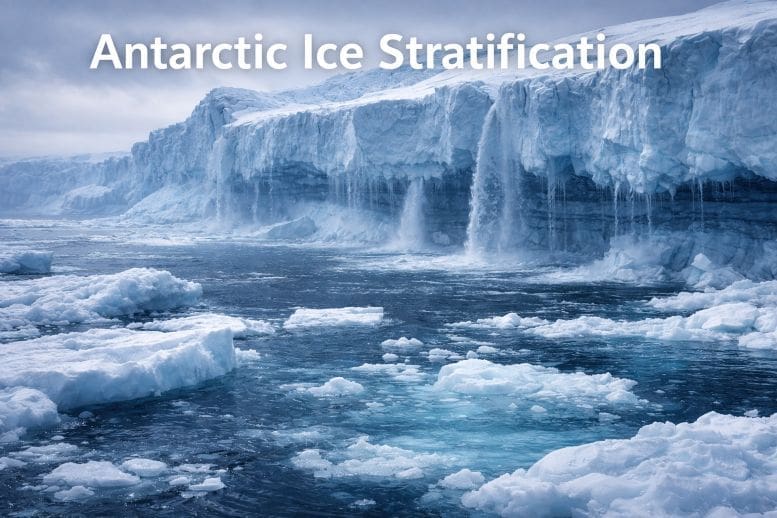
The Southern Ocean acts like a giant lung for our planet. At the present time, it absorbs vast amounts of heat and carbon dioxide. Scientists recently studied how this process changed during past warming periods. Their research shows that melting ice sheets can actually block this absorption. This happens by creating Antarctic Ice Stratification, a layer of fresh water on top.
Antarctic Ice Stratification and the Climate
Prior to this study, we knew the ocean helps cool the Earth. It pulls greenhouse gases from the atmosphere into deep waters. All in all, the Southern Ocean is a key player in climate change. However, the present time brings new worries about Antarctic Ice Sheet (AIS) melting. As a result, the ocean surface becomes less salty and less dense. This fresh water sits on the surface like a lid or a cap.
To explain, Antarctic Ice Stratification prevents the mixing of deep and surface waters. At the same time, it stops the ocean from taking up more heat. So far, we have seen this happen during the last two deglaciations. These were periods when Earth warmed up very quickly. In fact, the researchers found that as the ice melted, the ocean structure shifted. What’s more, this shift could speed up global warming today. You can learn more about STEM career paths to see how climate scientists track these changes.
Nitrogen Isotopes and Antarctic Ice Stratification
To illustrate how they found this, scientists looked at diatoms. These are tiny algae that live in the ocean. After all, these small organisms leave behind records in the mud. The team measured nitrogen isotopes trapped in their glass-like shells. By comparison, higher levels of these isotopes indicate more nutrient consumption. This happens when Antarctic Ice Stratification makes the water still.
With this in mind, the data showed a clear pattern. At first, the westerly winds pushed deep water to the surface. This brought up carbon dioxide and nutrients. After that, the Antarctic Ice Sheet began to melt rapidly. The fresh water from the ice created a strong top layer. Consequently, the mixing stopped almost completely. This phenomenon is often called the climatic “seesaw.”
STEM Careers Studying Antarctic Ice Stratification
To point out, this study is not just about the past. It helps us plan for our future. At the present time, many STEM students are looking into environmental engineering. In like manner, you could become a paleoclimatologist. These experts study ancient climates to predict future trends. So as to enter this field, you need a strong background in chemistry and physics.
To list a few skills, you would need:
- Data analysis for oceanographic models.
- Fieldwork skills for collecting ice cores.
- Knowledge of geochemical lab techniques.
All things considered, the Southern Ocean is a complex system. To put it another way, it is the Earth’s thermostat. At any rate, we must understand how it reacts to ice melt. Provided that we keep studying Antarctic Ice Stratification, we can build better climate models. In short, your interest in science could help save the planet.
The Future of Antarctic Ice Stratification
To sum up, the Southern Ocean changes when ice melts. This time, the stakes are very high for humanity. While it may be true that the ocean is vast, it is also fragile. At length, the research proves that Antarctic Ice Stratification has big impacts. So that we can protect our world, we need new innovations. To the end that you are curious, follow your passion for STEM.
As has been noted, the Antarctic is a laboratory for the whole world. Take the case of this PNAS study as an example. It combines biology, chemistry, and physics to solve a mystery. In similar fashion, you can combine your favorite subjects in a STEM career. By all means, keep asking questions about our environment. With attention to detail, we can find solutions for global warming.
Conclusion
In conclusion, the Antarctic Ice Sheet is more than just ice. It is a driver of global ocean circulation. With this intention, scientists continue to monitor its health. All of a sudden, the past reveals the risks of our future. To put it differently, we are all connected to the Southern Ocean. So long as we value research, we have hope for a cooler Earth.
Additionally, to stay updated with the latest developments in STEM research, visit ENTECH Online.
References
Fripiat, F., Sigman, D. M., Ai, X. E., Dumoulin, C., Moretti, S., Studer, A. S., Diekmann, B., Esper, O., Frederichs, T., Lamy, F., Liu, L., & Pattyn, F. (2026). Deglacial stratification of the polar Southern Ocean. Proceedings of the National Academy of Sciences, 123(9), e2502076123 23 https://doi.org/10.1073/pnas.2502076123
- Author
- Latest Posts

A Master’s-qualified Zoologist with a focus on Limnology, I combine hands-on laboratory experience with a sophisticated background in science communication. My career is defined by an interdisciplinary approach to the life sciences, merging technical research skills with a proven ability to teach and engage diverse audiences. I am committed to lifelong learning and the creative dissemination of medical and biological research, ensuring scientific literacy and inspiration remain at the forefront of the field.