Explore how Autonomous Operations and Self-Healing Systems are transforming data center management with automated responses.
Autonomous Operations and Self-Healing Systems
Estimated reading time: 6 minutes
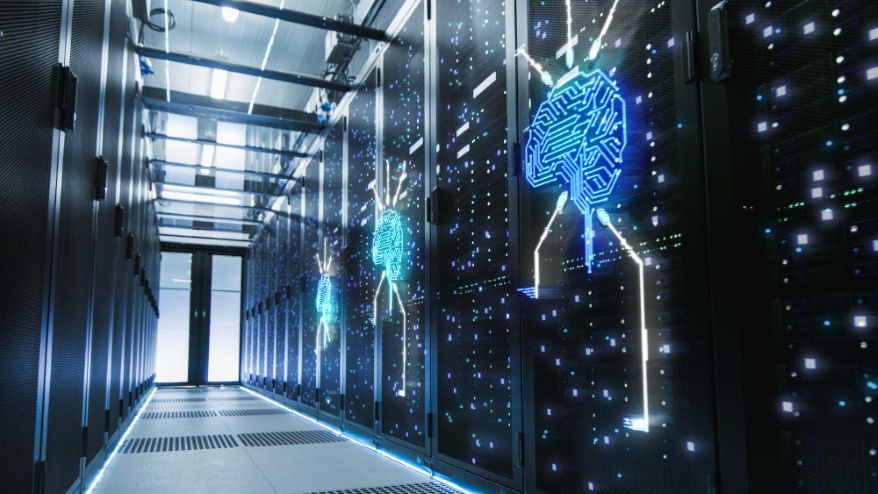
Walking into a huge, multi-story data center at 3 a.m. sounds wild, right? Usually, this place is a battleground for engineers under a lot of stress. Monitoring dashboards the size of walls flash red alert lights all the time, personal phones send out urgent warning pages. And IT teams that are already tired, and are scrambling to figure out what’s wrong with server crashes that are spreading before millions of users log on to their favourite apps in the morning.
Now, picture a very different world, one that is already happening at the cutting edge of enterprise technology. In this future, the server rack notices an odd rise in memory use. A microservice crashes because of an unexpected memory leak, and the infrastructure responds right away. However, Within milliseconds, a smart layer of artificial intelligence finds the problem, figures out the exact line of failure. Isolates the broken container, starts a new instance, reroutes live traffic without any problems, as well as logs a full root-cause analysis ticket—all without waking up a single person.
I’d like to welcome you to the world of self-healing systems and autonomous operations.
Read previous articles from this series here: AI Powered IT Operations for Students!
How Infrastructure Management Has Changed Over Time?
However, For many years, reactive firefighting was a big part of the IT system. When something went wrong, like a database timeout, a dropped network packet. Or a sudden rise in cloud server latency, sysadmins had to SSH into servers, read through thousands of lines of messy log files, run diagnostic scripts, and fix things by hand. Human latency was still the biggest problem, even with new alerting tools like PagerDuty or Datadog. There may have already been minutes or even hours of lost business time by the time an engineer wakes up. Reads an alert, rubs their eyes, and types out a remediation command.
Human-speed management is no longer useful because business ecosystems are much more complicated, use multiple clouds, and are spread out. These days, digital businesses need systems that are as resilient as living things. Infrastructure that can heal itself just like a living thing.
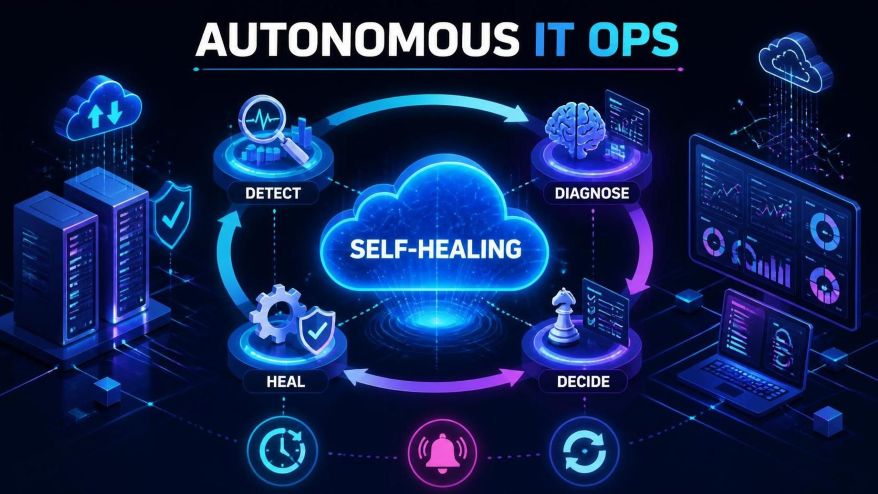
In this case, Autonomous Operations and Self-Healing Systems come into play. By combining AI, machine learning, and advanced orchestration engines. Modern infrastructure systems can find, identify, as well as fix operational problems on their own, without needing help from a person.
What Powers Self-Healing Systems?
Building a genuinely self-healing environment requires more than just a simple cron job that restarts a crashed service. It requires an integrated technological stack capable of complex reasoning, prediction, and execution. The foundational pillars of autonomous operations include:
- AI Automation: Moving beyond rigid, hard-coded scripts, AI-driven automation leverages historical patterns and real-time telemetry to make intelligent operational decisions.
- Workflow Orchestration: Complex tools and frameworks that coordinate multi-step remediation. Processes across distributed cloud environments, ensuring actions happen in the correct sequence.
- Intelligent Remediation: The ability of a system to evaluate various fixes. Select the most effective corrective action, and apply it safely.
- Autonomous Operations: End-to-end management loops where systems continuously monitor, analyze, decide, and execute changes independently.
- Predictive Recovery Systems: Rather than just reacting to failures after they occur. Machine learning models analyze leading indicators (such as CPU throttling trends or disk-fill rates) to preemptively mitigate failures before a crash happens.
When all of these work together, modern AI systems can do important things on their own, like:
- When services fail, they are restarted and threads that are stuck are cleared.
- Getting back cloud resources that were lost or not working well across multiple deployments.
- Finding and fixing temporary network bottlenecks by rerouting traffic on the fly through the best routes.
- Setting off automated processes that undo bad software deployments as soon as the error rate goes up and stays high.
Also Read: Automation Across Sectors – Building Resilient Operations and Driving Productivity
Autonomous Operations and Self-Healing Systems: Real-World Applications
The theory of self-healing infrastructure translates into tangible, high-impact business outcomes across industries today. Some of them include:
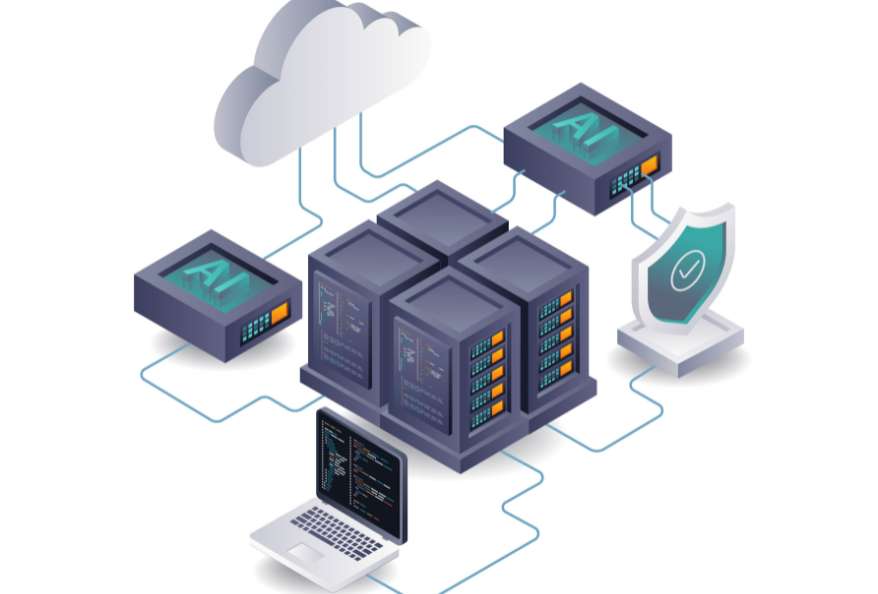
- Automatic Server Recovery: If a virtual machine freezes or stops responding, orchestration agents will immediately shut down the unhealthy node, create a new instance from a golden image, and restore the state.
- Smart Infrastructure Repair: Edge computing nodes placed in faraway places use localised AI models to find hardware degradation and fix configuration drifts without the need for a worker to be present.
- AI-Driven Cloud Remediation: Cloud-native settings use intelligent scaling and healing groups that keep an eye on cloud spend, resource limits, and application health, fixing mistakes and resource starvation on their own.
- Automated Network Troubleshooting: AI network optimisers find latency spikes, broken routing tables, or overloaded links, and they change BGP routing policies on the fly, in real time.
Student Learning Opportunities:
Students who want to work in software engineering, cloud computing, or IT operations today can find a huge range of amazing job opportunities by learning how to run autonomous systems. You don’t have to become an expert right away, but getting to know the basics will give you a huge edge over other people:
- Automation Logic: Knowing how to make logic flows for system jobs that are clean, conditional, and reliable.
- Workflow systems: learning how platforms like Kubernetes, Argo, or Apache Airflow coordinate actions that happen in many places at the same time.
- AI Ops: We are looking into how machine learning can be used on operational data, logs, metrics, and traces in AI Operations (AIOps).
- Cloud Automation: Learning how to use Infrastructure as Code (IaC) tools like Terraform and cloud-native management APIs is an important part of cloud automation.
- Python Scripting: Learning how to use Python as the standard language for making custom automation scripts, reading logs, and connecting APIs.
Career Path:
As businesses rush to adopt AI-driven resilience, the job market is exploding with roles that are specifically designed for autonomous infrastructure. Professionals who are ready for the future are going into jobs like:
- Automation Architects are in charge of creating the broad platforms that let business systems run and grow on their own.
- As an AI Workflow Engineer, your job is to build and manage the machine learning pipelines and orchestration workflows that make intelligent remediation possible.
- Autonomous Systems Specialist: Specialising in self-healing loops, resilience engineering, and cloud architectures that can handle failures.
- As an enterprise automation consultant, I help old businesses make the switch to digital operations with no human touch.
Conclusion:
Self-Healing Systems and Autonomous Operations are huge changes in the way we think about technology. They show that AI isn’t just a way to make text or look at data; it’s also changing the way infrastructure is managed today, getting rid of boring work, and paving the way for truly smart, self-sustaining operations in the future.
References:
- Adepu, R. (2025). AI-ENABLED AUTONOMOUS INFRASTRUCTURE MONITORING AND SELF-HEALING CLOUD SYSTEMS. INTERNATIONAL JOURNAL OF ARTIFICIAL INTELLIGENCE & MACHINE LEARNING (IJAIML), 4(1), 234–251. https://doi.org/10.34218/ijaiml_04_01_017
- “SELF-HEALING CLOUD SYSTEMS USING AUTONOMOUS AIOPS”, IJCSPUB – INTERNATIONAL JOURNAL OF CURRENT SCIENCE (www.IJCSPUB.org), ISSN:2250-1770, Vol.16, Issue 2, page no.426-429, May-2026, https://rjpn.org/IJCSPUB/papers/IJCSP26B1278.pdf
- Author
- Latest Posts

Srikanth Madabhushi is an AI Automation & Workflow Specialist with an MS in Artificial Intelligence. He designs innovative ServiceNow and AI-driven enterprise solutions that help organizations automate, optimize, and predict operational outcomes. Srikanth mentors students on emerging technologies, problem-solving, and career pathways in AI and automation.
- Author
- Latest Posts
Srikanth Madabhushi is an AI Automation & Workflow Specialist with an MS in Artificial Intelligence. He designs innovative ServiceNow and AI-driven enterprise solutions that help organizations automate, optimize, and predict operational outcomes. Srikanth mentors students on emerging technologies, problem-solving, and career pathways in AI and automation.