Understand the innovative use of Metal Oxide Semiconductor sensors in detecting VOCs, contributing to environment and health diagnostics.
Can machines smell their surroundings like us?

Estimated reading time: 9 minutes
INTRODUCTION: Metal Oxide Semiconductor sensors
Every breath we take and every smell around us carries invisible chemical information. From a new Sharpie smell to the scent of breakfast, almost all smells are due to Volatile Organic Compounds (VOCs). They are organic carbon and hydrocarbon compounds that easily turn into gases even at normal temperatures. Some are safe while others, when inhaled, may irritate your lungs and result in organ damage. In the atmosphere, VOCs react with sunlight and nitrogen oxides to produce ground-level ozone, a harmful pollutant that contributes to global warming. Interestingly, the human body also releases specific VOCs during metabolic processes. These compounds travel through the bloodstream and are exhaled in our breath, making them useful biomarkers for detecting diseases. To capture and analyze these faint chemical signals, scientists are now utilizing advancements in nanotechnology.
By using specialized sensors built with engineered nanoparticles, researchers can consequently detect even the most microscopic changes in exhaled compounds. In doing so, they are opening new doors for early medical diagnosis.

WORKING OF THE OLFACTORY SENSORS
Scientists are now developing advanced sensors capable of detecting these invisible gases quickly and accurately. One of the most promising technologies used for this purpose is the Metal Oxide Semiconductor (MOS) sensor, which combines nanotechnology, material science and electronics.
Small Scale, Big Impact: What are Nanoparticles?
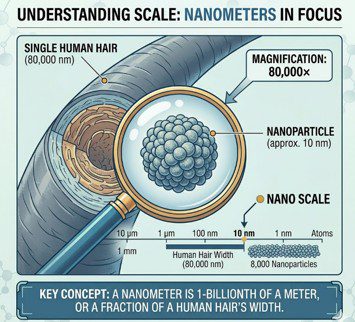
Nanoparticles are extremely tiny materials with sizes ranging from 1 to 100 nanometres. To understand this, a single human hair is nearly 80,000 nanometres wide. At such small dimensions, materials particularly exhibit unique physical and chemical properties. When we make things this small, the surface area compared to the volume gets really big. As a result, nearly every atom is exposed to the air around it, making it like a sponge that can catch lots of gas molecules. This certainly makes nanoparticles highly sensitive and ideal for gas sensing applications.
What are Metal Oxide Semiconductors?
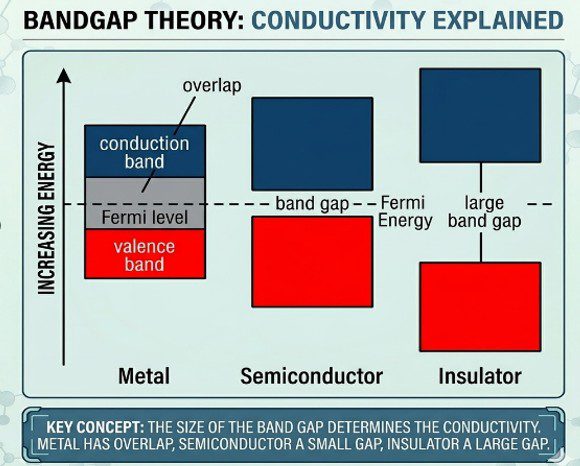
Metal Oxide Semiconductors are materials that basically conduct electricity only under certain conditions. To understand this, Their behaviour is explained using the concept of Bandgap Theory. Specifically, this theory groups materials based on the energy difference between the Valence Band, where electrons are tied up and the Conduction Band, where electrons can move freely.
Materials are generally classified into three categories:
- Conductors are materials where these bands overlap, allowing electricity to flow easily.
- Insulators have a huge gap, preventing electron movement.
- Semiconductors have a moderate gap. They act like insulators until they get some energy that helps the electrons jump over the gap.
Try This at Home: Understanding Bandgaps with a Jumping Game
Imagine a line drawn on the floor. Stand on one side and try to jump across it.
- If the line is very narrow, almost everyone can cross easily. This is similar to a conductor, where electrons move freely.
- If the line is extremely wide, most people cannot jump across. This is like an insulator, where electrons cannot move.
- If the line is moderately wide, only those who put in extra effort can cross. This is similar to a semiconductor, where electrons need some energy (from heat, light, or electricity) to jump from the valence band to the conduction band.
Think about it:
- What happens if you take a running start?
- What if the gap becomes smaller?
Just as extra energy helps you cross the gap, likewise energy supplied to a semiconductor helps electrons cross the bandgap and conduct electricity.

How do MOS Sensors Work?
MOS gas sensors operate chiefly through changes in electrical resistance caused by interactions between gases and the semiconductor surface.
1. Oxygen Adsorption
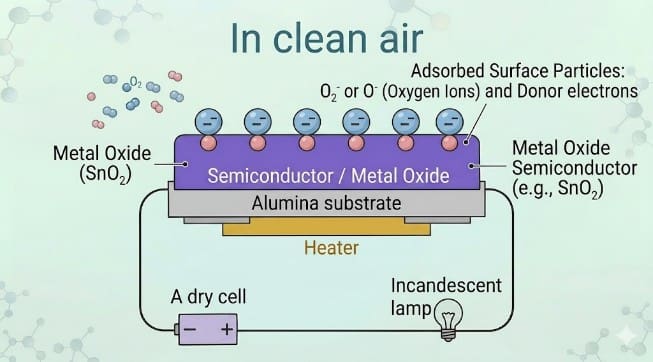
The sensor is first heated to an operating temperature. This thermal energy excites electrons into the conduction band. Then oxygen from the surrounding air(O2) adsorbs onto the nanoparticles and traps these electrons, forming negatively charged oxygen ions such as O– and O-2. This creates an electron depletion layer near the surface of the semiconductor, which in fact increases the resistance of the sensor.
2. Gas Detection Process
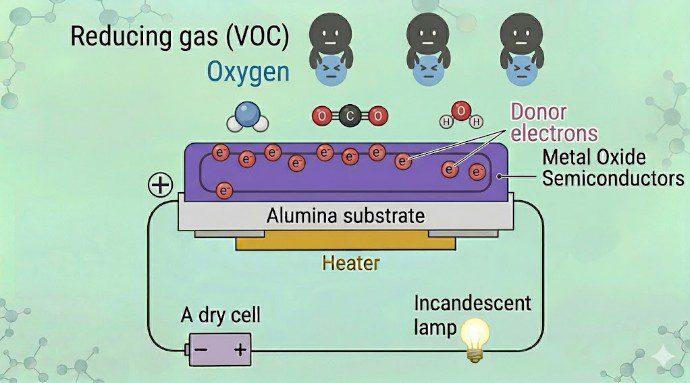
When VOC molecules come into contact with the sensor surface, they react with the adsorbed oxygen ions. During this reaction, gases are oxidised to form products such as carbon dioxide and water vapour, releasing the electrons back into the conduction band. The depletion layer becomes thinner, altogether decreasing the resistance of the sensor. The resistance drops, as a result the sensor senses it as a “hit”.
Why is Nanotechnology Crucial?
Nanotechnology significantly improves the performance of MOS sensors. Since nanoparticles provide a large active surface area, more oxygen and gas molecules can interact with the sensor surface simultaneously.
This results in:
- Higher sensitivity
- Faster response time
- Improved gas adsorption
- Better detection of low gas concentrations
Also Read: Careers in the Growing Semiconductor Industry
Recent Advancements in MOS sensors
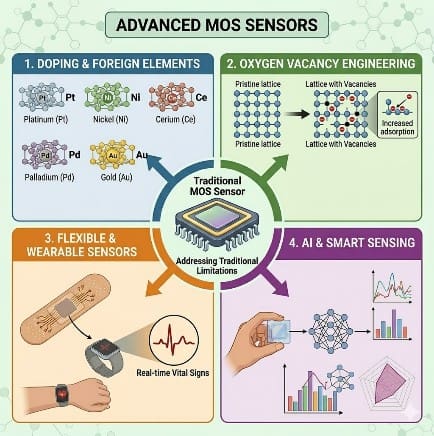
Traditional MOS sensors perform efficiently, but they also have certain limitations. Many sensors require high operating temperatures, leading to increased power consumption. They may also face difficulties in distinguishing between multiple gases in complex environments.
To overcome these challenges, researchers are developing advanced techniques such as:
a. Doping
Foreign elements such as Nickel (Ni), Cerium (Ce), Platinum (Pt), Palladium (Pd), and Gold (Au) are introduced into the semiconductor material. This process is called doping and improves sensitivity, selectivity, and response speed.
b. Oxygen Vacancy Engineering
Researchers intentionally create oxygen vacancies to increase the number of active reaction sites available for gas adsorption.
c. Artificial Intelligence Integration
Machine learning algorithms are now generally being combined with MOS sensors to analyse complex sensing patterns. This enables smart sensors to accordingly distinguish between multiple gases even in mixed environments.
d. Flexible and Wearable Sensors
Scientists are also developing lightweight and flexible sensors that can be integrated into wearable devices for real-time health monitoring.
Real-Life Applications of MOS Sensors

Metal oxide semiconductor sensors are consequently becoming increasingly important in our modern society.
Healthcare
MOS sensors can analyse human breath to detect diseases such as diabetes, asthma, and lung infections by identifying specific VOC biomarkers.
Environmental Monitoring
These sensors are widely used to monitor air pollution and harmful industrial gases in smart cities and factories.
Industrial Safety
Gas leakage detection systems based on MOS sensors help prevent accidents involving toxic or combustible gases.
Food Quality Monitoring
MOS sensors can detect spoilage gases released from food products, helping maintain food safety as well as quality.
Internet of Things (IoT)
Smart homes and industrial IoT systems use gas sensors for automated monitoring and also safety applications.
Future Scope of Metal Oxide Semiconductor sensors
The future of MOS sensors is indeed highly promising. Researchers are working toward room-temperature sensors that consume very little power while maintaining high sensitivity and selectivity. As nanotechnology and artificial intelligence continue to advance, MOS sensors are basically expected to play a major role in building safer, healthier, and smarter societies.
CONCLUSION: MOS Sensors
Metal Oxide Semiconductor sensors are certainly powerful technologies capable of detecting invisible gases with remarkable sensitivity. By combining nanotechnology, semiconductor physics, and advanced data analysis, these sensors are transforming fields such as healthcare, environmental monitoring, industrial safety, and smart electronics. Recent developments in doping techniques, oxygen vacancy engineering, wearable electronics and artificial intelligence are making MOS sensors not only faster, smarter, but also more energy-efficient. For students interested in science and technology, this field offers exciting opportunities for innovation as well as research. With continuous advancements in nanotechnology, MOS sensors may soon become an essential part of everyday life, helping humanity create cleaner environments, safer industries, and better healthcare systems.
Additionally, to stay updated with the latest developments in STEM research, visit ENTECH Online. Basically, this is our digital magazine for science, technology, engineering, and mathematics. Further, at ENTECH Online, you’ll find a wealth of information.
REFERENCES:
- Moura, P. C., Raposo, M., & Vassilenko, V. (2023). Breath volatile organic compounds (VOCs) as biomarkers for the diagnosis of pathological conditions: A review. Biomedical journal, 46(4), 100623. https://doi.org/10.1016/j.bj.2023.100623
- Isaac, N. A., Pikaar, I., & Biskos, G. (2022). Metal oxide semiconducting nanomaterials for air quality gas sensors: operating principles, performance, and synthesis techniques. Mikrochimica acta, 189(5), 196. https://doi.org/10.1007/s00604-022-05254-0
- Dutta, T., Noushin, T., Tabassum, S., & Mishra, S. K. (2023). Road Map of Semiconductor Metal-Oxide-Based Sensors: A Review. Sensors (Basel, Switzerland), 23(15), 6849. https://doi.org/10.3390/s23156849
- Fine, G. F., Cavanagh, L. M., Afonja, A., & Binions, R. (2010). Metal oxide semiconductor gas sensors in environmental monitoring. Sensors (Basel, Switzerland), 10(6), 5469–5502. https://doi.org/10.3390/s100605469
- Liu, F., Liu, Z., Zhang, X., Liu, Z., & Liu, Y. (2025). Machine learning-enhanced metal oxide gas sensor arrays: A review of selectivity and performance improvements. Sensor Review. Advance online publication. https://doi.org/10.1108/SR-08-2025-0639
- Cheng, J., Xue, N., Zhou, W., Qin, B., Qiu, B., Fang, G., & Sun, X. (2025). Recent Progress in Flexible Wearable Sensors for Real-Time Health Monitoring: Materials, Devices, and System Integration. Micromachines, 16(10), 1124. https://doi.org/10.3390/mi16101124
- Checker, S., Yadav, A. B., Sivnath Reddy, G. V., & Checker, R. (2026). Advances in volatile organic compounds-based biomarker detection using nanomaterial-integrated sensor platforms for cancer diagnosis. ACS Applied Electronic Materials, 8(6), 2198–2224. https://doi.org/10.1021/acsaelm.5c02148
- Author
- Latest Posts

Dyutikar is a student pursuing higher secondary education in Bangalore, Karnataka, India. He is interested in organic chemistry and electronics, especially Internet of Things, Machine Learning and Semiconductors. He enjoys building solutions to real-world problems that impact society.
- Author
- Latest Posts

Harshavardan is a student currently studying in a secondary high school in Kolar, India. He is ardent about understanding and working with nanotechnology, material sciences and sensor development, predominantly with advanced STEM opportunities and concepts through innovation and research with hands-on experience. He actively participates in science programs, projects, technologies and explorations.
- Author
- Latest Posts

Shamik is currently in the junior year of his secondary education in Bangalore, India. He is passionate about nanotechnology, especially its applications in real-life scenarios such as gas sensing, and semiconductor research.
- Author
- Latest Posts

Padmini K U is a physics researcher and Research Associate at the Prayoga Institute of Education Research. She holds a Bachelor of Science (B.Sc.) in Physics, Chemistry, and Mathematics from SJR College for Women (2019) and earned her Master of Science (M.Sc.) in Physics from Maharani Cluster University, Bengaluru, in 2021.
Since joining the Prayoga Institute in June 2022, Padmini has focused her work on experimental physics, educational research methodologies, and interactive science pedagogy. She is dedicated to advancing inquiry-based science education, designing hands-on laboratory experiments, and developing learning frameworks that make fundamental physical laws engaging and intuitive for students.
Her work focuses on sustainable materials, fiber-reinforced composites, and educational research, with interests in astrophysics and advanced functional materials.
- Author
- Latest Posts

Dr. Omprakash S.S. is a Researcher at Prayoga, specializing in the synthesis of nanomaterials for thin film coatings in both electronic device applications, such as thin film transistors (TFTs), sensors, memristors, supercapacitors, and batteries, and non-electronic applications like anti-reflection, anti-corrosion, and hydrophobic coatings. He completed his Ph.D. in 2020 at Mangalore University, focusing on fabricating amorphous metal oxides thin film transistors using custom-designed spin spray pyrolysis units.


