Aurora Lights are a fascinating example of how energy and light interact in nature.
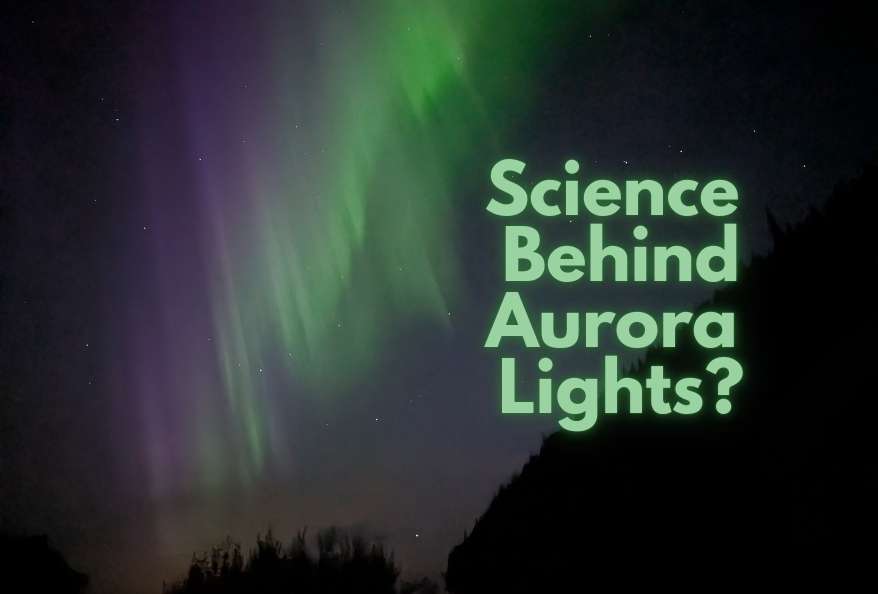
Science Behind Aurora Lights: The naturally occurring Physio-Chemical Phenomenon
Estimated reading time: 8 minutes
Science Behind Aurora Lights: Introduction
Nature is another name for excitement and full of surprises! It constantly shows us amazing sights that makes us wonder like rainbows, lightning, sunsets and many more. Among these wonders is a very special and magical-looking phenomenon called the Aurora. We see beautiful skies very day, especially during sunrise and sunset. But in some places around the world, the night sky suddenly fills with glowing green, pink, red, blue, and purple lights that dance across the sky. These glowing lights are called “Auroras” or “Aurora Lights”. Have you ever thought about why these lights appear? How they form? There must be a scientific reason behind such a stunning show, right? Let’s take a look into Science behind Aurora Lights.
What are Aurora Lights?

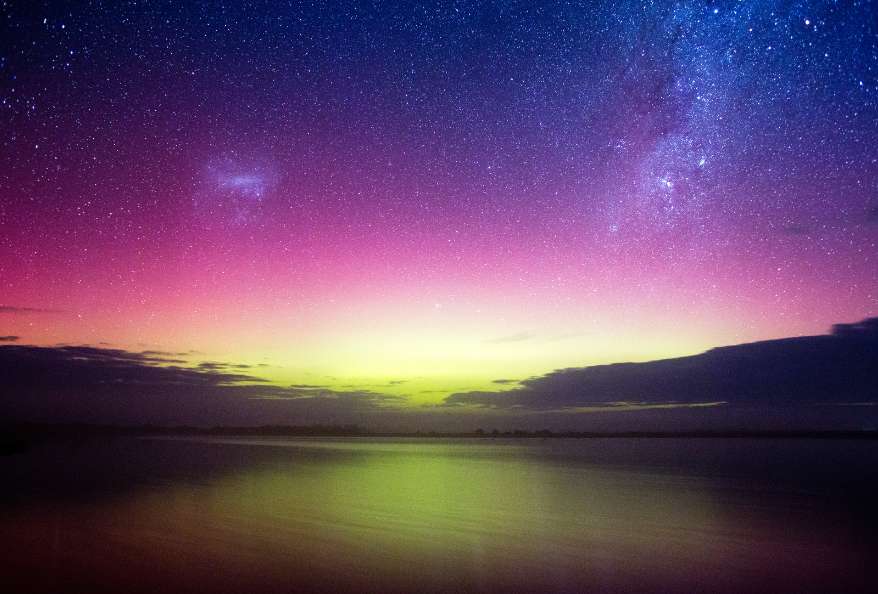
The word “aurora” comes from Latin and means “dawn.” The word “borealis” comes from Greek and means “north wind”. Auroras are glowing lights seen near the poles, in the north, they are called Aurora Borealis, and in the south, Aurora Australis. The best time to see them is during clear, dark winter nights in high-latitude regions such as Norway, Canada, or Alaska. Now you might wonder why do auroras form mostly near the poles?
The Science Behind Aurora Lights
The Sun is an extremely active star. It composed of hydrogen (92.1%), helium (7.8%) and a tiny amount of other elements. Deep inside its core, the temperature reaches about 15 million °C and the pressure is around 2850 million atmosphere. Under such extreme conditions, small atoms combine to form bigger ones, releasing a huge amount of energy. These are called nuclear fusion.
Some of this energy escapes from the Sun as a stream of fast, charged particles called the Solar wind. When this solar wind interacts with Earth. That’s when the magic of auroras or aurora lights begins!
Our planet has an invisible shield called the magnetosphere, which deflects most of the charge particles away. However, near the North and South Poles, the magnetic field lines bend inward, allowing some particles to enter the upper atmosphere.
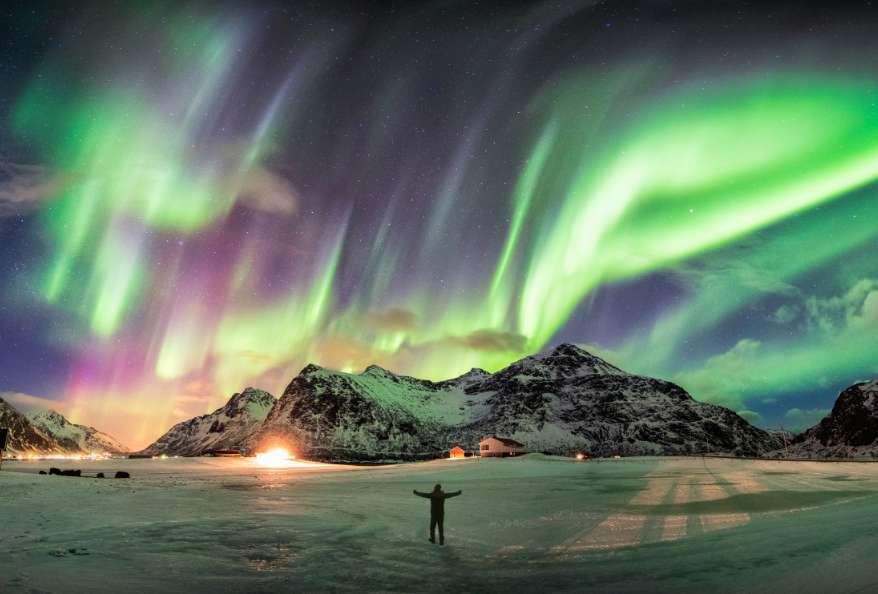
When these high-energy particles collide with atoms of oxygen and nitrogen gases high above Earth (about 80 to 300 kilometres up), they give energy to those atoms. The atoms then release this energy as light, which we see as beautiful colorful waves in the sky the aurora.
The color of the aurora depends on the type of gas and how high it is in the sky.
Green Aurora Lights
Green: This is the color we see most often. It comes form oxygen gas found about 100 to 300 kilometres above Earth.
Red/Pink Aurora Lights
Red or pink: These colors appear higher up in the sky, where oxygen and nitrogen mix and glow.

Blue/Purple Aurora Lights
Blue or purple: These show up during strong solar storms, when lighter gases such as hydrogen and helium are nit by fast-moving particles.

Science Behind Aurora Lights: Physics in Action
Aurora Lights are a fascinating example of how energy and light interact in nature. Inside every atom are there is a tiny negatively charged particles called electrons, which move around a central nucleus in specific energy levels. When charged particles from the Sun strike gases such as oxygen and nitrogen high above Earth, they transfer some of their energy to these electrons.
As a result, the electrons jump to higher energy levels a state known as excitation. However, they cannot stay in this state for long. When the electrons fall back to their original levels, they release the extra energy as light, in the form of small energy packets called photons. Since the emitted light wavelength is in the visible region(400 nm to 700 nm) we can able to see different colors.
This process demonstrates the key principles of atomic behaviour, electromagnetism, and energy transfer. In many ways, the aurora lights functions as a nature’s physics laboratory.
Why Study Aurora Lights?
Studying science behind aurora lights is not just about understanding a beautiful light show in the sky, rather it opens a window into the invisible relationship between the Sun and Earth. The same charged particles that create aurora lights can also disturb Earth’s magnetic field, a phenomenon known as space weather. These disturbances can affect satellite operations, GPS accuracy, radio communication, and even power grids on the ground.
By studying how aurora lights form and change, scientists can learn more about how solar wind and coronal mass ejections from the Sun interact with Earth’s storms, which is crucial for protecting satellites, astronauts, and electronic systems on Earth.
Auroral research also brings together several branches of science: Physics, Astronomy, Atmospheric Science and Space Technology. Science behind aurora lights helps us understand how energy travels through space and how magnetic fields shape our planet’s environment.
Aurora Lights Beyond Earth
Auroras are not unique to our planet. They also appear on other planets in our Solar System that have magnetic fields and atmospheres. Just like on Earth, they appear when charged particles from the solar wind collide with gases high in the atmosphere. Yet, their colors, intensity, and patterns differ depending on each planet’s composition and the strength of its magnetic field.
Aurora Lights on Jupiter
Jupiter has the strongest auroras in the Solar System. They are hundreds of times brighter than Earth’s. The magnetic field of the planet is around 20,000 times that of Earth. Jupiter’s moons Io, Europa, and Ganymede make bright auroras too. When they move through the planet’s magnetic field, they create electricity that lights up strong glowing spots. Most of this light appears in ultraviolet, visible only through telescopes like Hubble.
Aurora Lights on Mars
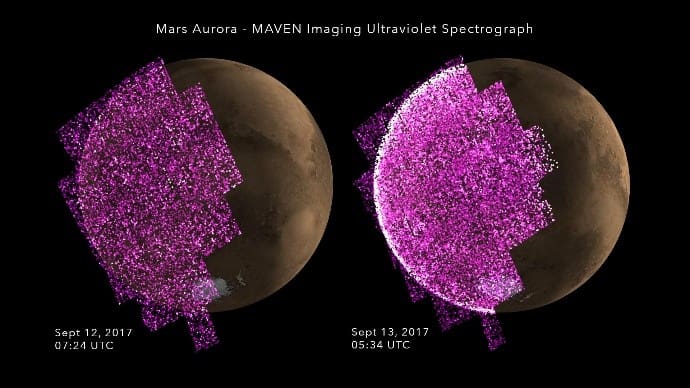
Image credit: NASA/Goddard/University of Colorado–Boulder (Public Domain).
Mar’s auroras are unlike Earth’s. The planet has no global magnetic field. It has traces of an ancient “fossil” field locked in its rocks. This makes its auroras scattered across the surface instead of glowing near the poles.
NASA’s MAVEN spacecraft spotted these faint lights in 2015. They shine mainly in ultraviolet. Mars’s thin atmosphere lacks enough oxygen and nitrogen to produce the bright colors seen on Earth.
Aurora Lights on Saturn
Saturn’s auroras are among the most mesmerizing sights in the Solar System. Softer than Jupiter’s and ring shaped. They form when powerful solar wind particles interact with the planet’s magnetic field and its hydrogen-rich atmosphere. Because of this, they shine mostly in ultraviolet light, invisible to the human eye.
Educational Opportunities in Science Behind Aurora Lights
Astrophysics is a fascinating field where you study stars, planets, galaxies, rockets, and satellites. Many colleges offer astrophysics or space-science courses in Bachelor’s and Master’s programs. Additionally, students can also choose aerospace engineering.
Students can gain experience through internships and programs offered by institutes like ISRO, NASA, BARC often through entrance exams.
Science Behind Aurora Lights: Career Options
With the right degree or study in science behind aurora lights, you can work as an:
- Astrophysicist
- Research Scientist
- Data Analyst
- Physicist
- Research Assistant
Space agencies, research labs, and defense organizations offer many opportunities and may even fund students projects.
Conclusion: Science Behind Aurora Lights
Aurora Lights remind us that science can be as beautiful as it is powerful.
What appears as glowing light in the sky is actually a story of energy between the Sun and Earth, revealing the beauty hidden within physics and magnetism.
For students and young explorers, aurora lights are more than a beautiful mystery. Studying them can spark paths in space science, atmospheric research or astrophysics. Getting involves in astronomy clubs, planetarium programs, helps turn curiosity into real experience.
With passion, persistence, and curiosity students can transform their fascination with auroras into a futuristic career.
Additionally, to stay updated with the latest developments in STEM research, visit ENTECH Online. Basically, this is our digital magazine for science, technology, engineering, and mathematics. Further, at ENTECH Online, you’ll find a wealth of information.
References:
- Genovese, P. (2022). The Northern lights phenomenon: Detect and predict them (Bachelor’s thesis). Theseus. https://urn.fi/URN:NBN:fi:amk-2022122731487
- Haerendel, G. (2022). My dealings with the Aurora Borealis. Frontiers in Astronomy and Space Sciences, 9, Article 1033542. https://doi.org/10.3389/fspas.2022.1033542
- Author
- Latest Posts

Padmini K U is a physics researcher and Research Associate at the Prayoga Institute of Education Research. She holds a Bachelor of Science (B.Sc.) in Physics, Chemistry, and Mathematics from SJR College for Women (2019) and earned her Master of Science (M.Sc.) in Physics from Maharani Cluster University, Bengaluru, in 2021.
Since joining the Prayoga Institute in June 2022, Padmini has focused her work on experimental physics, educational research methodologies, and interactive science pedagogy. She is dedicated to advancing inquiry-based science education, designing hands-on laboratory experiments, and developing learning frameworks that make fundamental physical laws engaging and intuitive for students.
Her work focuses on sustainable materials, fiber-reinforced composites, and educational research, with interests in astrophysics and advanced functional materials.
- Author
- Latest Posts

Pooja V. Domanekar is a Research Associate – Physics at Prayoga with an M.Sc. in Physics from Kuvempu University. Her work focuses on EMI shielding, ferrite nanomaterials, and piezoelectric materials for electronic applications. She has research experience in the synthesis and characterization of cobalt ferrite nanoparticles and is passionate about integrating physics into innovative material design.