QNodeOS: A Game-Changer for Quantum Networking
Find out how QNodeOS is paving the way for the quantum internet with its innovative approach to managing quantum information.

QNodeOS: A Game-Changer for Quantum Networking
Microsoft Quantum Computers: Majorana 1 Chip Transforms Quantum Computing

Revolutionizing Quantum Computing: Antimony Properties
Google’s Quantum Chip Willow : Revolutionizing Computing
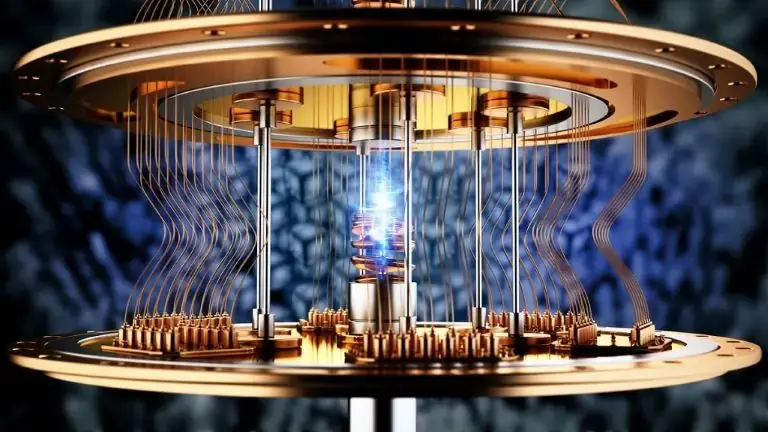
Forget Your PC: Quantum Computer is about to Change EVERYTHING

Advances in Quantum Computing: Record-Low Error Rates Achieved

Advancements in Quantum Internet: Entangled Photons in Optical Fiber
Potential of Calcium Oxide for Quantum Computing

Scientists Achieve Long-Distance Quantum Memory Entanglement

The Future of Quantum Computing: Silicon Based Qubits
Quantum computing is an emerging field of computing that uses principles of quantum mechanics to process information in new ways. Unlike conventional computers, which use bits represented by 0s and 1s, quantum computers use quantum bits, commonly known as qubits. These qubits can exhibit properties such as superposition and entanglement, allowing quantum systems to perform certain types of calculations differently from classical computers.
The field brings together quantum physics, mathematics, computer science, electrical engineering, and materials science. Researchers are developing quantum processors, algorithms, programming tools, and error-correction techniques to explore problems that may be difficult for conventional computers.
At ENTECH STEM Magazine, the Quantum Computing category explores the science, engineering, applications, and research behind this technology. Readers can discover how quantum computers work, what makes them different, and how they may influence industries such as healthcare, finance, cybersecurity, energy, and advanced materials.
Quantum computing is a computational approach that uses quantum-mechanical principles to represent and manipulate information.
A conventional computer processes information using bits. Each bit has a value of either 0 or 1. A quantum computer uses qubits, which can exist in quantum superpositions of different states.
This does not mean that a quantum computer simply performs every possible calculation simultaneously. Instead, quantum algorithms use carefully designed operations and quantum interference to influence measurement outcomes. The goal is to make useful answers more likely to appear when the system is measured.
Quantum computers are not intended to replace conventional computers for every task. Their potential advantage is concentrated in particular problems where quantum algorithms may offer a meaningful computational benefit.
Quantum computing relies on several important principles of quantum mechanics. These principles allow researchers to build and control quantum information systems.
A qubit is the basic unit of quantum information. It plays a role similar to that of a bit in conventional computing, but its behaviour is governed by quantum mechanics.
A qubit can be prepared in a state representing 0, 1, or a superposition of these states. When measured, it produces a classical result, typically 0 or 1.
Quantum processors combine multiple qubits and manipulate them through controlled operations to perform computations.
Superposition allows a qubit to represent a combination of quantum states before measurement. A system containing multiple qubits can therefore represent a complex quantum state involving many possible computational outcomes.
Quantum algorithms use this property alongside other quantum operations to process information in ways that are not available to ordinary classical bits.
Entanglement is a quantum phenomenon in which two or more qubits share a connected quantum state. Their properties cannot always be described independently of one another.
Entanglement is an important resource in quantum computing. It supports quantum algorithms, quantum communication research, and several approaches to quantum information processing.
Quantum interference occurs when probability amplitudes associated with different computational paths combine. Quantum algorithms use this behaviour to increase the likelihood of useful measurement outcomes and reduce the likelihood of unwanted ones.
Together, superposition, entanglement, and interference form important foundations of quantum information processing.
Building a quantum computer requires specialised hardware that can create, control, and measure qubits. Researchers are investigating several physical approaches.
Superconducting quantum computers use specially designed electrical circuits that exhibit quantum behaviour. These systems typically operate at extremely low temperatures to maintain their quantum states.
They are an important approach to quantum processor development and are being investigated for scalable quantum computing.
Trapped-ion systems use electrically charged atoms held in place using electromagnetic fields. Lasers or other control techniques manipulate their quantum states to perform computations.
These systems are known for their precise control and are an important area of quantum hardware research.
Neutral-atom systems use electrically neutral atoms arranged and controlled using laser-based techniques. Researchers investigate these systems for creating and manipulating large collections of qubits.
Photonic quantum computing uses particles of light, called photons, to represent and process quantum information. It is being explored for quantum communication, specialised computing architectures, and potential integration with optical technologies.
Spin-based approaches use quantum properties associated with particles, such as the spin of electrons or atomic nuclei. Some approaches investigate semiconductor materials and silicon-based structures for developing quantum processors.
Each hardware approach has different strengths and engineering challenges. Researchers continue to investigate coherence, connectivity, control accuracy, scalability, and manufacturing requirements.
Quantum algorithms are designed to take advantage of quantum-mechanical properties to solve specific computational problems.
Some important examples include:
Quantum programming involves translating these algorithms into operations that a quantum processor can execute. Quantum gates, circuits, and measurement operations are central concepts.
Programming frameworks such as Qiskit provide tools for creating quantum circuits, running simulations, and working with supported quantum computing platforms. Learning these tools can help students and researchers understand how quantum algorithms are developed and tested.
Quantum computing has potential applications across several scientific and industrial fields. Many are still being researched, and practical advantages will depend on future improvements in hardware and algorithms.
Quantum computers may help researchers simulate molecular systems and investigate complex chemical interactions. Such capabilities could contribute to research in drug discovery, molecular modelling, and the development of new medical materials.
Financial researchers are exploring quantum algorithms for selected optimisation, portfolio modelling, risk analysis, and other computational problems.
However, these applications need to demonstrate reliable advantages over existing classical methods before widespread adoption.
Quantum computing has important implications for digital security. Certain future large-scale quantum computers could threaten public-key cryptographic systems that rely on the difficulty of mathematical problems such as integer factorisation.
This has encouraged research into post-quantum cryptography, which aims to develop cryptographic methods resistant to attacks from both classical and quantum computers.
Quantum systems could help simulate the behaviour of molecules and materials at a more fundamental level. Researchers are investigating possible applications in superconductors, catalysts, semiconductors, and advanced materials.
Quantum simulation may support research into chemical reactions, energy materials, batteries, and catalysts. These areas could contribute to the development of improved energy technologies and environmental solutions.
Some researchers are investigating quantum algorithms for selected optimisation problems involving scheduling, transportation, resource allocation, and supply chains.
The practical value of these approaches remains an active area of research.
Despite its potential, quantum computing faces significant scientific and engineering challenges.
Qubit stability: Qubits are sensitive to environmental disturbances. Interactions with their surroundings can cause decoherence and affect computational accuracy.
Quantum errors: Quantum operations and measurements are not perfect. Errors can accumulate during computation and reduce the reliability of results.
Error correction: Quantum error correction aims to protect logical quantum information by encoding it across multiple physical qubits. Developing practical fault-tolerant systems remains a major research challenge.
Scalability: Increasing the number of qubits is not enough by itself. Researchers must also improve qubit quality, connectivity, control systems, and error rates.
Operating requirements: Some quantum hardware requires specialised environments, including extremely low temperatures, vacuum systems, precision lasers, or sophisticated control electronics.
Practical advantage: A quantum computer must demonstrate a meaningful advantage on a useful problem compared with the best available classical approaches. This remains an important benchmark for the field.
The future of quantum computing depends on progress in hardware engineering, quantum algorithms, error correction, and system integration.
Researchers are working towards fault-tolerant quantum computers that can perform longer and more complex computations with reliable error correction. Improvements in qubit quality, control systems, and processor architectures will be important steps towards this goal.
Quantum computing is also developing alongside other areas of quantum information science, including quantum communication and quantum sensing. These are related fields, but they have different objectives and applications.
As research advances, quantum computing may contribute to scientific discovery, advanced materials, chemical simulation, and specialised computational tasks. Its impact will depend on identifying problems where quantum methods provide practical benefits.
Quantum computing represents an important connection between fundamental physics and modern computer science. It introduces new ways of understanding information, computation, and the limits of conventional technology.
Through ENTECH STEM Magazine, readers can explore quantum computing alongside related subjects such as artificial intelligence, cybersecurity, electronics, mathematics, physics, and software engineering.
Our goal is to make complex STEM concepts easier to understand while introducing readers to the technologies, research developments, and career opportunities shaping the future of computing.