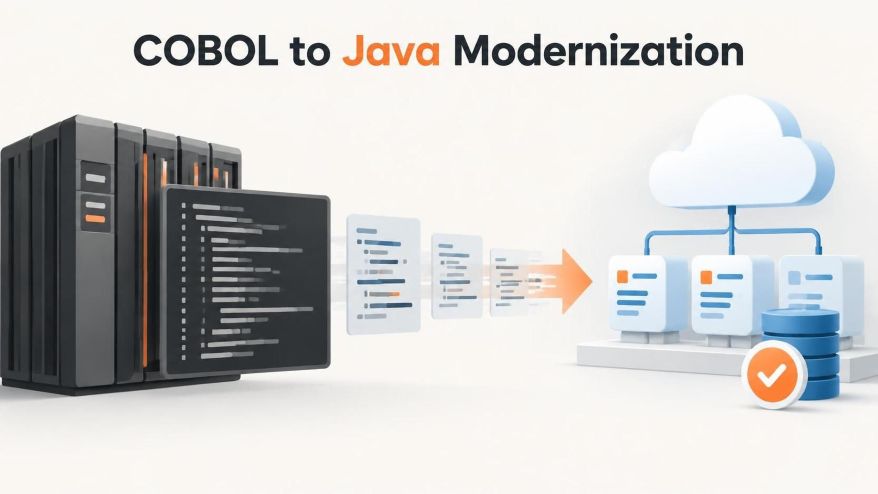
Learn how to establish effective Java code standards for a COBOL to Java modernization project. Discover best practices for data rules, testing, and automated checks.
A COBOL modernization project needs Java standards that do more than control formatting. Developers also need shared rules for representing legacy data, organizing converted logic, documenting business behavior, and proving that changes preserve expected results. Without those rules, each workstream can make different choices, leaving the target application harder to maintain than it should be. COBOL-to-Java Modernization services generally focus on moving existing systems into Java while preserving the behavior the business relies on.
Standards also help reviewers separate a safe cleanup from a change to business logic. Code that compiles and passes a limited test suite may still behave differently from the original application. COBOL Conversion Reliability depends on checks that compare behavior, not just code structure. Set practical rules before conversion work scales up, then apply them through code review, automated checks, and tests tied to business outcomes.
COBOL to Java modernization: Define the standards around two goals
Your standards should help developers produce code that is both maintainable and behaviorally correct. These goals overlap, but they are not the same.
Maintainability covers how developers name, structure, format, test, and review Java code. Behavioral correctness covers whether the new system handles data, calculations, errors, and outputs as the legacy system should.
Separate these goals in your standards document. A readable class can still calculate a value incorrectly. A passing comparison test can still leave the code too tangled for the next team to change.
Project teams should generally agree on clear goals before starting a large conversion. Establishing these objectives early enables teams to set consistent rules while time remains to adjust the strategy.
Choose a Java code style guide and automate the easy rules
Start with an established Java coding style guide rather than creating a long list of formatting preferences from scratch. The Google Java Style Guide is one option. Your team can adopt it as written or record a small set of approved differences.
Use an automated formatter to handle spacing, line breaks, and other mechanical choices. Add it to the build or pull request process so contributors get the same result. This saves reviewers from spending time on formatting comments.
Then settle a few basic conventions:
Package names follow a consistent organization-wide pattern.
Classes, methods, fields, and constants use agreed naming conventions.
Imports are ordered and unused imports are removed automatically.
Each class and method has a clear purpose.
Comments explain business context or non-obvious decisions, not every line.
A formatter can enforce layout. It cannot decide whether a method name explains the business rule or whether a class has too many responsibilities. Those decisions still need code review.
COBOL programs often organize behavior differently from Java applications. A direct one-to-one translation can preserve familiar labels and control flow, but it may also carry over very large methods, shared state, and unclear responsibilities.
Define what a maintainable Java component should own. For example, separate file parsing from business calculations, and keep integration code distinct from domain rules. Use packages and class names that help a developer locate a capability without knowing the original COBOL paragraph name.
Avoid setting a rule that every COBOL paragraph must become a Java method or that every source program must map to one class. These shortcuts can reproduce the old structure without making the new code easier to understand.
Document how teams should handle exceptions. A proposed exception to the target design should include a reason, an owner, and a plan for review. That keeps necessary compatibility code visible instead of letting temporary choices become permanent by accident.
Write down the data rules that Java code must preserve
Data conversion is one area where teams need precise standards. A COBOL field’s picture, usage, sign, and scale can affect how the application reads and calculates its value. Java types do not automatically preserve those details.
For every important data category, record:
The source representation and target Java type.
Allowed values, length, precision, and scale.
How blanks, zeros, and missing values differ.
Rounding and truncation rules.
Date, time, and time-zone assumptions.
How invalid or out-of-range values should behave.
Financial calculations need particular care. If the target uses BigDecimal, specify scale and rounding behavior where the business rule requires it. The class supports several rounding choices, so leaving the choice implicit can create inconsistent results.
Make these data rules part of code review and testing. Reviewers should be able to connect a type or conversion decision to a documented rule, not guess why one field became a string and another became a number.
Treat behavior tests as part of the code standard
A modernization project needs tests that verify the converted application against known behavior. Set a minimum expectation for each change: tests should cover the business rule affected, including relevant edge cases.
For selected programs or components, compare the original and target outputs using representative inputs. Include ordinary records, boundary values, invalid records, and cases that trigger alternate paths. For batch work, compare record counts, control totals, and key output fields.
Require tests to explain the rule they protect. A test named testCase17 tells a future developer little. A test that describes a rejected transaction or a specific rounding boundary gives useful context.
This evidence forms an essential part of a maintainable handoff. Future teams can rerun the checks when changing the code, even if the original project team has moved on.
Standards only help when developers can apply them without slowing every change. Put the rules where contributors work: in the repository, build configuration, pull request template, and onboarding notes.
Use automated checks for rules that tools can enforce:
Formatting and import order.
Compilation and test execution.
Dependency and vulnerability checks.
Required test results before merge.
Rules that flag known unsafe patterns.
Reserve human review for design and business meaning. Reviewers should ask whether the change has a clear owner, whether it alters behavior, and whether the tests cover that change.
Do not reformat a large converted codebase in the same change as a business fix. Broad formatting changes make diffs harder to review and can hide meaningful edits. Apply formatting in controlled stages, then keep later changes focused.
Pilot the Java code standards on a representative component
Before applying the rules across the full estate, test them on a component with realistic complexity. Choose one that uses shared data, has meaningful business logic, and includes enough tests or reference outputs to compare behavior.
Have developers from different teams implement or review the same small change. Note where they interpret the standards differently. If two qualified reviewers disagree about package boundaries, numeric handling, or test expectations, clarify the rule before conversion scales up.
A useful pilot should produce more than clean formatting. It should show that a new developer can find the relevant rule, run the tests, understand a change, and explain why the output remains correct. Update the standards based on what the pilot reveals.
Keep the Java code standards useful as the project grows
Treat the standards as a working agreement, not a one-time document. Review them when the project adds a new Java framework, data store, integration pattern, or conversion wave.
Keep the document focused. A short set of clear rules with automated enforcement is easier to follow than a long manual no one checks. When a rule changes, record why and tell the teams whose code or reviews it affects.
Strong Java standards give a COBOL modernization project a shared way to make decisions. They help teams create code that developers can understand while keeping business behavior visible and testable. Set the rules early, automate what tools can check, and refine the rest through real project reviews.
References:
Bandarupalli, G. (2025). Code Reborn AI-Driven Legacy Systems Modernization from COBOL to Java. arXiv (Cornell University). https://doi.org/10.48550/arxiv.2504.11335
Chakaravarthy, V. T., Choudhury, A. R., Garg, D., Kanvar, V., Pandian, S. S., Raghuvanshi, A., Sabharwal, Y., & Singhee, A. (2026). Enterprise-Scale COBOL-to-Java Translation: LLMs Augmented with Program Analysis. IEEE/ACM International Conference on Software Engineering: Software Engineering in Practice (ICSE-SEIP), 775–785. https://doi.org/10.1145/3786583.3786915
COBOL to Java modernization: FAQs
1. Why are Java standards needed for a COBOL modernization project?
They do more than control formatting. They help teams represent legacy data, organize logic, and preserve expected business behavior.
2. What two core goals should guide Java code standards?
Standards should focus on maintainability and behavioral correctness. These goals ensure code is readable and handles calculations and data accurately.
3. How should data conversion rules be defined?
Teams must record source and target types, length, precision, scale, and rounding rules. This prevents inconsistent results, especially in financial calculations.
4. How can teams effectively enforce these code standards?
Put the rules in repositories, build configurations, and pull request templates. Use automated checks for formatting, compilation, and tests.
5. Why should you run a pilot test before full conversion?
A pilot tests the standards on a component with realistic complexity. It helps clarify rule disagreements before conversion work scales up.
Deven Nandapurkar is a Software Engineer, Project Lead; working at the strategic intersection of software engineering, productivity science, and emerging technologies. Driven by a core philosophy of "building things worth building," he leads cross-functional teams and drives end-to-end technical strategy—from early-stage conceptualization through production-grade deployment.
A Computer Engineering graduate from Pune University, Deven brings a sharp systems-thinking approach to technical leadership, honed by years of managing high-stakes engineering projects and leading teams to top placements in national and international hackathons, including the NASA Space Apps Challenge and the Peerlist GenAI Hackathon.
Deven explores how human cognition and emerging technology converge. He regularly writes about cognitive performance optimization, attention management, AI integration, and the evolving dynamics of the modern workforce - offering actionable frameworks for professionals seeking to maximize their productivity and thrive alongside intelligent systems.
Sneha More is an Information Technology specialist, data analyst, and technology writer with a strong focus on data science, big data frameworks, and modern web technologies. Guided by a philosophy of continuous, hands-on learning, she explores how distributed systems and analytical models can be leveraged to extract meaningful insights from massive datasets.
With practical experience in data analytics, dataset manipulation, and statistical modeling, Sneha examines the intersection of machine learning, big data infrastructure, and practical software engineering. She is particularly interested in how emerging data architectures can drive informed decision-making and solve real-world technical challenges.