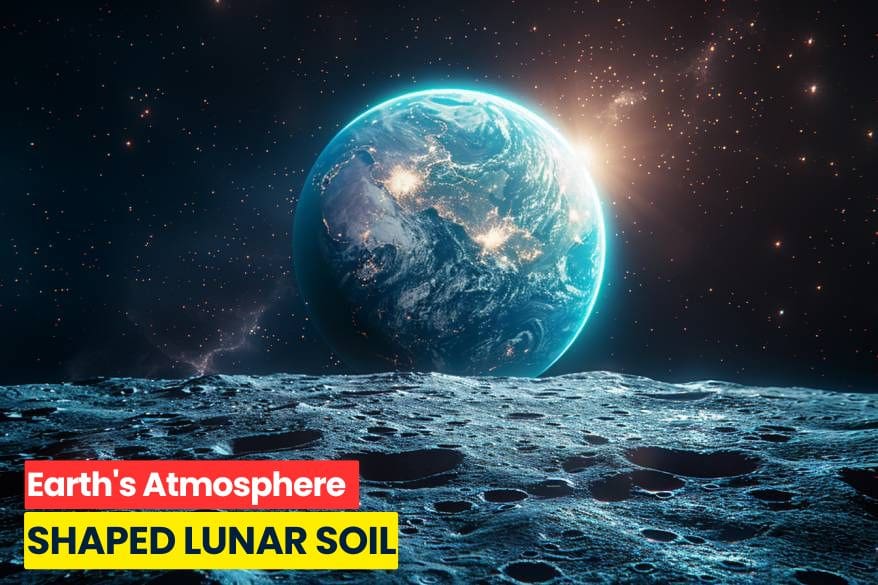
The Mystery of Lunar Nitrogen and Solar Wind The Moon’s surface holds intriguing clues about its history and interactions with space, where Earth’s atmosphere shaped lunar soil. Surprisingly, elements like hydrogen, carbon, nitrogen, and noble gases are nearly…
Earth’s Atmosphere May Have Shaped Lunar Soil: New Insights Into Moon’s Nitrogen Mystery
The Mystery of Lunar Nitrogen and Solar Wind
The Moon’s surface holds intriguing clues about its history and interactions with space, where Earth’s atmosphere shaped lunar soil. Surprisingly, elements like hydrogen, carbon, nitrogen, and noble gases are nearly missing from lunar rocks but appear in the lunar soil. Scientists have long understood that the solar wind implants some of these elements onto the Moon. However, the amount and variations in nitrogen isotopes puzzle researchers. The nitrogen levels far exceed expectations from solar wind alone, raising a critical question about Earth’s atmosphere adding to the Moon’s volatile element supply.
How Earth’s Atmosphere Shaped Lunar Soil
The Earth’s magnetic field forms a protective bubble called the magnetosphere. This shield limits how much atmospheric material escapes into space. When charged particles hit Earth, many bounce back due to this magnetic barrier. Yet, studies show that some ions still escape alongside solar wind plasma during specific conditions.
Interestingly, planets like Mars and Venus lack strong magnetic fields but lose atmosphere at rates similar to Earth. This finding challenges simple ideas about magnetospheres always preventing atmospheric loss. Instead, the complex interaction between Earth’s magnetosphere and solar wind controls volatile escape in a unique way.
Modeling Earth-Moon Interactions
A recent study used advanced simulation models to compare two scenarios: one where Earth had a strong magnetic field (like today), and one without it (early Earth). These models reveal how ions from Earth’s atmosphere may travel to the Moon’s surface during solar wind encounters.
This research helps clarify how Earth’s ancient atmosphere may have influenced lunar soil composition, noted Dr. Jane Smith, planetary scientist.
Does Earth’s Magnetic Field Protect or Promote Atmospheric Loss?
The geomagnetic field creates a magnetosphere around Earth that deflects harmful solar particles. This shield spans approximately 8 to 11 Earth radii toward the Sun’s direction. It also forms closed field lines that trap charged particles, reducing atmosphere loss dramatically.
However, while we often consider this magnetic field as protective, comparative data show planets without intrinsic magnetic fields (like Mars and Venus) lose atmospheres at rates similar to Earth’s. Therefore, atmospheric composition and thermal structure also play crucial roles in governing escape rates.
Implications for Lunar Surface Chemistry
The simulations show that Earth’s escaping atmospheric ions contribute significant amounts of nitrogen and oxygen onto the Moon—especially when Earth lacked a robust geomagnetic shield billions of years ago. This contribution helps explain observed isotope anomalies in lunar soil samples collected during Apollo missions.
Consequently, we now understand better why lunar soils contain more nitrogen than spallation processes or solar wind alone can provide.
The Role of Earth’s Magnetic Field
The Earth’s magnetic field forms a protective shield called a magnetosphere. This shield usually blocks harmful solar winds and reduces atmospheric loss by sending many ions back to Earth. However, this protection might not have always existed.
Scientists used dynamic computer models comparing two scenarios:
- An early Earth without a magnetic field (unmagnetized)
- The present-day Earth with an active magnetic field (magnetized)
The models simulate how solar wind interacts with Earth’s atmosphere and how many ions escape towards the Moon.
Additionally, to stay updated with the latest developments in STEM research, visit ENTECH Online. Basically, this is our digital magazine for science, technology, engineering, and mathematics. Also, at ENTECH Online, you’ll find a wealth of information.
Reference
- Paramanick, S., Blackman, E. G., Tarduno, J. A., & Carroll-Nellenback, J. (2025). Terrestrial atmospheric ion implantation occurred in the nearside lunar regolith during the history of Earth’s dynamo. Nature. https://doi.org/10.1038/s43247-025-02960-4
- Author
- Latest Posts

Ashwini Kshirsagar holds a graduate degree in Chemistry and a postgraduate degree in Environmental Science from Shivaji University, Kolhapur. With a strong foundation in scientific principles and a creative flair, she blends her expertise in environmental science with skills in technical writing, graphic design, and video editing. Proficient in Adobe software, Ashwini excels at transforming complex scientific concepts into clear, engaging, and visually compelling content. Her unique ability to merge science and storytelling allows her to create impactful communication materials that are both informative and accessible to a wide audience.