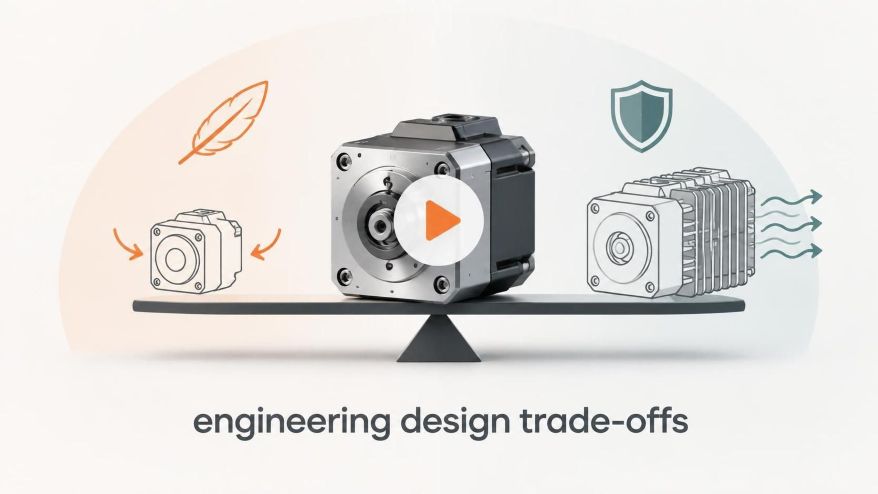
A student engineering design trade-offs project becomes more interesting when two reasonable concepts conflict. For example, one solution might be compact but awkward to repair, while another is easy to open but takes up valuable desk space. Using a short video can make that disagreement immediately visible, giving classmates something concrete to evaluate before anyone commits to a finished physical prototype.
Consider a hypothetical school project: a small desktop organizer that holds charging cables. One design uses a closed box with a narrow opening. The other uses an open tray with removable dividers. While both may look equally tidy in a drawing, they force users to interact differently. Highlighting these practical engineering design trade-offs creates a meaningful starting point for technical discussion.
The educational goal of the video is to explain a design decision, rather than produce a polished advertisement for a single idea. A helpful comparison shows the exact same person completing the same task with each prototype. As a result, viewers can easily identify what changed, what stayed fixed, and which critical observations still require further hands-on testing.
For the visual planning stage, students working within their school’s account and tool-use rules can use tools such as minimax h3 to develop short scenes from written descriptions or reference images. However, they should be treated strictly as concept illustrations – with that role clearly stated in the presentation. And the short videos shall not be referenced as measurements of how a physical device actually performs.
Choose engineering design trade-offs that can be seen
“Better engineering design” is too broad to evaluate. A more useful question is whether a user can replace one cable without disturbing the others. The comparison could begin with both organizers holding the same number of cables, then show the steps involved in retrieving the middle one. This makes access and arrangement visible without pretending that appearance alone determines quality.
Some criteria need a different medium. Cost belongs in a bill of materials with stated assumptions. Strength requires an appropriate physical test. A project video may explain where force is applied, but a convincing-looking bend does not establish a load limit. Choosing the right evidence for each claim is part of the engineering design exercise.
A comparison becomes misleading if one engineering design receives flattering close-ups while the other appears only in a confusing wide shot. Keep the camera angle, starting arrangement, and task sequence similar. If one design includes an extra step, show it rather than hiding it in a cut. The audience should judge the engineering design difference and trade-offs, not the editing.
Use a simple comparison sheet alongside the storyboard. It might list access, organization, ease of cleaning, and the ability to replace a broken part. For each item, write what the video can show and what remains unknown. An empty evidence box is useful: it tells the team what to investigate next instead of encouraging a confident guess.
Use revisions to sharpen the explanation
After classmates view the first version, ask them to describe the engineering design trade-offs in their own words. If they remember the colors but cannot explain the access problem, the scene may be emphasizing the wrong detail. A closer view of the opening or a slower depiction of the hand movement could communicate the point more clearly.
During that revision, tools similar to minimax ai can be used to explore a different visual presentation of the same proposed interaction. Keep the underlying design description beside the revised scene so that a newly generated detail does not silently become part of the engineering specification. If a divider moves to a different position, the team should decide whether that is a deliberate design change or a visual inconsistency.
Engineering Design trade-offs: End with a decision that admits its limits
A strong conclusion can be conditional: the open tray appears easier to access in the proposed interaction, while the closed box may better suit a setting where loose objects need containment. Identifying these engineering design trade-offs leads directly to the next step, such as building cardboard models to examine reach and spacing. This approach is far more informative than declaring one design universally superior.
Students can submit the comparison video with their sketches, assumptions, and proposed tests. Together, these materials show how the team reasoned about alternatives. The most valuable outcome is not a cinematic clip; it is a design decision that another person can understand, challenge, and help improve.
Engineering Design trade-offs – FAQs
1. Why is it important to evaluate engineering design trade-offs in student projects?
Evaluating engineering design trade-offs helps students understand that no single solution is perfect, encouraging them to defend their design choices based on real usability, space, and maintenance limits.
2. How do short videos help explain engineering design trade-offs?
Short videos make user interaction visible, allowing reviewers to observe how hand movements, access steps, and component layouts differ between competing design options in real time.
3. What kind of engineering design trade-offs can be effectively demonstrated in a video?
Visual and physical interaction trade-offs—such as ease of replacing a part, accessibility of cables, or opening mechanism clearances—are best demonstrated through side-by-side video comparisons.
4. What criteria should not be judged solely through a video comparison?
Quantitative metrics like exact cost, material load limits, and structural strength cannot be proven by video alone and require a bill of materials or physical testing.
5. How do you ensure a fair video comparison between two competing designs?
Keep camera angles, lighting, starting setups, and task sequences identical for both options so viewers judge the engineering design trade-offs rather than differences in video editing.
References:
Royster, L. A., & Hou, G. (2023). Gradient-Based Trade-Off design for engineering applications. Designs, 7(4), 81. https://doi.org/10.3390/designs7040081
Nickel, J., Hurst, A., & Duimering, P. R. (2024). Contextual influences on trade-offs in engineering design: a qualitative study. Design Science, 10. https://doi.org/10.1017/dsj.2024.34
Deven Nandapurkar is a Software Engineer, Project Lead; working at the strategic intersection of software engineering, productivity science, and emerging technologies. Driven by a core philosophy of "building things worth building," he leads cross-functional teams and drives end-to-end technical strategy—from early-stage conceptualization through production-grade deployment.
A Computer Engineering graduate from Pune University, Deven brings a sharp systems-thinking approach to technical leadership, honed by years of managing high-stakes engineering projects and leading teams to top placements in national and international hackathons, including the NASA Space Apps Challenge and the Peerlist GenAI Hackathon.
Deven explores how human cognition and emerging technology converge. He regularly writes about cognitive performance optimization, attention management, AI integration, and the evolving dynamics of the modern workforce - offering actionable frameworks for professionals seeking to maximize their productivity and thrive alongside intelligent systems.