Scientists developed a hollow-core optical fibre with record-low loss below 0.1 dB/km, enabling faster, longer-distance internet and data networks.
Hollow-Core Optical Fiber Breaks Signal Loss Record Below 0.1 dB/km
Estimated reading time: 5 minutes
Researchers have created a hollow-core optical fiber with record-low signal loss. Remarkably, it achieves attenuation below 0.1 dB/km across a wide bandwidth. For the first time, this performance surpasses traditional solid glass fibers. As a result, internet signals can now travel much farther without the need for frequent signal boosters.
Marco Petrovich, Eric Numkam Fokoua, Yong Chen, Hesham Sakr, Abubakar Isa Adamu, Rosdi Hassan, Dong Wu, Ron Fatobene Ando, Athanasios Papadimopoulos, Seyed Reza Sandoghchi, Gregory Jasion & Francesco Poletti conducted this research and published it under the title “Broadband optical fibre with an attenuation lower than 0.1 decibel per kilometre” in September 2025.
ENTECH STEM Magazine has included this research in its list of Top 10 Physics Discoveries and Innovation of 2025.
This breakthrough marks a major step forward for global communication networks and high-speed data transfer.
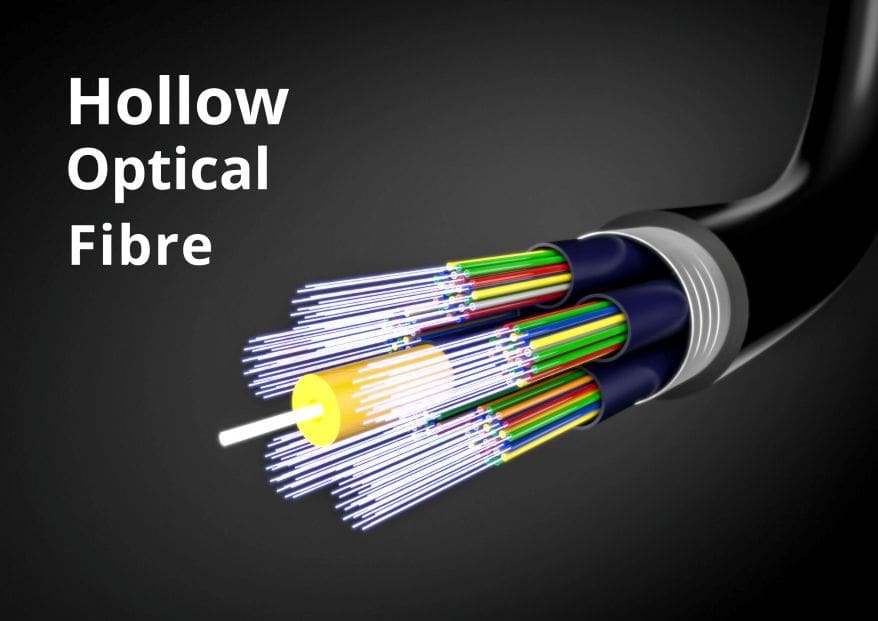
The innovation is a broadband hollow-core optical fiber with attenuation lower than 0.1 dB/km. Instead of traveling through glass, light propagates through an air-filled core. A double-nested antiresonant nodeless design traps light efficiently inside the fiber.
The fiber reaches a minimum loss of 0.091 dB/km at 1550 nm. In addition, it maintains losses below 0.1 dB/km across an 18 THz bandwidth. For example, optical signals can span wavelengths from 1481 nm to 1625 nm without repeaters. Consequently, data transmission becomes faster, cleaner, and more energy efficient.
How the Hollow-Core Optical Fiber Works
Design and Performance
The fiber uses nested glass tubes to create an antiresonant structure. Light reflects repeatedly inside a 29-micrometer air core, remaining confined. Thin membranes, each about 500 nanometers thick, prevent energy leakage.
Importantly, three sources of loss are carefully balanced: leakage, surface scattering, and bending loss. Tests on 15 kilometers of fiber confirmed stable performance. Compared to standard silica fibers, this design reduces loss by 30 percent. Therefore, signals can travel up to ten times farther.
Advantages Over Traditional Fibers
Conventional glass fibers absorb and scatter light. In contrast, the hollow-core optical fiber avoids these limits by guiding light through air. As a result, it delivers 30 percent lower latency and handles up to 1,000 times more optical power.
Because of these advantages, networks can scale more easily to support AI workloads and massive data flows.
Practical Uses in Real Life
Internet and Data Centers
First, longer transmission spans reduce the need for amplifiers. As a result, data centers save energy and lower operating expenses. Next, the wide bandwidth supports much higher traffic volumes.
For instance, the fiber covers the C and L bands, plus additional spectrum. Therefore, homes and businesses gain faster broadband. Streaming, cloud computing, and AI services all benefit from this hollow-core optical fiber.
Sensing and Laser Applications
Beyond communications, this fiber supports high-power laser systems. Its low nonlinearity prevents thermal damage. In addition, it improves fiber-based sensors used in oil pipelines and structural monitoring.
Medical imaging systems also benefit from higher precision and power handling. Consequently, several industries are already preparing to adopt this technology.
Commercial Readiness Timeline
From Laboratory to Prototypes
Currently, the hollow-core optical fiber exists in research laboratories. However, field testing is expected to begin within three years. Meanwhile, clean gas filling techniques are reducing absorption peaks further.
By 2028, short commercial cables may be deployed. Submarine cable trials could follow by 2030. As manufacturing scales up, costs will gradually decrease. Therefore, telecom upgrades will occur step by step.
Full Market Rollout
Looking ahead, larger-core fibers may reach losses as low as 0.03 dB/km by 2035. Although multi-fiber cable designs will need adjustments, global networks could transform during the 2040s.
At the same time, niche applications such as sensing and lasers will grow more rapidly.
Research Areas and Career Paths for Students
Fiber Fabrication
Students can specialize in stack-and-draw fabrication techniques. Skills include operating glass drawing towers and producing long fiber lengths. Career opportunities exist at companies like Corning and OFS Optics.
Typically, students begin with prototypes and later move to large-scale production roles.
Photonic Simulation and Design
Another path involves modeling antiresonant hollow-core optical fiber designs. Students use finite-element tools to simulate losses and optimize structures.
These skills open research and development roles at universities and photonics companies.
Optical Systems Testing
Students may also focus on testing fiber transmission. Tasks include tuning amplifiers and measuring bandwidth limits. Telecom companies actively hire engineers for large-scale field trials.
This experience builds strong industry credentials.
Advanced Photonics Innovation
Finally, students can explore low-latency optical networks and AI data links. Startups increasingly seek photonics experts. These roles often lead to patents and leadership positions.
Why This Hollow-Core Optical Fiber Matters
This hollow-core optical fiber breaks a 40-year performance barrier. It enables exabyte-scale internet growth while reducing energy consumption. Moreover, lower power loss supports greener communication systems.
For students and researchers, the timing is ideal. This field blends physics, materials science, and engineering. In short, a single fiber innovation is driving massive technological progress worldwide.
Additionally, to stay updated with the latest developments in STEM research, visit ENTECH Online. Basically, this is our digital magazine for science, technology, engineering, and mathematics. Further, at ENTECH Online, you’ll find a wealth of information.
Reference:
- Petrovich, M., Fokoua, E. N., Chen, Y., Sakr, H., Adamu, A. I., Hassan, R., Wu, D., Ando, R. F., Papadimopoulos, A., Sandoghchi, S. R., Jasion, G., & Poletti, F. (2025). Broadband optical fibre with an attenuation lower than 0.1 decibel per kilometre. Nature Photonics, 19(11), 1203–1208. https://doi.org/10.1038/s41566-025-01747-5
- Author
- Latest Posts

I’m a web developer and science writer with a Master’s degree in Computer Applications (MCA) from Pune University.
I work in tech, building websites and staying updated with the latest developments. I also love writing about physics, chemistry, technology, robotics, mathematics, and breakthrough innovations. My passion is breaking down complex scientific topics into simple, easy-to-understand stories.
My goal is to help everyone stay informed about the exciting changes happening in science and technology. I believe understanding science shouldn’t be complicated—it should be accessible to all.