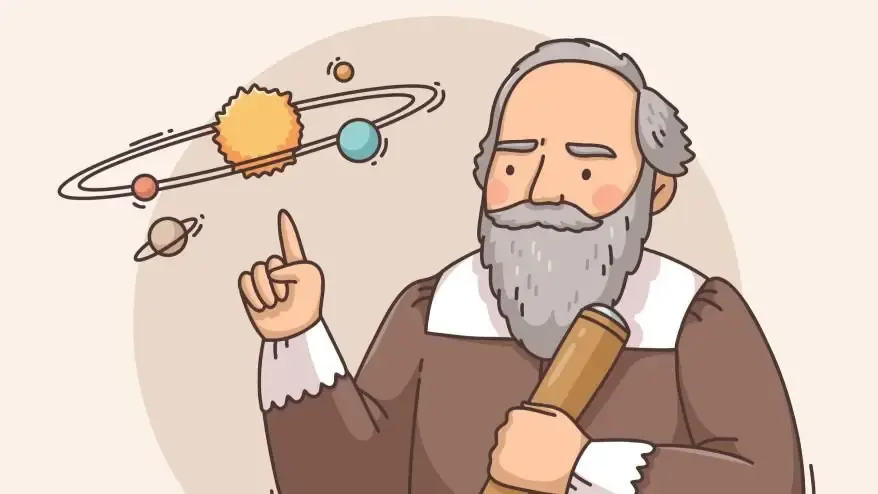
It describes how planets move around the Sun.
Kepler’s Laws of Planetary Motion: Understanding the Mathematics of Orbits
Estimated reading time: 1 minute
Kepler’s Laws of Planetary Motion describe how planets move around the Sun. These laws, formulated by Johannes Kepler in the early 17th century, laid the groundwork for Newton’s theory of gravity. That is, they explain planetary motion using simple yet powerful mathematical relationships, making them crucial in astrophysics and orbital mechanics. In this article, we will explore Kepler’s three laws in detail, derive key equations, analyze real-world applications, and solve example problems to solidify our understanding.
The History Behind Kepler’s Work
Johannes Kepler, a German mathematician and astronomer, formulated his laws in the early 1600s based on the precise astronomical observations of Tycho Brahe. Before Kepler, planetary motion was believed to follow perfect circular orbits, as proposed by Ptolemy and later refined by Copernicus. However, Kepler discovered that planets move in elliptical orbits, which drastically changed our understanding of the solar system. Furthermore, his work provided the foundation for Newton’s law of universal gravitation, bridging the gap between observational astronomy and theoretical physics.
This most beautiful system of the sun, planets, and comets, could only proceed from the counsel and dominion of an intelligent and powerful Being.
-Isaac Newton
Also Read: Simplified Classical Mechanics for Young High-School Students
Kepler’s First Law of Planetary Motion: The Law of Ellipses
Definition:
Each planet orbits the Sun in an elliptical path, with the Sun at one of the two foci of the ellipse.

Mathematical Representation:
Since an ellipse is defined by the equation:
![\[\frac{x^2}{a^2} + \frac{y^2}{b^2} = 1\]](https://b3411452.assetcdn.net/2.0/3411452/wp-content/ql-cache/quicklatex.com-598cedb6c3c4686ee801053cdf72846d_l3.png?lossy=1&strip=0&webp=1 "Rendered by QuickLaTeX.com")
where:
 is the semi-major axis,
 is the semi-minor axis.
 is the semi-minor axis.
Therefore, the distance of a planet from the Sun at any point in its orbit is given by:
![\[r = \frac{a(1 - e^2)}{1 + e \cos \theta}\]](https://b3411452.assetcdn.net/2.0/3411452/wp-content/ql-cache/quicklatex.com-c68e9d903c8c08c2dd3ed44d8057bcb0_l3.png?lossy=1&strip=0&webp=1 "Rendered by QuickLaTeX.com")
where:
 is the distance from the Sun,
- is the eccentricity,
 is the true anomaly.
 is the eccentricity,
 is the true anomaly.
Implications:
- If
 , the orbit is a perfect circle.
 - If is close to 1, the orbit is highly elongated.
 , the orbit is a perfect circle.
Also Read: Concise Introduction to Physics
Kepler’s Second Law of Planetary Motion: The Law of Equal Areas
Definition:
A line segment joining a planet and the Sun sweeps out equal areas in equal intervals of time.
Mathematical Derivation:
Firstly, the area  swept in a small time
  is:
is:
![\[dA = \frac{1}{2} r^2 d\theta\]](https://b3411452.assetcdn.net/2.0/3411452/wp-content/ql-cache/quicklatex.com-69f1d5a61a86400e7e337f6eaf101823_l3.png?lossy=1&strip=0&webp=1 "Rendered by QuickLaTeX.com")
Subsequently, by conservation of angular momentum:
![\[L = mrv = \text{constant}\]](https://b3411452.assetcdn.net/2.0/3411452/wp-content/ql-cache/quicklatex.com-6152ab4d6420f1decfd4b75e633d7d09_l3.png?lossy=1&strip=0&webp=1 "Rendered by QuickLaTeX.com")
Rearranging:
![\[\frac{dA}{dt} = \frac{L}{2m} = \text{constant}\]](https://b3411452.assetcdn.net/2.0/3411452/wp-content/ql-cache/quicklatex.com-cc76d4a008d117fabb8f187fd904195d_l3.png?lossy=1&strip=0&webp=1 "Rendered by QuickLaTeX.com")
which proves that the planet moves faster when it is closer to the Sun and slower when it is farther away.

Kepler’s Third Law of Planetary Motion: The Law of Harmonies
Definition:
The square of a planet’s orbital period is proportional to the cube of the semi-major axis of its orbit.
Mathematical Formulation:
![\[T^2 \propto a^3\]](https://b3411452.assetcdn.net/2.0/3411452/wp-content/ql-cache/quicklatex.com-51834d7c02cd37dfb60de22296960b79_l3.png?lossy=1&strip=0&webp=1 "Rendered by QuickLaTeX.com")
That is, in terms of Newton’s laws:
![\[T^2 = \frac{4\pi^2}{GM} a^3\]](https://b3411452.assetcdn.net/2.0/3411452/wp-content/ql-cache/quicklatex.com-9f4eae6b3fc214e167b3c88ac9236359_l3.png?lossy=1&strip=0&webp=1 "Rendered by QuickLaTeX.com")
where:
 is the orbital period,
 is the gravitational constant,
 is the mass of the Sun.
 is the gravitational constant,
Therefore, this law allows us to compare orbital periods of different planets and understand celestial mechanics.
Orbital Time Periods of Planets in the Solar System
Hence, applying Kepler’s third law, we can compute the approximate orbital periods of planets in the solar system:
| Planet | Semi-Major Axis (AU) | Orbital Period (Years) |
|---|---|---|
| Mercury | 0.39 | 0.24 |
| Venus | 0.72 | 0.62 |
| Earth | 1.00 | 1.00 |
| Mars | 1.52 | 1.88 |
| Jupiter | 5.20 | 11.86 |
| Saturn | 9.58 | 29.46 |
| Uranus | 19.22 | 84.02 |
| Neptune | 30.05 | 164.8 |
How Kepler’s Laws Led to Newton’s Law of Gravity
Establishing the Connection:
Initially, Kepler’s laws were purely empirical, meaning they were based on observational data without a theoretical foundation. Newton took Kepler’s third law and used his law of universal gravitation to derive it mathematically, proving that the same force governing falling objects on Earth also governed planetary motion.
The sun, with all those planets revolving around it and dependent on it, can still ripen a bunch of grapes as if it had nothing else in the universe to do.
-Galileo Galilei
Derivation of Kepler’s Third Law from Newton’s Gravity
Although, Kepler’s laws were derived from observational data without an explanation of the underlying forces, Newton provided a theoretical foundation by introducing the Universal Law of Gravitation, which explains why planets follow Kepler’s laws.
Hence, to derive Kepler’s Third Law using Newton’s laws, we equate the gravitational force to the centripetal force required to keep a planet in orbit.
Step 1: Gravitational Force on a Planet
From Newton’s Law of Universal Gravitation, the force acting on a planet of mass  due to the Sun of mass
  is:
is:
![\[F = \frac{GMm}{r^2}\]](https://b3411452.assetcdn.net/2.0/3411452/wp-content/ql-cache/quicklatex.com-e334044e9e3a55f8fb0a9ddd907c16b4_l3.png?lossy=1&strip=0&webp=1 "Rendered by QuickLaTeX.com")
where:
- is the gravitational constant (
 )
) - is the mass of the Sun
- is the distance between the Sun and the planet
 )
)Step 2: Centripetal Force Required for Orbital Motion
Then, for a circular orbit, the planet experiences a centripetal force given by:
![\[F = m \frac{v^2}{r}\]](https://b3411452.assetcdn.net/2.0/3411452/wp-content/ql-cache/quicklatex.com-c86578e788c547a4de6df22d4da58f7a_l3.png?lossy=1&strip=0&webp=1 "Rendered by QuickLaTeX.com")
where  is the orbital velocity of the planet.
Since orbital velocity is:
![\[v = \frac{2\pi r}{T}\]](https://b3411452.assetcdn.net/2.0/3411452/wp-content/ql-cache/quicklatex.com-efc09e40082e39c0f0160446123da917_l3.png?lossy=1&strip=0&webp=1 "Rendered by QuickLaTeX.com")
Squaring both sides:
![\[v^2 = \frac{4\pi^2 r^2}{T^2}\]](https://b3411452.assetcdn.net/2.0/3411452/wp-content/ql-cache/quicklatex.com-fb2480dde6c24aef844906163ecd837e_l3.png?lossy=1&strip=0&webp=1 "Rendered by QuickLaTeX.com")
Step 3: Equating Gravitational and Centripetal Forces
Since gravity provides the necessary centripetal force:
![\[\frac{GMm}{r^2} = m \frac{4\pi^2 r}{T^2}\]](https://b3411452.assetcdn.net/2.0/3411452/wp-content/ql-cache/quicklatex.com-ce7779b1520f8307bee27673e86fd1b6_l3.png?lossy=1&strip=0&webp=1 "Rendered by QuickLaTeX.com")
Then, cancel from both sides:
![\[\frac{GM}{r^2} = \frac{4\pi^2 r}{T^2}\]](https://b3411452.assetcdn.net/2.0/3411452/wp-content/ql-cache/quicklatex.com-7a9359d5998164d3b393a1634382e747_l3.png?lossy=1&strip=0&webp=1 "Rendered by QuickLaTeX.com")
Then, rearranging for  :
:
![\[T^2 = \frac{4\pi^2}{GM} r^3\]](https://b3411452.assetcdn.net/2.0/3411452/wp-content/ql-cache/quicklatex.com-09475d3e54f87ab22868316c565b5863_l3.png?lossy=1&strip=0&webp=1 "Rendered by QuickLaTeX.com")
Since  is the semi-major axis aa for elliptical orbits:
that is Kepler’s Third Law in Newtonian form. Hence, this derivation confirms that planetary motion follows from Newton’s Law of Universal Gravitation.
Also Read: Comprehensive Guide to Practical Physics
Contributions to Future Science and Space Exploration
Kepler’s laws have had a lasting impact on space science and technology. For instance, they are used in:
- Designing satellite orbits
- Predicting comet trajectories
- Planning interplanetary missions
- Understanding exoplanets and their orbits
Example Problems
Problem 1: Calculating Orbital Period
Question:
If a planet orbits a star with a semi-major axis of  m and the star has a mass of
  kg, find the planet’s orbital period.
Solution:
Using Kepler’s third law:
Firstly, substituting values:
![\[T^2 = \frac{4\pi^2 (2.5 \times 10^{11})^3}{(6.674 \times 10^{-11}) (2.0 \times 10^{30})}\]](https://b3411452.assetcdn.net/2.0/3411452/wp-content/ql-cache/quicklatex.com-ec698d24be4fa115f767d62d9880be8f_l3.png?lossy=1&strip=0&webp=1 "Rendered by QuickLaTeX.com")
Finally, solving for  :
:
![\[T = 3.15 \times 10^7 \text{ seconds} \approx 1 \text{ year}\]](https://b3411452.assetcdn.net/2.0/3411452/wp-content/ql-cache/quicklatex.com-5d23add051c8e4fd861390bd6af86b53_l3.png?lossy=1&strip=0&webp=1 "Rendered by QuickLaTeX.com")
Problem 2: Velocity at Perihelion
Question:
A planet moves in an elliptical orbit with a semi-major axis of  m and an eccentricity of 0.2. Then, find its velocity at perihelion.
Solution:
Firstly, using the equation:
![\[v = \sqrt{GM \left( \frac{2}{r} - \frac{1}{a} \right)}\]](https://b3411452.assetcdn.net/2.0/3411452/wp-content/ql-cache/quicklatex.com-047dcbe041948f54798f80492fa8c3b4_l3.png?lossy=1&strip=0&webp=1 "Rendered by QuickLaTeX.com")
At perihelion,  :
:
![\[r_p = (1.5 \times 10^{11}) (1 - 0.2) = 1.2 \times 10^{11} \text{ m}\]](https://b3411452.assetcdn.net/2.0/3411452/wp-content/ql-cache/quicklatex.com-8c71b3d37897c47183d2b256a1f45ba7_l3.png?lossy=1&strip=0&webp=1 "Rendered by QuickLaTeX.com")
Therefore, substituting into the equation:
![\[v_p = \sqrt{(6.674 \times 10^{-11}) (2.0 \times 10^{30}) \left( \frac{2}{1.2 \times 10^{11}} - \frac{1}{1.5 \times 10^{11}} \right)} <!-- /wp:paragraph --> <!-- wp:paragraph --> $ $v_p = 3.65 \text{ km/s}\]](https://b3411452.assetcdn.net/2.0/3411452/wp-content/ql-cache/quicklatex.com-f3fbb07c2693de285f22a2ee20169c10_l3.png?lossy=1&strip=0&webp=1 "Rendered by QuickLaTeX.com")
Problem 3: Finding Semi-Major Axis from Orbital Period
Question:
A moon orbits a planet in 8 days. If the mass of the planet is  kg, determine the moon’s orbital radius.
Solution:
Using Kepler’s third law:
Firstly, rearranging for  :
:
![\[a^3 = \frac{GMT^2}{4\pi^2}\]](https://b3411452.assetcdn.net/2.0/3411452/wp-content/ql-cache/quicklatex.com-b05726b564e0b2c9971f3389431b0619_l3.png?lossy=1&strip=0&webp=1 "Rendered by QuickLaTeX.com")
Then, substituting values:
![\[a^3 = \frac{(6.674 \times 10^{-11}) (5.0 \times 10^{24}) (8 \times 86400)^2}{4\pi^2}\]](https://b3411452.assetcdn.net/2.0/3411452/wp-content/ql-cache/quicklatex.com-1f5d28071b99b0b501676083c859fa46_l3.png?lossy=1&strip=0&webp=1 "Rendered by QuickLaTeX.com")
Therefore, solving for :
![\[a \approx 4.8 \times 10^8 \text{ m}\]](https://b3411452.assetcdn.net/2.0/3411452/wp-content/ql-cache/quicklatex.com-67606bfad4024f25dc3af31d8626e64c_l3.png?lossy=1&strip=0&webp=1 "Rendered by QuickLaTeX.com")
Problem 4: Velocity at Aphelion
Question:
A comet has a perihelion distance of  AU and an aphelion distance of
  AU. If its velocity at perihelion is
  km/s, find its velocity at aphelion.
Solution:
Firstly, using conservation of angular momentum:
![\[v_a r_a = v_p r_p\]](https://b3411452.assetcdn.net/2.0/3411452/wp-content/ql-cache/quicklatex.com-99e0e555c313b373778a9cb6bf08fd9c_l3.png?lossy=1&strip=0&webp=1 "Rendered by QuickLaTeX.com")
Then, solving for  :
:
![\[v_a = v_p \frac{r_p}{r_a}\]](https://b3411452.assetcdn.net/2.0/3411452/wp-content/ql-cache/quicklatex.com-8f3cfb367891a0f913cd18fe4fe64cad_l3.png?lossy=1&strip=0&webp=1 "Rendered by QuickLaTeX.com")
Hence, substituting values:
![\[v_a = 40 \times \frac{0.5}{4.0} va=5 km/sv_a = 5 \text{ km/s}\]](https://b3411452.assetcdn.net/2.0/3411452/wp-content/ql-cache/quicklatex.com-adcebc009f333b7f6c9e4f72c4ec7af3_l3.png?lossy=1&strip=0&webp=1 "Rendered by QuickLaTeX.com")
Problem 5: Finding Orbital Eccentricity
Question:
If a planet orbits a star with a perihelion distance of  m and an aphelion distance of m. Then, find its orbital eccentricity.
Solution:
Using the eccentricity formula:
![\[e = \frac{r_a - r_p}{r_a + r_p}\]](https://b3411452.assetcdn.net/2.0/3411452/wp-content/ql-cache/quicklatex.com-07c8ce72a466d67e204ff9f34ef1846e_l3.png?lossy=1&strip=0&webp=1 "Rendered by QuickLaTeX.com")
Then, substituting values:
![\[e = \frac{(2.5 \times 10^{11}) - (1.0 \times 10^{11})}{(2.5 \times 10^{11}) + (1.0 \times 10^{11})}\]](https://b3411452.assetcdn.net/2.0/3411452/wp-content/ql-cache/quicklatex.com-53e3b8b89ba318e91528548d1b2e2df3_l3.png?lossy=1&strip=0&webp=1 "Rendered by QuickLaTeX.com")
![\[e = \frac{1.5 \times 10^{11}}{3.5 \times 10^{11}}\]](https://b3411452.assetcdn.net/2.0/3411452/wp-content/ql-cache/quicklatex.com-1590521c68a2a1a393267f3c6692c3cb_l3.png?lossy=1&strip=0&webp=1 "Rendered by QuickLaTeX.com")
Therefore,
![\[e = 0.43\]](https://b3411452.assetcdn.net/2.0/3411452/wp-content/ql-cache/quicklatex.com-63437d40feb2e9e98e3d9c34dde9f24f_l3.png?lossy=1&strip=0&webp=1 "Rendered by QuickLaTeX.com")
Frequently Asked Questions
1. Do Kepler’s laws of planetary motion apply to moons and artificial satellites?
Yes, Kepler’s laws apply to any two-body system where one body is much more massive than the other, including moons orbiting planets and artificial satellites orbiting Earth.
2. What happens if a planet’s orbit is a perfect circle?
If the orbit is a perfect circle, Kepler’s laws still hold. The eccentricity in this case is zero, meaning the semi-major and semi-minor axes are equal, and the planet moves at a constant speed.
3. Why is Kepler’s Second Law called the Law of Equal Areas?
Kepler’s Second Law states that a planet sweeps out equal areas in equal time intervals. This means that a planet moves faster when it is closer to the Sun and slower when it is farther away due to conservation of angular momentum.
4. Can Kepler’s Third Law help in determining the mass of a star?
Certainly, by rearranging Kepler’s Third Law in terms of Newton’s law of gravitation, we can determine the mass of a star by observing the orbital period and semi-major axis of a planet orbiting it.
5. How does Kepler’s Second Law affect satellite motion around Earth?
Kepler’s Second Law implies that satellites in elliptical orbits move faster when closer to Earth and slower when farther away, which is crucial for planning space missions and satellite launches.
6. What is the relationship between Kepler’s Laws and Newton’s Law of Gravitation?
Kepler’s laws were derived from observational data, while Newton later explained them using his Law of Universal Gravitation, showing that planetary motion results from the gravitational attraction between celestial bodies.
7. How do astronomers use Kepler’s laws to find exoplanets?
Astronomers use variations in a star’s light (due to planetary transits) and the gravitational wobble (due to a planet’s mass) to apply Kepler’s laws and determine exoplanetary orbits and masses.
8. Do Kepler’s Laws hold true in modern physics?
Yes, Kepler’s laws remain accurate for most planetary motions. However, for extreme conditions like those near black holes, Einstein’s General Theory of Relativity provides a more precise description of gravity.
Conclusion
In conclusion, Kepler’s Laws of Planetary Motion provide a fundamental understanding of celestial mechanics. In particular, these laws explain how planets move, predict orbital parameters, and connect directly to Newton’s gravity. Hence ,understanding Kepler’s laws is essential for space exploration, astronomy, and astrophysics. Consequently, the laws continue to be relevant in modern science, from planetary exploration to satellite communications.
Additionally, to stay updated with the latest developments in STEM research, visit ENTECH Online. Basically, this is our digital magazine for science, technology, engineering, and mathematics. Further, at ENTECH Online, you’ll find a wealth of information.
References
- Murray, C. D., & Dermott, S. F. (1999). Solar system dynamics. Cambridge University Press. https://doi.org/10.1017/CBO9781139174817
- Russell, J. L. (1964). Kepler’s Laws of Planetary Motion: 1609–1666. The British Journal for the History of Science, 2(1), 1–24. https://doi.org/10.1017/S0007087400001813
- Wilson, C. (1994). Kepler’s derivation of the elliptical path. Physics Today, 47(9), 66-71. https://doi.org/10.1063/1.2808640
- Author
- Latest Posts

Uddhav Thakore is a passionate Physicist with a Master’s degree, specializing in Astrophysics and Quantum Physics. With expertise in Mechanics, Wave Theory, the Standard Model, Engineering Electronics, and Control Systems, Uddhav is dedicated to making complex scientific concepts clear and engaging for a broad audience.