Explore the concept of learning by doing and discover how hands-on experiences can enhance your education and skill development.
Learning by Doing: Why building, testing and making things is the fastest route to real skill

Estimated reading time: 6 minutes
Introduction: Learning by Doing
Think about how you learned to ride a bicycle. Nobody handed you a textbook on balance and friction and then expected you to cycle perfectly. You climbed on, wobbled, fell, adjusted, and tried again. That is Learn-by-Doing, and it is one of the most powerful ideas in modern education. This article looks at why doing beats only reading, how schools and universities are now running thousands of hands-on activities for huge numbers of students, and how you can use the same approach right now to build skills that employers and colleges genuinely value.
Also Read: Learning to Learn: Meta-Learning for Future-Ready Students
The Science of Learn By Doing
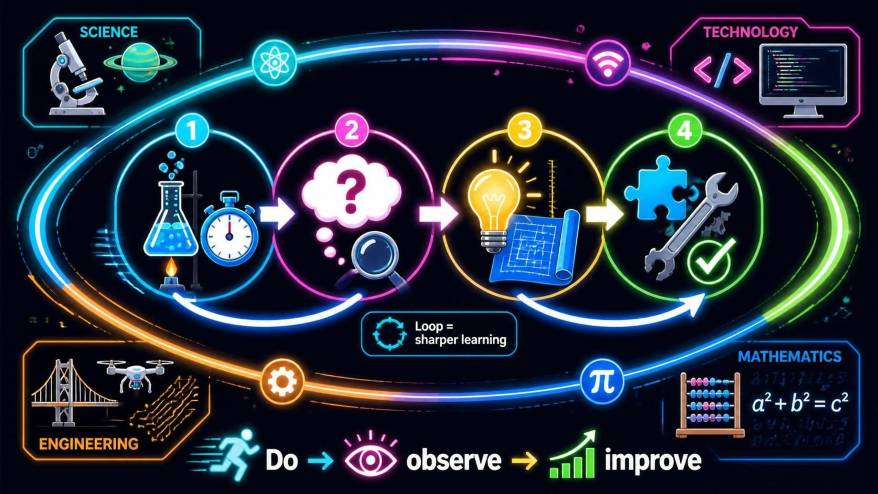
Learn-by-Doing, often shortened to LBD, sits inside a branch of education science called experiential learning. The core idea is simple. Knowledge becomes useful only when you apply it. When you read a fact, it stays in your short-term memory for a while and then quietly fades. When you use that fact to solve a problem, build a model, or fix something that is broken, your brain treats it as important and stores it far more deeply.
Researchers describe a repeating loop with four stages. Firstly, you have an experience, such as running an experiment. Then you reflect on what happened and ask why it turned out that way. Next you form an idea or a rule that explains it. Finally, you test that idea with a new attempt. Each trip around this loop makes your understanding sharper. A wrong answer is not a failure here. It is data that tells you what to change.
LBD shows up across every part of STEM. In science it is the lab experiment and the field study. In technology it is writing code and watching it run. While in engineering it is the design, build and test cycle used to create bridges, drones and circuits. Also, in mathematics it is solving a real problem with messy numbers rather than only memorising a formula. The branch you choose matters less than the habit itself.
The habit is this: do not stop at knowing about something. Make something with it, observe the result, and improve.
Also Read: Rapid Prototyping and Agile Execution | Future Skills 2030
How Learn By Doing is Run at a Large Scale?
A single teacher can guide one class through a project. The harder and more interesting challenge is running applied, hands-on learning for tens of thousands of students at once. Modern digital learning platforms now do exactly this, and understanding how they work tells you a lot about the field you might one day join.
Large online programmes break each course into small applied tasks rather than long lectures alone. A learner might build a simple web page, clean a real dataset, wire a virtual circuit, or analyse a set of survey responses. These activities run inside virtual labs, which are safe online environments where students can experiment without expensive equipment. Automated systems then check the work, give instant feedback, and let the learner try again. Designing hundreds of such activities across many courses is careful, structured work, and it is what allows a programme to grow from a few thousand learners to ninety thousand without losing quality.
If this kind of work appeals to you, several study paths lead toward it. A degree in computer science, education technology, instructional design, or data science gives you the foundations. Useful tools to learn early include a programming language such as Python, basic data handling, and simple design software. Look for courses that include internships, capstone projects, and assessment design, because these teach you to build learning experiences, not just consume them. Many short online certifications in instructional design and learning analytics are open access and free to begin.
Career Path: Learn By Doing

The people who design Learn-by-Doing experiences hold a range of job titles, and the field is growing quickly as education moves online. At entry level you might join as a content developer, a junior instructional designer, or a learning technologist. With experience you can become a learning experience designer, a curriculum architect, or a learning innovation lead who shapes how an entire programme teaches.
Major employers include universities, large online education companies, school technology firms, and the training divisions of big corporations. There is also strong demand inside research groups that study how people learn and how artificial intelligence can support teaching. Funded research projects in education technology are common, and they often welcome people who can both understand learners and build practical tools. The mix of psychology, technology and creativity makes this an unusually varied career, and it rewards people who like solving problems for real users.
Conclusion
You do not need to wait for the perfect course to start learning by doing. Begin with small projects this month. Build a simple website, write a short program that solves a real annoyance in your daily life, run a science experiment at home and record what happens, or join a robotics or coding club at school.
Enter a science fair or a hackathon, since the deadline forces you to finish something real. Read widely, but always pair your reading with a build. Visit a local college open day or a maker space and ask to see student projects. Over a few years these small efforts add up to a portfolio of things you have actually created. That portfolio, far more than marks alone, is what shows a college or an employer that you can turn knowledge into results.
Passion becomes a profession when you keep doing, keep reflecting, and keep improving.
Additionally, to stay updated with the latest developments in STEM research, visit ENTECH Online. Basically, this is our digital magazine for science, technology, engineering, and mathematics. Further, at ENTECH Online, you’ll find a wealth of information.
References:
- Kolb, D. A. (2015). Experiential learning: Experience as the source of learning and development (2nd ed.). Pearson Education. https://www.researchgate.net/publication/235701029
- Freeman, S., Eddy, S. L., McDonough, M., Smith, M. K., Okoroafor, N., Jordt, H., & Wenderoth, M. P. (2014). Active learning increases student performance in science, engineering, and mathematics. Proceedings of the National Academy of Sciences, 111(23), 8410-8415. https://doi.org/10.1073/pnas.1319030111
- Siddique, M. M. (2025). Unlocking text analytics: A cross-disciplinary guide for modern learners. Notion Press. https://www.notionpress.com/in/read/unlocking-text-analytics/
- Author
- Latest Posts

M M Siddique is a Fellow of the Higher Education Academy (FHEA) and a senior EdTech and higher education leader with more than thirty years of experience across India, Oman and United Kingdom academic partnerships. His career spans university teaching, academic leadership, and the design of large digital learning programmes, and he is known for connecting formal higher education with practical EdTech product innovation. Most recently, he helped scale a major online learning programme to ninety thousand learners across more than two hundred courses, with measurable gains in learner engagement, faster time to market, and reliable on-time delivery. His work focuses on applied, hands-on learning, on AI-enabled assessment, and on building scalable, learner-centred education systems. He has led practical projects on automated question generation and automated descriptive evaluation, areas where artificial intelligence supports fairer and faster grading. He is the author of Unlocking Text Analytics, a cross-disciplinary guide for modern learners, and co-author of Educational Research Methods, NEP 2020 Perspectives. He contributed the NEP-MultiSent multilingual dataset to IEEE DataPort and has co-authored several research papers in multilingual sentiment analytics and Natural Language Processing. He holds a Master of Technology in Computer Science and Engineering and a Postgraduate Certificate in Higher Education and Professional Practices from Coventry University, United Kingdom, and is currently pursuing a PhD in Computer Science and Engineering. He is a professional member of the IEEE and the IET, and has served as an industry trainer in artificial intelligence, machine learning and Python for data science. He is passionate about helping young learners turn curiosity into capability through building, experimenting and reflecting.
Email: [email protected]
LinkedIn: www.linkedin.com/in/mmsiddique
IEEE DataPort: https://ieee-dataport.org/documents/nep-multisent-large-scale-multilingual-dataset-national-education-policy-nep-2020


