Meet the leaders shaping how the next generation will study
INTRODUCTION
Imagine your school in the year 2040. Will you still sit in rows facing a board? Will a test still mean a printed paper and a silent hall? Someone, right now, is deciding the answer to those questions. Behind every modern school and university there is a small group of senior leaders whose entire job is to design how learning happens. This article introduces that field, often called education leadership and learning strategy, explains how artificial intelligence is changing it, and shows how a student who is curious today could grow into one of those decision makers tomorrow.
THE DOMAIN: EDUCATION LEADERSHIP AND LEARNING STRATEGY
Most people picture a school as teachers and students. Behind them, though, sits a layer of strategy. Large institutions appoint senior leaders, sometimes called the Chief Academic Officer or the Chief Learning Officer, whose role is to plan the future of learning. They decide what subjects are taught, how courses are designed, which technologies are used, and how quality and fairness are protected. This work blends three things: an understanding of how people learn, a grasp of technology, and the leadership skill to guide large teams.
Artificial intelligence is now reshaping every part of this domain. AI can suggest a personalised study path for each learner, spot when a student is falling behind before a teacher would notice, and handle slow tasks such as first round grading. This means tomorrow’s education leaders need to understand AI well enough to use it wisely and to question it when it is wrong. The domain has several branches. Curriculum design decides what is taught and in what order. Learning analytics studies the data that learning produces, so that decisions are based on evidence. Education policy connects a single institution to the wider rules of a country, such as a national education framework. Academic quality and accreditation make sure that a qualification genuinely means what it claims to mean.
What ties these branches together is a simple aim. The goal is not technology for its own sake. The goal is a learning experience that is effective, fair and genuinely useful for the student who lives it.
EDUCATIONAL OPPORTUNITIES
Nobody begins a career as a Chief Academic Officer. The path is built in stages, and it usually starts with deep knowledge of one subject. A useful first degree can be in almost any field, including science, engineering, mathematics, computer science or the social sciences, because education leaders come from many backgrounds. What matters is that you understand at least one area well enough to teach it or design learning around it.
Later study then adds the leadership and learning layer. Postgraduate courses in education, education technology, learning design, or education management are common next steps, and many leaders also earn a certificate in teaching and learning in higher education. Research degrees, including a PhD, are valued in this field because they train you to ask careful questions and to test ideas with evidence rather than opinion. Useful subjects to build along the way include data literacy, basic understanding of artificial intelligence, project management, and clear communication. Look for programmes that include real projects, internships in education organisations, and research opportunities, since leadership is learned by doing, not only by studying.
Many short open access courses on learning design, learning analytics and education leadership are available online, and they are a low cost way to test whether this field excites you. Treat them as small experiments. If you find yourself enjoying the question of how a course should be built, rather than only the subject it teaches, that is a strong signal that this path may suit you.
CAREER PATH
A career toward education leadership usually begins in a hands-on role, such as a teacher, a lecturer, an instructional designer, or a learning technologist. From there, people move into roles that carry more responsibility, such as programme coordinator, head of department, or learning innovation lead. With experience and a track record of good decisions, the most senior roles open up, including Dean, Director of Learning, Chief Academic Officer, and Chief Learning Officer.
Employers include schools, colleges, universities, large online education companies, and the learning and development divisions of major corporations. There is also growing demand in education technology firms and in advisory roles, where experienced leaders help many institutions at once. Funded research projects on the future of learning are common, and they welcome people who can connect bold ideas to practical change. It is a long path, but it places you in the room where the future of education is actually decided.
CONCLUSION: Education Leadership and Learning Strategy
You can begin preparing for this field long before you choose a career. Practice leadership in small ways now, by organizing a club, leading a project team, or running a school event, because managing people and ideas is the core skill. Stay curious about how learning works, and notice what helps you understand a hard topic and what does not. Read about education and about artificial intelligence, and try simple projects that use data to answer a question. Attend workshops, visit college open days, and talk to teachers about why courses are designed the way they are. Enter debates and science fairs, since both train you to defend an idea with evidence. The leaders who will design learning in 2040 are students today who are simply paying attention. If the future of education fascinates you, start by understanding your own learning deeply, and let that curiosity grow into a profession.
REFERENCES:
Siddique, M. M., & Kumar, S. (2025). Multilingual sentiment analytics for India’s NEP 2020. In Proceedings of the 2025 IEEE 4th International Conference on Data, Decision and Systems (ICDDS) (pp. 1-4). IEEE. https://doi.org/10.1109/ICDDS67737.2025.11344683
Siddique, M. M., Patil, C., Jaiswal, S., & Patel, A. M. (2024). Educational research methods: NEP 2020 perspectives. A2Z EduLearningHub. https://www.amazon.in/dp/B0DHV2H12X
Zawacki-Richter, O., Marín, V. I., Bond, M., & Gouverneur, F. (2019). Systematic review of research on artificial intelligence applications in higher education–where are the educators?. International journal of educational technology in higher education, 16(1), 39.
This article was written by MM Siddique and reviewed for editorial accuracy by our editorial team. It has not yet undergone independent review by a professional.
M M Siddique is a Fellow of the Higher Education Academy (FHEA) and a senior EdTech and higher education leader with more than thirty years of experience across India, Oman and United Kingdom academic partnerships. His career spans university teaching, academic leadership, and the design of large digital learning programmes, and he is known for connecting formal higher education with practical EdTech product innovation. Most recently, he helped scale a major online learning programme to ninety thousand learners across more than two hundred courses, with measurable gains in learner engagement, faster time to market, and reliable on-time delivery. His work focuses on applied, hands-on learning, on AI-enabled assessment, and on building scalable, learner-centred education systems. He has led practical projects on automated question generation and automated descriptive evaluation, areas where artificial intelligence supports fairer and faster grading. He is the author of Unlocking Text Analytics, a cross-disciplinary guide for modern learners, and co-author of Educational Research Methods, NEP 2020 Perspectives. He contributed the NEP-MultiSent multilingual dataset to IEEE DataPort and has co-authored several research papers in multilingual sentiment analytics and Natural Language Processing. He holds a Master of Technology in Computer Science and Engineering and a Postgraduate Certificate in Higher Education and Professional Practices from Coventry University, United Kingdom, and is currently pursuing a PhD in Computer Science and Engineering. He is a professional member of the IEEE and the IET, and has served as an industry trainer in artificial intelligence, machine learning and Python for data science. He is passionate about helping young learners turn curiosity into capability through building, experimenting and reflecting.
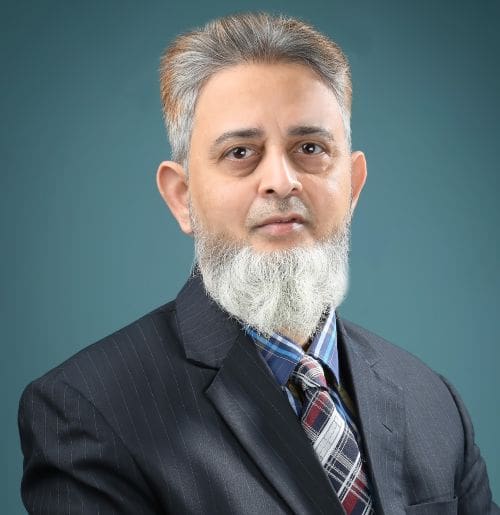
Mohammad Mustafa Siddique FHEA Fellow | Senior EdTech and Higher Education Leader | PhD Researcher, Computer Science and Engineering
M M Siddique is a Fellow of the Higher Education Academy (FHEA) and a senior EdTech and higher education leader with more than thirty years of experience across India, Oman and United Kingdom academic partnerships. His career spans university teaching, academic leadership, and the design of large digital learning programmes, and he is known for connecting formal higher education with practical EdTech product innovation. Most recently, he helped scale a major online learning programme to ninety thousand learners across more than two hundred courses, with measurable gains in learner engagement, faster time to market, and reliable on-time delivery. His work focuses on applied, hands-on learning, on AI-enabled assessment, and on building scalable, learner-centred education systems. He has led practical projects on automated question generation and automated descriptive evaluation, areas where artificial intelligence supports fairer and faster grading. He is the author of Unlocking Text Analytics, a cross-disciplinary guide for modern learners, and co-author of Educational Research Methods, NEP 2020 Perspectives. He contributed the NEP-MultiSent multilingual dataset to IEEE DataPort and has co-authored several research papers in multilingual sentiment analytics and Natural Language Processing. He holds a Master of Technology in Computer Science and Engineering and a Postgraduate Certificate in Higher Education and Professional Practices from Coventry University, United Kingdom, and is currently pursuing a PhD in Computer Science and Engineering. He is a professional member of the IEEE and the IET, and has served as an industry trainer in artificial intelligence, machine learning and Python for data science. He is passionate about helping young learners turn curiosity into capability through building, experimenting and reflecting.