The way we work has fundamentally changed. Cellphones aren’t just for North American folk; they quickly became a tool in many businesses. Statistics have proven that most employees use their personal phones as tools when…
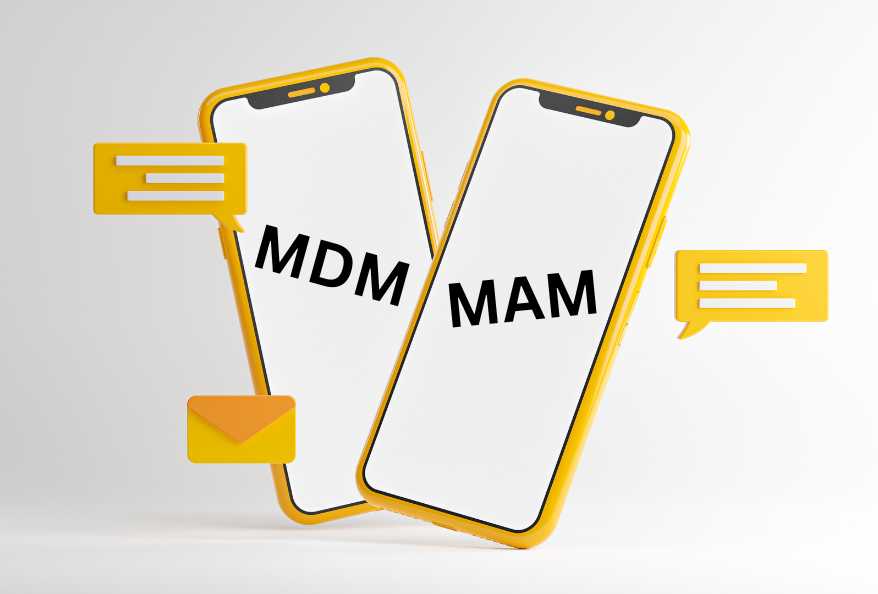
MDM vs MAM Solutions for Managing Apps and Devices Safely
Estimated reading time: 8 minutes
The way we work has fundamentally changed. Cellphones aren’t just for North American folk; they quickly became a tool in many businesses. Statistics have proven that most employees use their personal phones as tools when working outside the building. 75% of Americans use their cell phones for work and proudly express their productivity at this increase in stress. Users frequently introduce iron-naturally sounding human errors alongside internet flexibility, but they also get tangled in big webs of privacy challenges. This is precisely why the choice between MDM vs MAM has become central to enterprise security strategy.
Businesses should solve the problem of phones and other devices by finding the right approach. The main obligation is to find a balance of privacy, security, and freedom. Specialized management solutions have developed in response to this new cell phone dilemma, with successful implementations of MDM vs MAM technology. Although they’re both about getting businesses up and going, they take different actions. You need to choose the best plan for your business that’s secure and safe.
The Core Function of Mobile Device Management (MDM)
Mobile Device Management (MDM) is a security configuration that enables IT administrators to fully control the mobile device subsystem. Think of it as a top-down approach. When a device joins MDM, it is managed through policies set by engineering in the management portal. Therefore, they can impose physical controls using an Android device MDM, such as user lock and settings that control which users can access the device and its applications. Most often, this is the solution used for managing corporate-owned devices, where the organization has full ownership of the entire asset.
Mobile Device Management (MDM) solutions are installed on the client or agent of the mobile device. The client acts as a bridge between the required mobile device and the mobile device management server. IT teams can use this agent to push updates. They can restrict access to some features, including the camera and app store. They can enforce passcode requirements. And we can be sure the OS is up to date. The ability to manage device security settings is highly effective in maintaining a uniform security posture. MDM provides granular control for industries with strict regulatory requirements. For instance, the finance and government industries require MDM to protect data against breaches from compromised devices.
However, such comprehensive control comes at a cost, especially in a BYOD environment namely, user privacy. When workers use their own devices for work, signing them up for an MDM system offers the company visibility into and control over the whole device, including personal apps, photos, and data. People may find this disruptive to their work and may become uncomfortable with this. The boundary between private and public relationships begins to erode, which can put the organization in trouble due to privacy implications and liability issues.
A Focus on Applications with Mobile Application Management (MAM)

Mobile Application Management (MAM) provides a more focused solution. MAM does not manage the entire device; it only secures and controls the corporate apps and their corporate data. This is often described as a “containerization” strategy. Corporate apps are installed in a secure, managed environment within the user’s device. This keeps them separate from the user’s personal apps and data. This enables IT administrators to apply security policies at the application level.
With MAM, a firm can manage behaviour in its own apps. It can prevent employees from copying confidential information from a managed work email and pasting it into a personal messenger application. While, it may require a separate pin or even biometric authentication to access work apps. The firm can remove only corporate data from the device when an employee leaves, leaving all personal data untouched. BYOD is a policy that allows employees to use their personal devices for work. It protects employees’ private information without compromising their privacy while providing strong security for corporate assets.
The debate between MDM vs MAM often hinges on this distinction. While MDM secures the device, MAM secures the data. The latter is becoming increasingly popular as it meets the expectations of today’s employees, who increasingly use a single device for both their personal and professional lives. It gives them flexibility without sacrificing control over their property.
Key Differences in Security and Management
When comparing MDM and MAM, we need to consider their differing philosophies on security and control, as well as their experience. The decision between them affects how an organization manages risk and assists its employees.
MDM is device-centric. Its primary goal is to secure the endpoint itself. This is effective when the device is company property since it allows the organization to enforce a minimum security standard across all hardware. Policies can mandate a specific OS version, restrict the use of unapproved apps, and more. MDM can lock your device down completely. This means the device is completely secured for corporate data. The weakness is the way it interferes and is inflexible for personal use. A full wipe of your device wipes everything. It is an important security measure if a corporate phone goes missing, but it can be disastrous if it is your personal phone.
MAM, on the other hand, is data-centric. Since we can’t fully control the device, we focus on what matters most: the Corporate Applications and corporate data. MAM creates a security bubble for work-related activities that prevents data leakage and ensures sensitive data remains protected, regardless of the device it resides on. The fact that it is at the app level, we could enforce policies like conditional access. This could restrict the app from working on a jailbroken or rooted device while still not managing the device. It naturally offers greater BYOD and privacy protection.
User experience also plays a role in the MDM vs. MAM debate. MDM can sometimes feel a bit restrictive for end users, as it enforces policies that limit personal use. In contrast, MAM solutions are often less intrusive. Users can continue using their devices as they do now. The only change will be the security protocols covering their work apps.
MDM vs MAM: Making the Right Choice for Your Organization
Deciding between MDM and MAM is not about which one is better. It is about which one is right for you, your culture, and your risk appetite. Several factors should guide this decision.
Firstly, consider your device ownership model. MDM is often the most practical and efficient solution when your company gives workers a corporate-owned single-use device. It gives the best control and security over the assets that the organization owns and is responsible for.
If your business has a strong BYOD program or mainly uses contract workers and temps on their own gear, MAM is probably the way to go. You can keep your data safe without invading privacy, reducing friction with employees and the risk of lawsuits. This method allows for flexible working while also ensuring data governance.
Another key factor is what type of data your workers deal with. An organization in a highly regulated sector, such as healthcare (HIPAA) or defense (controlled information), may require a more sophisticated security posture. In some instances, certain MDM policies might be used with an MAM (Mobile Application Management) framework. Enterprise Mobility Management (EMM) and Unified Endpoint Management (UEM) are often used interchangeably, though the latter may include EMM.
The MDM vs MAM debate is really about strategy and not functionality. You need to balance the importance of controlling devices with that of user privacy and flexibility. Many businesses today are shifting towards application-centric security that protects the data that matters most while enabling employees to work the way they want, wherever they are.
MDM vs MAM: Final Analysis
The mobile security landscape is always evolving. The way employees work and use technology is continually changing. MDM manages mobile devices, and MDM controls mobile applications. While both ensure corporate assets are well safeguarded, they seem to approach it quite differently. MDM is all about protecting the complete device. Therefore, this is effective for hardware operating businesses that require total control.
The way the MAM manages business and data applications across many mobile devices without compromising privacy. It worked efficiently in the BYOD environment.
Choose the right method by carefully evaluating your organization’s device policy, security demands, and corporate culture. In today’s world, where people work from anywhere, we need ways to protect data. These ways should not harm work, fun, or privacy.
Your organization can use a mobile security strategy that works for today’s workers when they understand the pros and cons of each approach.
Additionally, to stay updated with the latest developments in STEM research, visit ENTECH Online. Basically, this is our digital magazine for science, technology, engineering, and mathematics. Further, at ENTECH Online, you’ll find a wealth of information.
Image Source: Canva.
- Author
- Latest Posts

Deven Nandapurkar is a Software Engineer, Project Lead; working at the strategic intersection of software engineering, productivity science, and emerging technologies. Driven by a core philosophy of “building things worth building,” he leads cross-functional teams and drives end-to-end technical strategy—from early-stage conceptualization through production-grade deployment.
A Computer Engineering graduate from Pune University, Deven brings a sharp systems-thinking approach to technical leadership, honed by years of managing high-stakes engineering projects and leading teams to top placements in national and international hackathons, including the NASA Space Apps Challenge and the Peerlist GenAI Hackathon.
Deven explores how human cognition and emerging technology converge. He regularly writes about cognitive performance optimization, attention management, AI integration, and the evolving dynamics of the modern workforce – offering actionable frameworks for professionals seeking to maximize their productivity and thrive alongside intelligent systems.