Multiscale Aperture Synthesis Imager changes this by recording data at the diffraction plane using an array of coded sensors without any reference waves.
How Multiscale Aperture Synthesis Imager (MASI) is Advancing Optical Imaging
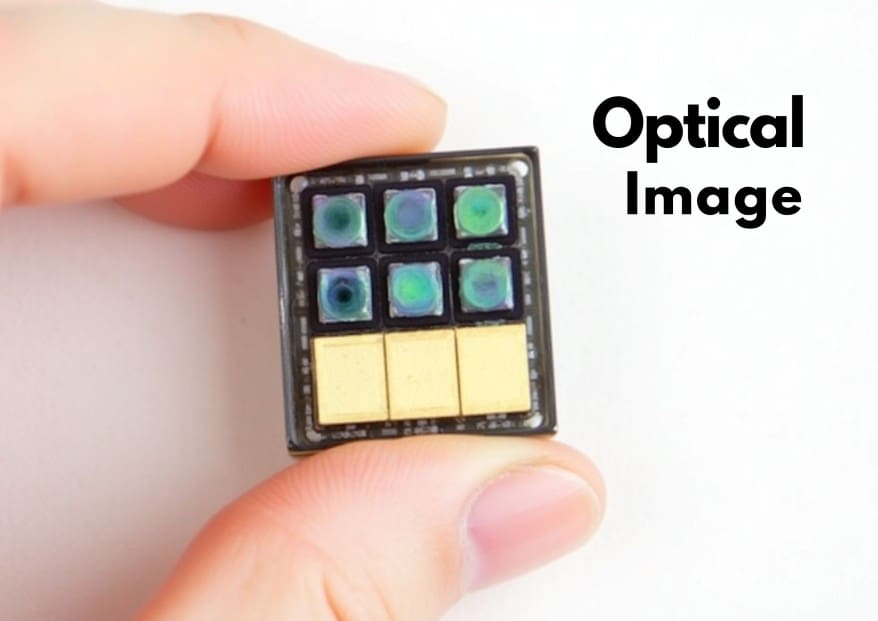
Optical imaging technology has made significant strides, but it still faces challenges in resolution and synchronization. Researchers have introduced a new approach called the Multiscale Aperture Synthesis Imager (MASI). Which pushes the limits of optical imaging by combining data from multiple small sensors. Multiscale Aperture Synthesis Imager’s design overcomes traditional hurdles by using computational methods instead of complex physical setups.
What Makes Multiscale Aperture Synthesis Imager Different?
Traditional synthetic aperture imaging combines signals from separated sensors to improve resolution. While this technique is effective for radar and radio astronomy, it struggles in optics because light’s shorter wavelength demands extremely precise synchronization between sensors. Usually, optical systems rely on interferometric methods, which need delicate alignment and can only work well in controlled labs.
Multiscale Aperture Synthesis Imager changes this by recording data at the diffraction plane using an array of coded sensors without any reference waves. Instead of aligning these sensors physically, MASI uses software to align and combine the images digitally at the object plane. This method bypasses the difficulty of synchronizing sensors physically and enables sharper images without complicated hardware.
How Computational Phase Synchronization Works
At the heart of the Multiscale Aperture Synthesis Imager is a process called computational phase synchronization. Each sensor captures wave patterns independently. MASI then iteratively adjusts their phases to maximize image clarity based on energy concentration in the final picture. This approach mimics techniques used in adaptive optics, where light paths are optimized to produce better focus.
This digital tuning lets distributed sensors function like one large aperture. Dramatically improving resolution with no overlapping measurement regions needed between individual sensors. It means that many small independent devices can work together, making the overall system scalable and simpler to build.
The Multiscale Approach for High Resolution
MASI borrows ideas from gigapixel imaging where big pictures come from many smaller pieces stitched together carefully. Instead of just expanding field-of-view as previous multiscale methods did, Multiscale Aperture Synthesis Imager applies this concept to increase resolution by synthesizing apertures across different scales.
The system pads wavefields captured by each sensor digitally and backpropagates them to reconstruct a single cohesive image in real space. This process also naturally expands the field of view beyond individual sensor dimensions by accounting for diffraction effects during propagation.
Building Practical MASI Systems
The practical multiscale aperture synthesis imager setup uses an array of nine coded sensors arranged closely but with gaps between them. These gaps would normally degrade image quality if traditional techniques were applied because overlapping fields are usually required for coherence.
This multiscale strategy simplifies building larger optical synthetic aperture systems capable of surpassing diffraction limits using mostly software innovations supported by clever hardware designs.
Pushing Beyond Conventional Limits
Multiscale Aperture Synthesis Imagersolves problems that troubled previous approaches like Fourier ptychography. Which cannot recover phases with significant variations, such as abrupt phase jumps or multiple 2π wraps, accurately.
The coded modulation technique within each sensor converts slow phase changes into measurable intensity variations. Even linear phase gradients become spatial shifts detectable computationally, making accurate wavefield recovery possible here where other methods fail.
The Future Impact of MASI Technology
This breakthrough expands possibilities for high-resolution optical imaging across many fields including biology, materials science, remote sensing, and beyond. By eliminating fragile physical interconnections between aperture elements and relying on powerful computation instead, large-scale practical implementations now appear feasible outside laboratories.
Younger students interested in optics engineering or computational imaging will find this technology a promising area with opportunities to innovate both hardware design and algorithm development simultaneously.
Additionally, to stay updated with the latest developments in STEM research, visit ENTECH Online. Basically, this is our digital magazine for science, technology, engineering, and mathematics. Further, at ENTECH Online, you’ll find a wealth of information.
Reference:
- Wang, R., Zhao, Q., Wang, T., Modarelli, M., Vouras, P., Ma, Z., Hong, Z., Hoshino, K., Brady, D., Zheng, G., Wang, R., Zhao, Q., Wang, T., Modarelli, M., Vouras, P., Ma, Z., Hong, Z., Hoshino, K., Brady, D., & Zheng, G. (2025). Multiscale aperture synthesis imager. Nature Communications, 16(1). https://doi.org/10.1038/s41467-025-65661-8
- Author
- Latest Posts

I’m a web developer and science writer with a Master’s degree in Computer Applications (MCA) from Pune University.
I work in tech, building websites and staying updated with the latest developments. I also love writing about physics, chemistry, technology, robotics, mathematics, and breakthrough innovations. My passion is breaking down complex scientific topics into simple, easy-to-understand stories.
My goal is to help everyone stay informed about the exciting changes happening in science and technology. I believe understanding science shouldn’t be complicated—it should be accessible to all.