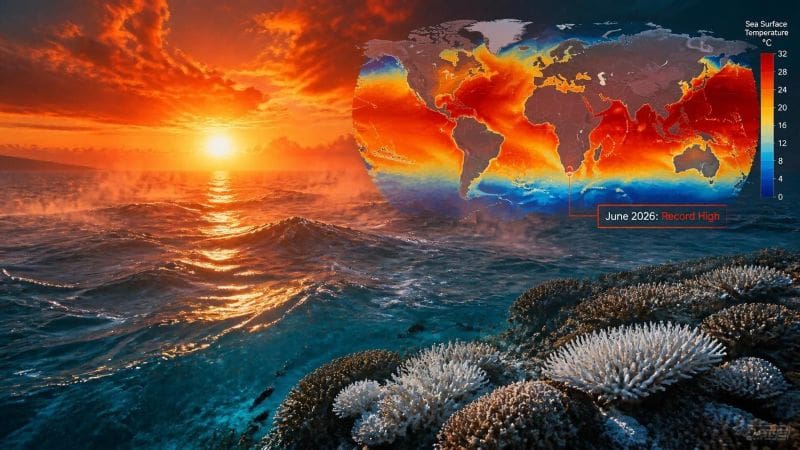
June 2026 marks a record high in ocean surface temperature, signaling alarming climate changes affecting marine life.
Ocean Surface Temperature and Climate Change Impact
Estimated reading time: 6 minutes
The ocean surface temperature just broke another alarming record. June 2026 sets a new all-time high for global sea surface heat for ocean surface. Scientists just say this is a clear sign of accelerating climate change in our environment. This heat is not just in the air. It is also found in the water too. Warm oceans fuel stronger storms that are caused due to evaporation. They can also harm marine life as well . This article explains why this occurence matters for the environment.Let’s look at the science behind this phenomena.
Highlight: Ocean surface temperature
- June 2026 record: Global sea surface temperature hit an all-time high, signaling accelerating climate change.
- Main drivers: Greenhouse gas emissions, weaker trade winds, reduced cloud cover, and El Niño.
- Stronger storms: Warmer oceans fuel more powerful hurricanes and heavier rainfall.
- Marine life at risk: Causes coral bleaching, fish displacement, and ecosystem collapse.
- Urgent action needed: Cutting emissions can slow warming, but some impacts are already locked in
Key Takeaways: Ocean surface temperature
- June 2026 marks a record high for ocean surface temperature, indicating accelerating climate change.
- Human activity, greenhouse gas emissions, and natural patterns like El Niño drive rapid increases in ocean temperatures.
- Warm ocean temperatures contribute to stronger storms, marine life displacement, and coral reef bleaching.
- Scientists monitor ocean heat using satellites, buoys, and various tools, confirming a clear upward trend.
- Future impacts include more extreme weather, accelerated sea level rise, and heightened risks for coastal communities.
Why Are Ocean Surface Temperatures Rising So Fast?
The present time shows a clear pattern of the ocean surface temperature rising this year. Human activity is the main driver for this cause. Carbon emissions like these trap the heat in the atmosphere that will increase the temperature. The ocean absorbs the majority of this extra heat thus increasing the ocean temperature. To enumerate this, the sea has taken up over 90% of global warming since the year 1970. This process is not slowing down. At this instant, the heat builds up faster than expected.
List of main causes for the ocean temperature surge in June :
- High greenhouse gas levels in the air due to global warming.
- Reduced cloud cover over some ocean regions all over the world.
- These winds are weaker than usual trade winds found in the environment.
- Natural climate patterns like El Niño are adding extra warmth to the ecosystem.
Another key point is the role of the ice melt on the land. Freshwater from melting glaciers changes the oceanic currents. These shifts can trap warm water near the surface for a longer duration as well. So far, scientists have linked this phenomena to the current spike in ocean surface temperature..
Ocean Surface Temperature Impact on Weather and Marine Life
What’s more is that warm ocean currents change the weather worldwide. Hurricanes need warm water to be formed. Each degree of warmth adds more energy to it as well. This makes the storms stronger and wetter as well. After all, a hotter ocean means more evaporation to occur. That leads to heavier rainfall.
List of direct impacts from high ocean surface temperature:
- Stronger tropical cyclones will occur.
- Faster melting of sea ice into water from extreme heat.
- Displacement of fish populations in the oceans.
- Increased frequency of marine heatwaves from oceans.
With this in mind, coral reefs are especially very vulnerable. Bleaching will occur when the water stays too warm for a long time. Corals will expel the algae that are living in their tissues. This in turn makes them white. If this heat persists, this will lead to coral death. At the same time, the fisheries will lose all the key habitats. Whole ecosystems will face collapse. This time, the risk is global in scale. The review by Oliver et al. (2018) also shows that these heatwaves are now covering larger ocean areas.
Tracking Ocean Surface Temperature: How Scientists Gather the Data
Scientists use satellites and buoys to measure the ocean surface temperature. Satellites can scan the entire ocean surface every day. Buoys provide the readings from the specific spots present in the water. Scientists combine this data to create global maps.. To illustrate this, the National Oceanic and Atmospheric Administration (NOAA) releases the monthly reports regarding the temperature change. The June 2026 report shows a clear anomaly about this change. The average temperature was 0.2 degrees Celsius above the previous record.
List of tools that were used to monitor the ocean heat:
- Scientists use satellite radiometers to detect the surface skin temperature.
- Drifting buoys for the near-surface readings as well.
- Argo floats are used to measure the deeper water warmth.
- Ship-based sensors are used for long-term records.
All in all, this network provides reliable data. After that, scientists will cross-check every measurement. They will confirm these numbers before releasing them. Scientists pay close attention to accuracy, so they consider the records solid evidence. After seeing all this, they consider the trend undeniable Oceans are getting hotter every decade. Long-term data from open-access studies supports this finding as well (Oliver et al., 2018).
Also Read: What is Oceanography?
What Does This Mean for the Future?
At the present moment, the experts are highly concerned. The ocean surface temperature will affect the global climatic conditions. Future decades may see even the higher records as well. This could trigger more extreme weather conditions. It could also raise the sea levels faster. Provided that the emissions continue, the warming will never stop.
List of predicted outcomes if the ocean heat persists:
- More categories of 4 and 5 hurricanes.
- Collapse of the major coral reef systems.
- Shifts in the global rainfall patterns.
- Increased the risk of coastal flooding.
In conclusion, action is very much required now. Cutting emissions can eventually slow down the warming as well. While this may be true, some changes are already locked in. So as to adapt, communities must prepare for the higher risks. To put it differently, the ocean is telling us something that we need to listen to it.
Conclusion: Ocean Surface Temperature
We must act now. Cutting emissions can slow down warming, but we have already locked in some changes Communities must prepare for higher risks. In other words, the ocean is telling us something, and we need to listen.
Frequently Asked Questions (FAQs): Ocean surface temperature
What is the current ocean surface temperature record?
The June 2026 record is the highest ever recorded. Exact numbers will vary from region to region. The global average was around 0.2°C above the prior records as well.
How does ocean surface temperature affect the hurricanes?
Warm water will fuel the hurricanes. Each degree will increase the wind speed and rainfall. This will make the storm more destructive.
Can we reverse ocean warming?
Not quickly, The ocean holds the heat for several decades. Cutting down the emissions can slow the rate of global warming. However some changes are already permanent.
Are marine animals affected by this heat?
Yes. Many fish moved towards the cooler waters. That will disrupt the food chains. Coral reefs will also die off entirely in some areas.
References:
- Intergovernmental Panel on Climate Change. (2021). Climate change 2021: The physical science basis. Contribution of Working Group I to the Sixth Assessment Report of the Intergovernmental Panel on Climate Change. Cambridge University Press. https://www.ipcc.ch/report/ar6/wg1/
- Oliver, E. C. J., Donat, M. G., Burrows, M. T., Moore, P. J., Smale, D. A., Alexander, L. V., Benthuysen, J. A., Feng, M., Sen Gupta, A., Hobday, A. J., Holbrook, N. J., Perkins-Kirkpatrick, S. E., Scannell, H. A., Stuecker, M. F., & Wernberg, T. (2018). Longer and more frequent marine heatwaves over the past century. Nature Communications, 9, Article 1324. https://doi.org/10.1038/s41467-018-03732-9
- National Oceanic and Atmospheric Administration. (2024). State of the climate: Monthly global climate report. https://www.ncei.noaa.gov/access/monitoring/monthly-report/global/
- Author
- Latest Posts

Ms. Adrita Roy is a dual master’s holder specializing in Biological Sciences and Sustainable Development. She completed her Master’s in Biological Sciences from Bangalore University in 2025, followed by a Master’s in Sustainable Development from the University of Sussex in 2026.
With over three years of professional experience across biosciences, sustainability, education, ESG consulting, and science communication, Ms. Roy has developed a multidisciplinary profile focused on research, sustainability, and impactful communication.
Her subject expertise includes Biological Sciences, Sustainable Development, ESG consulting and sustainability frameworks, science communication, environmental awareness communication, and sustainability-focused content development. She also possesses expertise in Biology and Chemistry academic content development for Classes 11 and 12, including MCQs, assignments, case studies, and educational learning resources.
Ms. Roy is experienced in scientific writing, journal drafting, research communication, policy drafting, stakeholder engagement, sustainability reporting, web content creation, marketing communication, case study preparation, and master sheet preparation. Her multidisciplinary background enables her to combine research-oriented knowledge with effective communication strategies in the fields of science, sustainability, and education.