University of Virginia engineers printed soft conductive films on a two-layer liquid bath, then turned them into RFID tags that tracked milk and banana spoilage over 10 days.
Flexible electronics can bend, stretch, and wrap around curved objects. Making their thin films, however, often causes defects. Now a team reports a fresh approach called liquid-surface printing. Instead of a solid base, the team prints ink onto a layered liquid bath. Baoxing Xu of the University of Virginia is the corresponding author. Mengtian Yin and Ziyu Chen share first authorship. In addition, Pei Dong and Boshen Xu of George Mason University took part. The paper appeared online in Science Advances on October 28, 2026. It also appears in the October 30 issue. In short, ink droplets spread across the liquid in a controlled way. They then cure into smooth, even films. As a result, the films can move onto curved surfaces like bottles and fruit. Its DOI, for reference, is 10.1126/sciadv.aei8289.
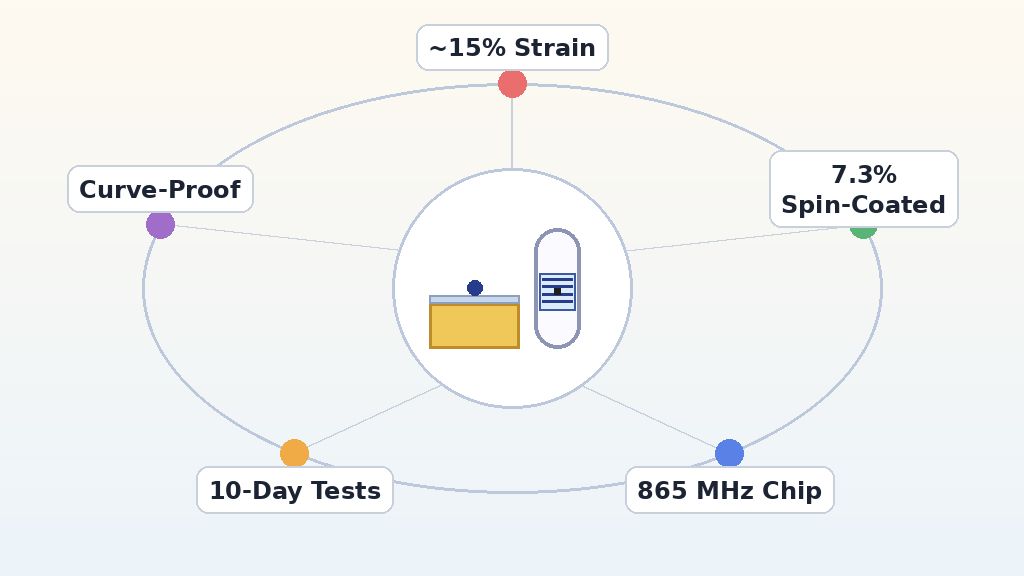
The team used the films to build radio-frequency identification tags, or RFID tags. These tags let a reader identify objects wirelessly. They work like barcodes that need no line of sight. Printed films stayed conductive up to about 15% strain. Spin-coated films, by contrast, failed at about 7.3% strain. The printed tags also worked on curved surfaces of many shapes. A commercial tag, meanwhile, stopped responding on a sharply curved surface. Next, the team attached tags to milk bottles and bananas. Over 10 days, the tag signals changed as the food spoiled. Water in an identical bottle, in contrast, showed no such change. Still, all tests took place in a lab at room temperature. The paper also reports no shelf trials in real stores. Below, we explain how the printing works and what limits remain.
Why Liquid-Surface Printing Matters
Soft thin films sit at the heart of flexible electronics. Skin patches, soft robots, and wearable sensors all depend on them. Engineers usually make these films by spin coating or printing on solid surfaces. Those methods, however, bring several problems. Rough surfaces, for instance, create uneven films with weak spots. Strong sticking also makes it hard to peel films off without damage. In addition, moving a film onto a curved object can crack it. A liquid base, on the other hand, offers a perfectly smooth surface. Films can also lift off liquid more easily and with less damage. Earlier liquid methods, though, let ink spread in hard-to-control ways. For this reason, the Virginia team sought controlled spreading on a liquid surface. Our story on laser-made graphene films covers another path to flexible conductive layers.
The Problem With Solid Surfaces
Spin coating spreads liquid onto a fast-spinning solid disk. The method gives films with a well-defined thickness. Its results, however, depend heavily on surface roughness and wettability. Small surface flaws can, in turn, become defects in the film. Thicker films also behave differently from thinner ones. In the team’s tests, thin spin-coated films cracked early when stretched. Thicker spin-coated films, by contrast, lasted longer. That difference means film thickness affects performance a great deal. Designers would prefer films that behave the same at any thickness. Transfer, on top of this, adds another hurdle. Films stuck firmly to a solid base can tear during removal. Some methods use extra layers or outside triggers to loosen them. In other words, solid surfaces add steps and risks. A liquid base could, therefore, cut out several of those problems.
How Double-Layer Liquid Printing Works
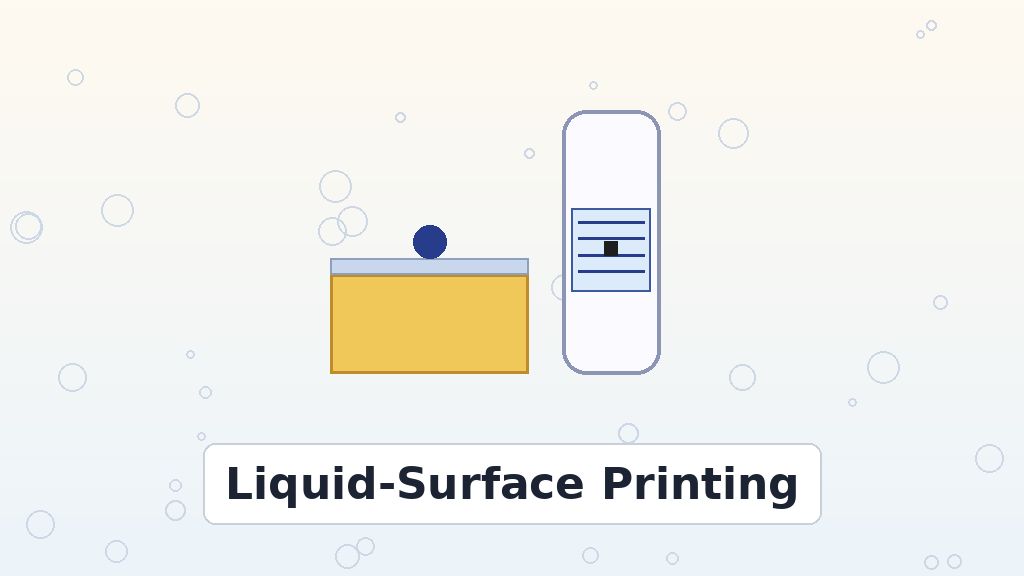
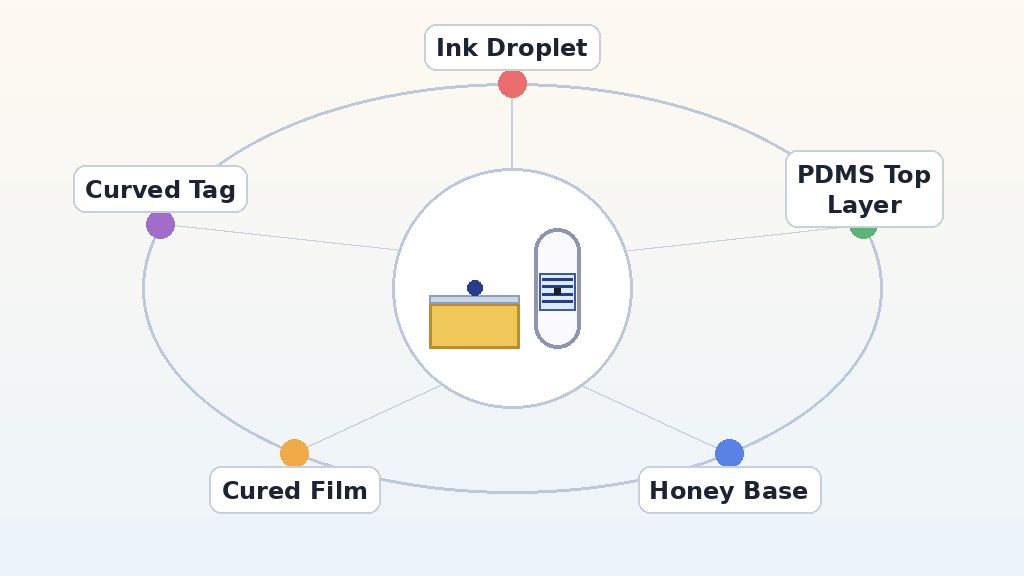
The team built a bath with two liquid layers. A thick bottom layer of honey forms the base. On top, a thin layer of uncured silicone, or PDMS, sits with 1% hexane. The ink contains a conductive polymer called PEDOT:PSS. It also includes 1.3% PEO and 10% ethanol to tune spreading. A 3D printer then places tiny ink droplets on the top layer. Each droplet spreads outward until forces at the liquid boundaries balance. In this way, physics rather than luck sets the shape. After that, the top layer limits how far the ink can travel. As a result, the final film size and thickness become predictable. The ink then cures at room temperature for at least 24 hours. Finally, weak van der Waals forces let the film lift off and transfer. Full details appear in the Science Advances paper.
Testing Soft Film Printing on Curves
The team tested the finished films in several careful ways. First, they stretched films while measuring electrical resistance. Printed films held nearly steady resistance up to about 15% strain. This behavior, in fact, stayed largely independent of film thickness. Spin-coated films, in contrast, showed a sharp rise in resistance at 7.3% strain. Next, the team printed RFID antenna layouts with this method. They transferred them onto flat and spherical surfaces. On spheres of different curvature, resistance barely changed. In addition, the team mounted films on a plastic bottle. Squeezing the bottle changed its curvature, yet resistance stayed steady. Theory and experiments agreed closely across all these tests. The team, after all, modeled spreading before printing. Overall, the films proved uniform and tough under bending. That set the stage for working wireless tags with real chips attached.
Fig. 1: Key Results of the Liquid Printing Study
Explainer: How Radio Tags Sense Spoilage
An RFID tag has an antenna and a small chip. A reader sends radio waves, and the tag sends a signal back. Engineers measure this exchange using a value called return loss, which tracks reflected signal power. The team fitted their tags with 865 megahertz chips. Printed tags matched a commercial tag closely on flat surfaces. On curved surfaces, however, the two tags behaved very differently. Printed tags kept a steady signal at every tested curvature. The commercial tag, on the other hand, failed at a curvature of 0.33 per centimeter. Food spoilage changes the material right under the tag. That change, in turn, shifts the tag’s signal. The paper, however, reports the signal trend without a detailed chemical explanation. Such a link would need further study, for example. Our report on robot-designed food packaging explores another way to keep food fresh.
Flexible RFID Tags on Milk and Bananas
The team first tested fat-free milk bought from a local supermarket. Five tags sat at different spots on the bottle, labeled L#1 to L#5. A commercial tag, meanwhile, sat just below L#1 for comparison. Over 10 days, the lowest return loss value dropped clearly at position L#1. At the same time, the milk turned from white to light yellow and separated. A water-filled bottle, by contrast, showed no signal change. All five printed tags gave nearly identical readings, regardless of position. Next, the team placed tags directly on banana skin. Again, five printed tags and one commercial tag tracked the fruit. The signal dropped clearly as the banana skin changed color over 10 days. Printed and commercial tags, in fact, gave very similar results. Together, the tests show printed tags can follow spoilage on curved food.
Fig. 2: How Ink Spreads on a Two-Layer Liquid
Challenges for Liquid-Surface Printing
Several hurdles remain before these tags reach store shelves. First, the food tests ran only at room temperature. Refrigerated storage, for example, was not tested. Second, the team tested only one milk type and one fruit type. Other foods, such as meat or juice, might affect signals differently. Third, the paper does not link signal changes to specific safety thresholds. In other words, it shows a trend, not a clear spoiled-or-safe alarm. On top of that, films need at least 24 hours to cure. The paper calls the method low cost but gives no price per tag. In addition, the authors note limits on very fine patterns. Extending the method down to the nanoscale, they write, may be challenging. Our metal oxide gas sensors story shows another sensing route.
What Could Come Next
To begin with, the authors say the method could extend beyond PEDOT:PSS. Other materials could work if they meet the same spreading conditions. Also, finer features could come from thicker inks and faster curing. A thinner top layer would help as well, according to the authors. The team suggests uses in food safety and packaging. Skin electronics and soft robots could also benefit, according to the paper. Funding came from the US National Science Foundation and other sources. These included the Department of the Interior, the NIH, and the 4-VA program. Meanwhile, large-scale printing would need testing in factory settings. Cold-chain trials would also need to confirm performance in fridges. For now, the work remains a promising lab demonstration. Still, it shows how a simple liquid bath can improve printed electronics. Many labs, after all, already own the needed tools.
Conclusion: Soft Films, Smarter Food Tags
This study shows a clever new route called liquid-surface printing for soft films. A honey and silicone bath controls how ink droplets spread. The resulting films stay conductive up to about 15% strain. Spin-coated films, by contrast, failed at about 7.3%. Printed RFID tags also kept working on curved surfaces where a commercial tag failed. On milk and bananas, the tag signals tracked spoilage over 10 days. At the same time, tests stayed in the lab at room temperature. Real-world storage, costs, and safety limits remain open questions. Such work joins fluid mechanics, materials science, and radio engineering. The US FDA’s page on food loss and waste explains why better freshness tools matter. Next, researchers must test cold storage, more foods, and larger production runs. Until then, the tags remain an encouraging step for smart packaging.
References
Yin, M., Chen, Z., Xu, B., Zhang, Y., Dong, P., & Xu, B. (2026). Double-layer liquid-surface printing of soft films for flexible electronics. Science Advances, 12(44), eaei8289. https://doi.org/10.1126/sciadv.aei8289
The liquid-bath printing explanation is vivid and stays with the food-packaging hook. Strengthen the challenges section by naming what scale-up would still need to prove, in plain words. Also consider a gentler reminder that spoilage signals are research observations, not safety rules. Readers are encouraged to refer to the original source paper from which this story is sourced.
Editorial note
This RFID printing piece is in the lineup because flexible electronics and food waste sit at a useful career crossroads. Editorial framing favors clarity over hype. Independently verify the claims using the Science Advances article and the linked context sources.
Swarali Barpande is an Electronics and Telecommunication Engineer and technology enthusiast based in Pune, India. She is passionate about making complex physics and engineering concepts accessible, with a core focus on applied electromagnetics, signal transmission, and fundamental circuit theory.
As an author for ENTECH Magazine, Swarali specializes in breaking down foundational topics such as electromagnetism, electromagnetic induction, and modern telecommunication principles for students and young STEM researchers. Through her writing, she aims to bridge academic engineering fundamentals with real-world technological applications.