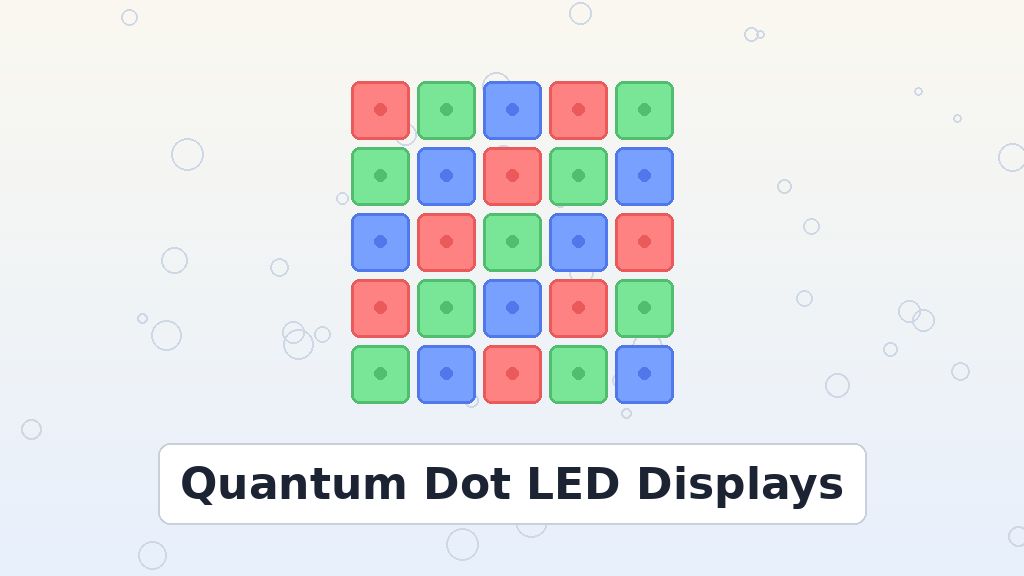
Your phone screen glows for hours every day. Each tiny dot of color comes from a light source that slowly wears out. Because of this, engineers keep hunting for brighter, longer-lasting pixels. Quantum dot LED displays offer one promising answer. Each pixel uses tiny crystals called quantum dots. Now, a Sun Yat-sen University team reports a major step forward. Baiquan Liu and Chuan Liu led the work. Along with South China University of Technology, they built red, green, and blue devices. Their study appears in the journal Nature Communications under DOI 10.1038/s41467-026-79228-8. In addition, the team showed working 64 × 64 pixel screens. Notably, these screens ran on the same kind of thin-film transistors that drive many TVs. As a result, the work moves this technology closer to real products.
This result matters for a simple reason. Most screens today use either liquid crystals or organic LEDs. In practice, each option has trade-offs in color, cost, and lifetime. Quantum dots, by contrast, give very pure colors. However, devices that use them often fade fast, especially in blue. The new design adds a salty liquid, called an ionic liquid, into the glowing layer. On top of that, it flips the usual order of layers. Thanks to both changes, all three colors reached high efficiency at once. For example, red devices turned 24.2% of injected charges into light. At the same time, green and blue devices set records for this device type. Still, the authors used cadmium-based dots, and blue lifetime remains short. In this article, we explain how the devices work and what comes next.
Why Quantum Dot LED Displays Still Face Hurdles
A display pixel must do two jobs well. First of all, it must turn electricity into light with little waste. Second, it must keep doing so for years. Quantum dots, which earned the 2023 Nobel Prize in Chemistry, handle color beautifully. Put simply, their size sets their color, so makers can tune hues precisely. Even so, getting charges into the dots evenly proves hard. Electrons often arrive faster than holes, their positive partners. In turn, extra electrons pile up and waste energy as heat. That imbalance also speeds up damage inside the device. Moreover, many lab devices use a normal stack that fits poorly with common TV backplanes. Our guide to how semiconductors control current explains why charge balance matters. For this reason, balance became the main target.
Blue Light Wears Out Fastest
Blue pixels pose the toughest problem for quantum dot LED displays. In fact, blue light carries more energy per photon than red or green light. Consequently, blue devices need a larger push of voltage. Because of this, the extra stress breaks down materials sooner. In practice, blue pixels often limit the life of an entire screen. A display with weak blue soon shows shifted colors, such as a yellow tint. Engineers therefore treat blue lifetime as a key benchmark. Before this work, quantum-dot electrolyte LEDs existed only in red. Those earlier red devices reached 20.5% efficiency and 6,642 hours of T95 life. T95 means the time until brightness drops to 95% of its starting value. Up to now, no group had reported green or blue versions at all. So the Sun Yat-sen team set out to build a full color set.
Ions That Help Charges Move
The team’s earlier idea relied on ions. An ionic liquid contains positive and negative ions that can drift under voltage. When a device switches on, these ions slide toward the electrodes. As a result, they build thin charged layers at each contact. Thus those layers act like ramps that help charges enter the dots. Holes, in particular, gain an easier path, which improves balance. The researchers chose an ionic liquid called TBA-TFSI for this job. Mixing it into the dot layer creates what they call an electrolyte LED. Meanwhile, the device can run at lower voltage for the same brightness. In turn, lower voltage means less heat and slower wear over time. Yet ions alone could not solve every issue. Even so, electrons still leaked through too easily in the inverted stack.
What the Sun Yat-sen Team Built
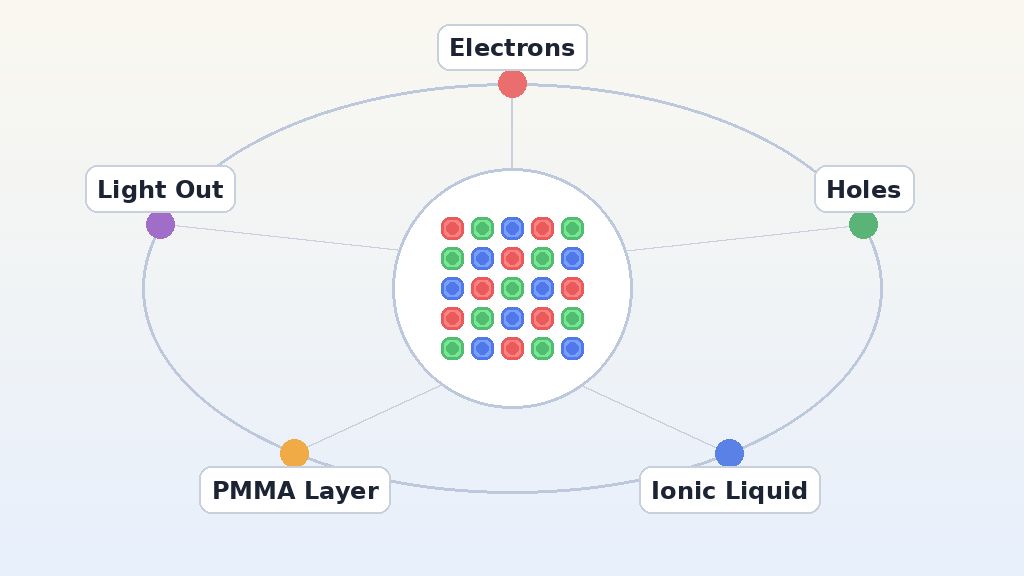
The researchers describe their full design in the Nature Communications paper. Yunfei Ren is the first author, with Baiquan Liu and Chuan Liu leading the team. Their device stacks layers from the bottom up in an inverted order. In this way, electrons enter from the bottom electrode. Then they pass through a zinc magnesium oxide layer before reaching the dots. Holes, by contrast, enter from the top. A thin plastic film of PMMA sits between the oxide and the dots. As a result, this film slows electrons just enough to match the slower holes. At the same time, the ionic liquid in the dot layer speeds holes along. Together, these two tricks bring the charges into balance. The result is a device that wastes far less energy than before.
An Upside-Down Layer Stack for QE-LEDs
Flipping the stack serves a practical goal. Many large displays use transistors made of amorphous silicon or metal oxides. These n-channel transistors work best with an inverted LED on top. For example, an inverted device links naturally to that kind of circuit. Hence, makers could reuse existing factory lines rather than design new ones. That point matters a great deal for scaling up. The team tested this idea directly. To begin with, they partnered with Hangzhou LinkZill for thin-film transistor backplanes. Each pixel used two transistors to control its current. On these boards, the researchers built 64 × 64 red, green, and blue screens. All three screens displayed clear images during testing. In other words, the devices did not just work alone on a lab bench. As well, they worked inside a real display circuit.
Record Numbers for Quantum Dot LEDs
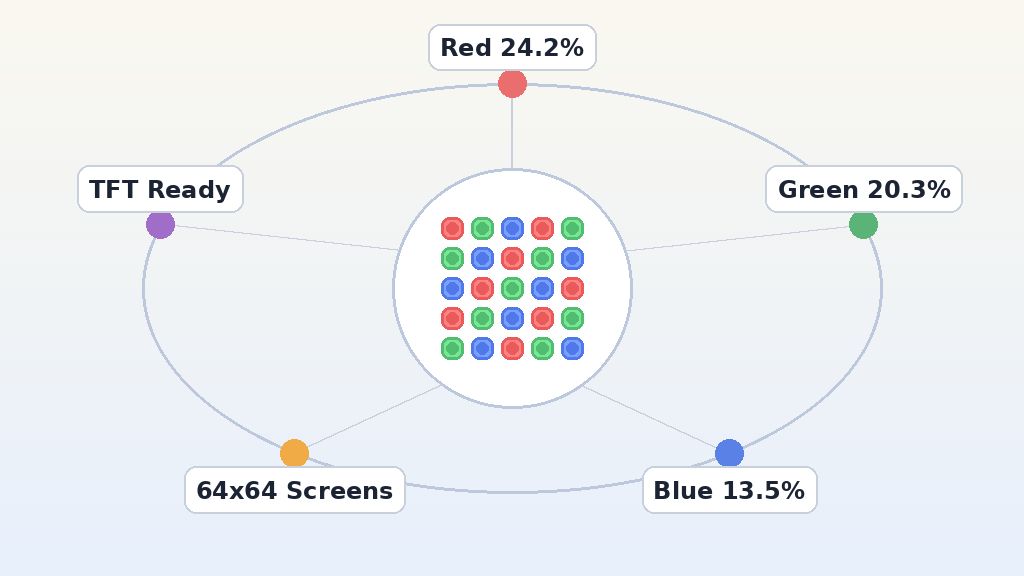
The efficiency numbers stand out. Red devices reached an external quantum efficiency of 24.2%. Green devices hit 20.3%, and blue devices reached 13.5%. The authors call the blue value a record. It beats other solution-processed blue LEDs without outcoupling tricks. In addition, lifetimes impressed. At 1,000 candelas per square meter, red devices kept 95% brightness for 13,100 hours. Green devices lasted 14,400 hours by the same measure. Blue devices, however, lasted only 244.5 hours. Across 20 red devices, efficiency averaged 22.3%, which shows good repeatability. The green device also topped 100 lumens per watt in power efficiency. For context, the earlier best red electrolyte LED managed 20.5% and 6,642 hours. So the new red device roughly doubled that lifetime. Its efficiency also climbed by nearly four points.
Fig. 1: Key Results From the RGB QE-LED Study
How Quantum Dot LED Displays Make Color
An LED works like a tiny meeting point. Electrons come from one side, and holes come from the other. When an electron meets a hole, it drops to a lower energy state. Then that drop releases energy as a flash of light. In these devices, the meeting happens inside crystals only a few nanometers wide. Our earlier feature on the Nobel-winning nanocrystal discovery explains their history. Inside each crystal, the electron’s energy depends on the crystal size. Smaller dots emit bluer light, while larger dots glow redder. Scientists call this effect quantum confinement. Consequently, makers can tune color simply by growing dots to the right size. Every glowing pixel thus combines the right crystal size with good charge delivery. Both parts must also work well for a bright, stable screen.
Tiny Crystals, Pure Colors
Pure color matters for realistic pictures. Each quantum dot also emits a narrow band of wavelengths. As a result, reds look truly red and greens look truly green. Screens with pure primaries can mix a wider range of shades. Efficiency, on the other hand, depends on how many charges make light. External quantum efficiency counts photons that leave the device per electron sent in. A value of 24.2% means about one photon escapes for every four electrons. The layers trap some light inside, so no real device reaches 100%. Lifetime describes how long a pixel holds its brightness. In this case, the ionic liquid helps both measures by balancing charges. Fewer stray charges mean less heat and less chemical damage. In short, balance drives both efficiency and lifetime in these devices.
Fig. 2: How Ions Balance Charges in a Pixel
From Lab Test Panels to Real Screens
Display tests offer the clearest sign of progress for quantum dot LED displays. To start, the team ran the 64 × 64 screens for long periods. Its red screen worked for 480 hours, and the green one for 576 hours. In contrast, the blue screen ran for 132 hours. From these data, the authors projected lifetimes at normal indoor brightness. At 100 candelas per square meter, they estimate a T95 of 46.8 years for red. Green reaches an estimated 90.9 years, while blue reaches only 1.7 years. At the same time, these figures come from extrapolation, not direct tests. Even so, they suggest red and green already meet long-life needs. This study builds on the group’s earlier red-only device. That 2025 work proved the ionic-liquid idea in a single color first. The new paper extends it to all three primaries.
Open Questions for Quantum Dot Displays
Several hurdles remain before quantum dot LED displays reach stores. First, the dots contain cadmium, a toxic metal that many regions restrict. In the long run, cadmium-free dots would ease safety and regulatory concerns. Second, blue lifetime still trails red and green by a wide margin. After all, a screen ages only as slowly as its weakest color allows. Third, the test screens hold just 4,096 pixels, far fewer than a phone. Scaling up will test whether every pixel behaves the same way. The authors also declare a competing interest worth noting. Three of them applied for a patent on these devices in 2026. Such patents appear often in applied research, yet readers should know about them. Finally, independent groups will need to repeat the results before anyone can call them settled.
Conclusion: A Brighter Path for Quantum Dot LED Displays
This study shows that ions and smart layer order can work together. By blending an ionic liquid into the dots, the team balanced charges. On top of that, a thin PMMA film slowed runaway electrons. Thanks to both steps, red, green, and blue devices all performed well. Moreover, the inverted design fits transistors already found in many displays. Working 64 × 64 screens prove the idea beyond single test pixels. Still, blue lifetime and cadmium content need more work. For now, quantum dot LED displays built this way remain a lab success. Later, they could bring purer color and longer life to TVs. Our story on materials science shaping modern tech traces such advances. Many grow from basic chemistry. Bright screens, after all, start with tiny crystals.
I checked the brief against the Article in Press PDF. The device design matches the paper: an inverted stack with TBA-TFSI ionic liquid doped into the quantum dots and a PMMA blocking layer between the emitting layer and the ZnMgO electron transport layer. The figures are correct: peak EQEs of 24.2%, 20.3% and 13.5% and T95 lifetimes of 13,100 h, 14,400 h and 244.5 h at 1000 cd/m2 for red, green and blue; 22.3% ± 1.1% across 20 red devices; 64 x 64 displays with two TFTs per pixel running 480 h, 576 h and 132 h; and extrapolated display T95 of 46.8, 90.9 and 1.7 years at 100 cd/m2. The brief correctly flags the extrapolation, the weaker blue, the Cd-based quantum dots (listed in Methods) and the unedited status. Verdict: accurate; no corrections needed.
Editorial note
ENTECH runs this story because screens are one of the biggest electronics industries in the world, and this paper moves a new quantum-dot LED design from single devices to working active-matrix displays. A Sun Yat-sen University team built red, green and blue quantum-dot-electrolyte LEDs with high efficiency and long lifetimes, then put them on thin-film-transistor backplanes to make 64 x 64 displays that ran for hundreds of hours. For teens, it links chemistry, materials science and electrical engineering to jobs in display fabs and materials companies. Caveats: blue pixels still fade much faster than red and green, the quantum dots contain cadmium, the displays are small single-color prototypes, and the multi-year lifetimes are extrapolated from accelerated tests. Takeaway: printable quantum-dot screens are getting closer, but blue is the bottleneck.
Swarali Barpande is an Electronics and Telecommunication Engineer and technology enthusiast based in Pune, India. She is passionate about making complex physics and engineering concepts accessible, with a core focus on applied electromagnetics, signal transmission, and fundamental circuit theory.
As an author for ENTECH Magazine, Swarali specializes in breaking down foundational topics such as electromagnetism, electromagnetic induction, and modern telecommunication principles for students and young STEM researchers. Through her writing, she aims to bridge academic engineering fundamentals with real-world technological applications.