Researchers have developed an optical chip almost 100 times thinner than a human hair. This tiny optical chip controls lasers with extreme precision, marking...
Quantum Computing Discovery: A Optical Chip Smaller Than a Human Hair
Estimated reading time: 4 minutes
Ultra-Thin Optical Chip Advances Quantum Computing
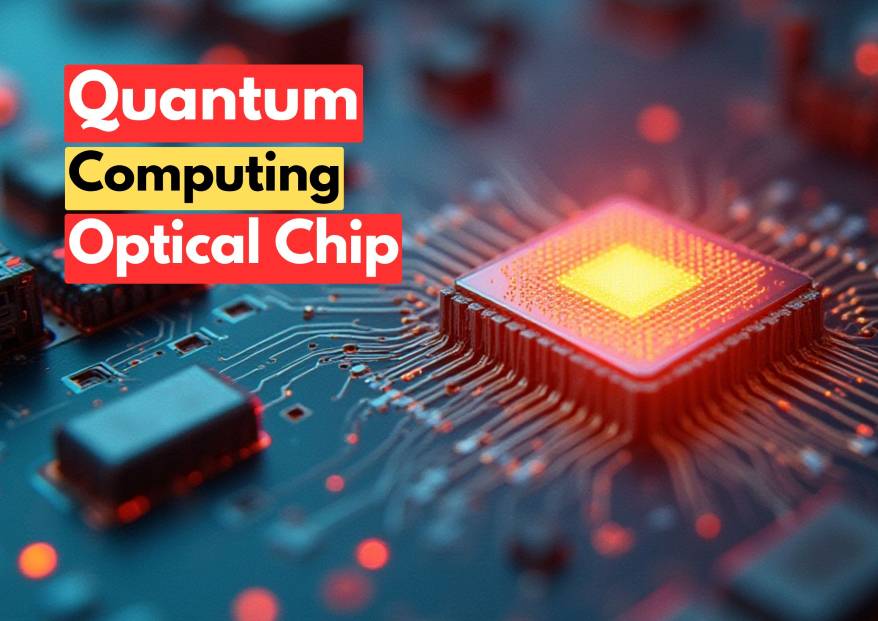
Researchers have developed an optical chip almost 100 times thinner than a human hair. This tiny optical chip controls lasers with extreme precision, marking a major step forward in quantum computing. Since quantum systems rely on controlling many qubits—units of quantum information—high accuracy in laser frequencies is essential for building powerful quantum computers.
To achieve this, the optical chip uses microwave-frequency vibrations that oscillate billions of times per second. These rapid vibrations precisely adjust the phase of laser beams, generating stable new laser frequencies. As a result, this level of control is critical for quantum sensing, quantum networking, and building robust quantum machines.
The Importance of Precise Laser Frequencies
Quantum computers based on trapped ions or atoms depend on lasers to communicate with qubits. Each laser beam must be tuned within billionths of a percent accuracy. This precision allows scientists to deliver exact instructions to atoms for complex calculations. Consequently, engineers designed this new optical chip to support thousands of precisely controlled lasers required by current large-scale quantum systems.
Notably, the device can generate new laser frequencies using about 80 times less microwave power. The optical chip emits less heat due to its lower power consumption and enables many channels to be placed close together on a single chip. This efficiency makes it practical for future large-scale quantum systems.
Also Read: Why Is VPS Hosting Crucial for the Future?
Scalable Manufacturing Using CMOS Technology
The manner in which this optical device is manufactured is yet another significant advantage. The production process for the chip is scalable, just like the manufacturing processes used for other common electronic devices, such as computers and cellphones. Manufacturing companies are able to generate millions of identical optical chips in a short amount of time and at a low cost because to CMOS fabrication.
In contrast, typical optical devices are cumbersome, must be constructed by hand, and are expensive. Therefore, production based on CMOS marks a substantial change toward efficiency and scalability in the field of advanced photonic technology.
A New Era for Optical Components
The introduction of this optical chip marks a transition away from cumbersome optical equipment and toward integrated photonic technologies that are more compact. Researchers draw parallels between this shift and the time when vacuum tubes were replaced by transistors in the early stages of electronic technology. In a similar vein, the fabrication of these optical chips in mass quantities is becoming less difficult, which is paving the way for the implementation of quantum computing and other cutting-edge technologies.
In addition, the research team is working on building photonic circuits that can merge frequency production, filtering, and pulse shaping onto a single optical device. These completely integrated devices bring scalable quantum computing closer to becoming a reality by allowing for the integration of a greater number of functionalities into a smaller space.
Collaboration With Quantum Technology Leaders
Looking ahead, the researchers plan to collaborate with companies working on trapped-ion and neutral-atom quantum computers. Testing the optical chip in real systems will help evaluate its performance under actual operating conditions. Ultimately, this collaboration aims to solve one of the final challenges in making scalable quantum computers practical.
Why This Optical Chip Matters
- Tiny optical chips: Enable precise laser control for powerful quantum computers
- Lower power use: Keeps devices cooler and more compact for large-scale systems
- Mass production: Uses proven electronics manufacturing for affordability
- A bright future: Supports real-world advances in computing, sensing, and networking
Additionally, to stay updated with the latest developments in STEM research, visit ENTECH Online. Basically, this is our digital magazine for science, technology, engineering, and mathematics. Further, at ENTECH Online, you’ll find a wealth of information.
Reference:
Freedman, J. M., Storey, M. J., Dominguez, D., Leenheer, A., Magri, S., Otterstrom, N. T., & Eichenfield, M. (2025). Gigahertz-frequency acousto-optic phase modulation of visible light in a CMOS-fabricated photonic circuit. Nature Communications, 16(1), 10959. https://doi.org/10.1038/s41467-025-65937-z
- Author
- Latest Posts

I’m a web developer and science writer with a Master’s degree in Computer Applications (MCA) from Pune University.
I work in tech, building websites and staying updated with the latest developments. I also love writing about physics, chemistry, technology, robotics, mathematics, and breakthrough innovations. My passion is breaking down complex scientific topics into simple, easy-to-understand stories.
My goal is to help everyone stay informed about the exciting changes happening in science and technology. I believe understanding science shouldn’t be complicated—it should be accessible to all.