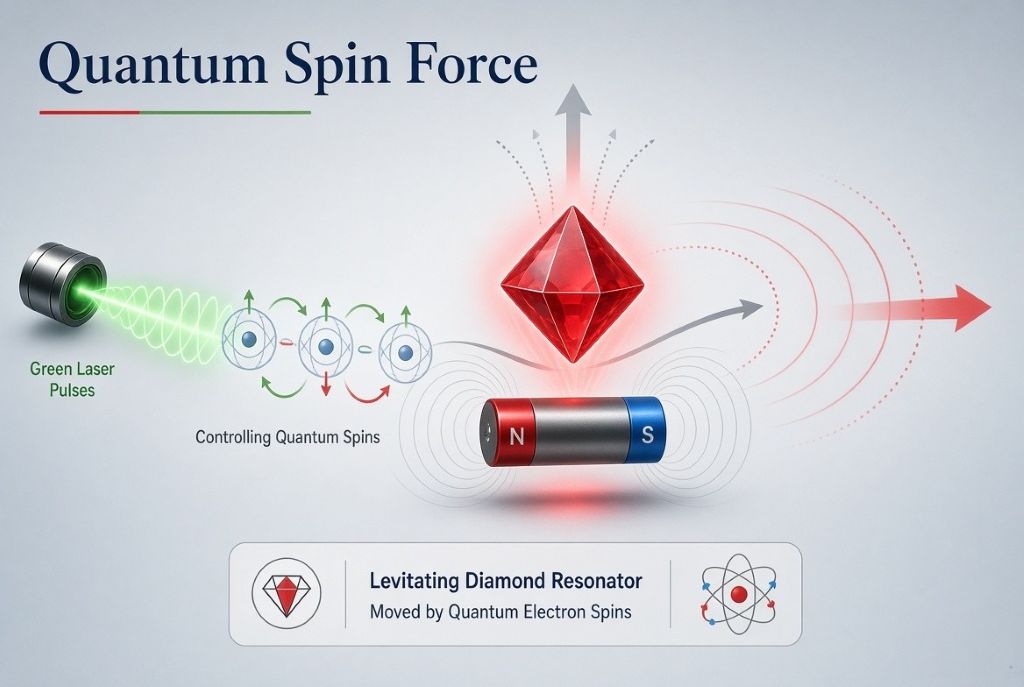
A small bead-sized diamond can float above a magnet. Scientists in Okinawa just made that floating diamond move up and down using only the quantum spins of electrons trapped inside it. What is so special about this quantum spin force-levitated diamond? No wires, no mechanical push—just the spin of electrons. This is the first time a quantum effect has visibly moved an object heavy enough that gravity matters. The same idea could lead to extremely sensitive detectors for tiny magnetic fields, useful in medical imaging or searching for dark matter.
How the quantum spin force levitated diamond worked?
Researchers at the Okinawa Institute of Science and Technology used a diamond containing billions of nitrogen-vacancy (NV) centers. These defects act like tiny magnets whose spin researchers can control with green laser pulses. The diamond sat on a levitating graphite plate connected by a carbon-fiber rod, with a total mass of about 100 mg. When the laser flipped the electron spins, the resulting magnetic force shifted the whole assembly.
An interferometer measured the movement. The displacement matched the expected spin force and disappeared when the laser was off. The object is eight to nine orders of magnitude more massive than previous spin-mechanical experiments. The paper appeared in Science Advances on 7 October 2026.
Career paths and skills
Students interested in this work can combine physics with engineering. Relevant university tracks include quantum information science, experimental condensed-matter physics, or precision measurement. Undergraduate research teaches lab skills such as laser alignment, vacuum systems, and data acquisition.
Companies and labs working on quantum sensors hire people who can design, build, and characterize these systems. Early projects might involve characterizing NV centers in diamond or building simple magnetic levitation setups. Programming for instrument control and basic statistics are practical starting points.
Original references
Nayak, A., Kim, D., Tian, S., & Twamley, J. (2026). Spin force from a nitrogen-vacancy ensemble drives a 100-mg levitated resonator. Science Advances, 12, eah0566. https://doi.org/10.1126/sciadv.aeh0566
Okinawa Institute of Science and Technology. (2026, October 8). First observation of quantum spins shifting a centimeter-scale object in the lab. https://www.oist.jp/news-center/news/2026/10/8/first-observation-quantum-spins-shifting-centimeter-scale-object-lab

Author
Mahi Shitut is a Science Communicator at ENTECH STEM Magazine, with a BSc in Physics from Fergusson College, Pune, and an ongoing MSc in Mathematics at the Indian Institute of Science Education and Research (IISER), Kolkata. Her areas of interest include theoretical physics, pure mathematics, astronomy, space science, set theory, asymptotic series, and science education. She completed the National Initiative in Undergraduate Science (NIUS) Physics Programme at the Homi Bhabha Centre for Science Education, TIFR, Mumbai, where she carried out a 1.5-year research project at the UM-DAE Centre for Excellence in Basic Sciences. She was also a top scorer in the Madhava Mathematics Competition and was selected for the Madhava Nurture Camp at IIT Bombay, and she attended the IWM Winter School for Young Women in Mathematics.
Mahi specializes in explaining advanced physics and mathematics in simple, clear, and easy-to-understand language for teenagers and school students. Drawing on everyday examples and practical analogies, she helps readers make sense of ideas like infinity, space missions, telescopes, and how the universe works, without losing scientific accuracy. Her skill comes from hands-on experience. She has explained models of Chandrayaan-3 to more than 3,000 visitors at IUCAA’s National Science Day open day, volunteered at SPPU’s National Space Day celebrations, presented at Fergusson College’s Astro Club Poster Exhibitions, and delivered undergraduate lectures on countability and uncountability, the infinite hotel paradox, and asymptotic series through the Synectics Math Club. With earlier experience in editorial work and content strategy, including editing a newsletter and writing for digital audiences, she aims through ENTECH STEM Magazine to bridge the gap between advanced science and public understanding, making physics and mathematics engaging, accessible, and relevant for young minds.