Illusion of Free Technology and the True Cost of AI Tools
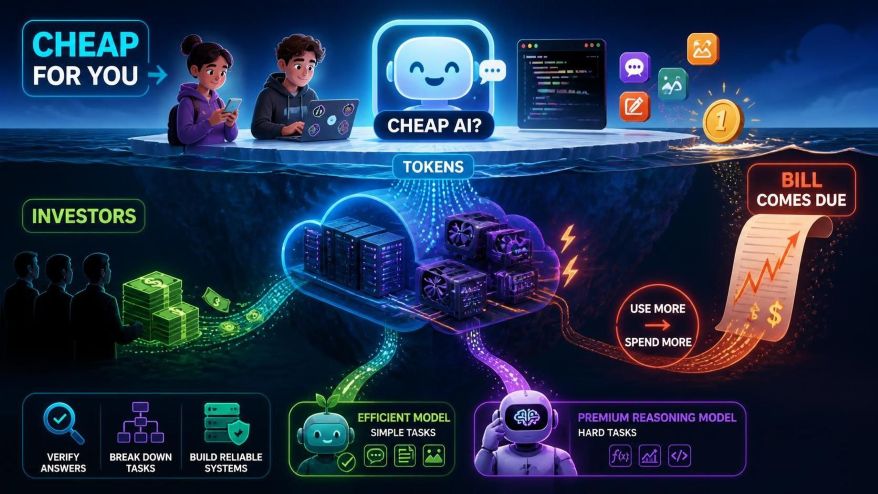
You are using some of the most expensive technology ever built, and it is costing you almost nothing. ChatGPT is free for most people, or a few dollars a month. Coding helpers finish your work for about the price of two movie tickets. You can build a small app or a bot that talks and reasons and spend basically zero. If you like to tinker and make things, this is the best deal you will ever get.
Those prices are not real, though. Someone else is paying most of the bill, and they are not going to do it forever.
I work with these tools every day inside a large company, where our AI usage blows past its budget every few months and leadership keeps telling everyone to use more. I wanted to understand how that was even possible, and the question I kept landing on is a simple one that matters for anyone who is going to build with AI: who actually pays when AI is this cheap?
How the Meter Runs: Tokens and Pricing of AI tools
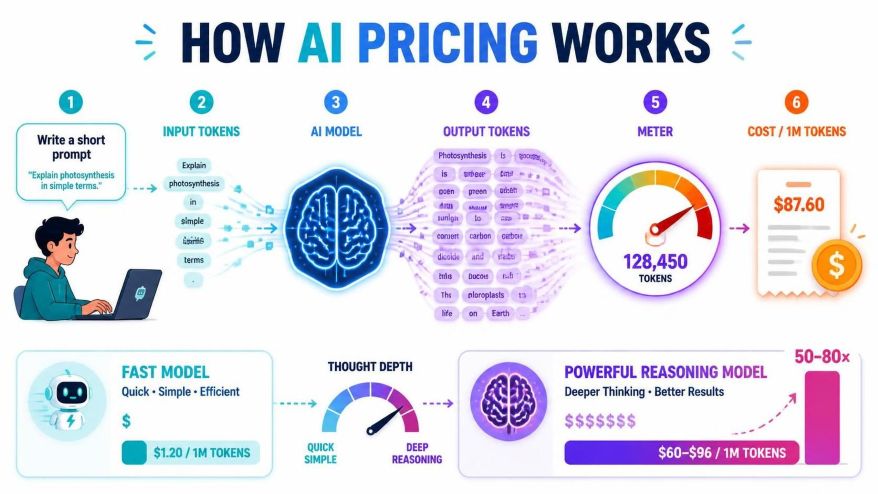
Fig. 1: AI tool – pricing model
Start with what happens when you enter, because you never see a bill but a meter is running somewhere. Everything a model reads or writes is counted in tokens, roughly three-quarters of a word. Your prompt is input tokens, the model’s answer is output tokens. The output costs more, simply because writing takes the machine more work than reading. The companies that build with AI pay by the million tokens, and the prices are all over the place. A small, fast model might cost a few cents per million tokens. A top model that reasons carefully can cost fifty to eighty times more.
Same company, same menu, wildly different prices, depending on how much thinking you ask for.
Even at your scale that is worth knowing, because the smartest model is not always the right one. Answering a quick question and solving a hard problem are different jobs, and they shouldn’t cost the same.
Why AI Is Currently So Cheap (and Why It Won’t Last)?
So why is it all so cheap? Two reasons. The first is real progress: chips got faster, models got more efficient, and free open-source models keep forcing the big companies to cut their prices. By one popular estimate, the cost of a given level of AI has fallen about a thousand times in under four years. That part is real, and it is not going away.
The second reason is the one to watch. The companies handing you cheap AI are mostly losing money doing it. OpenAI has said it loses money even on its most expensive subscribers, because they lean on the tools so hard. These companies are burning billions, funded by investors betting that if everyone gets hooked now, they can charge properly later. So cheap AI is two things at once: a real efficiency story, and a discount someone is paying to win the market. And discounts end.
The “Tokenpocalypse” and Rising Corporate Bills
You can already watch it starting. In one week in June 2026, three of the most popular coding tools, GitHub Copilot, Cursor, and Devin, all switched from flat “unlimited” plans to charging by how much you use. People started calling it the “tokenpocalypse“. For those tools, unlimited was over.
And it is not only small companies feeling it. Uber’s head of technology said the company burned through its entire 2026 budget for AI coding tools in four months. The engineers loved the tools, the tools quietly used far more than anyone had planned for, and someone had to decide what to cut. That is the pattern in miniature: people use much more than expected, the bill arrives, and the free part quietly shrinks.
The Paradox: Falling Prices and Soaring Totals
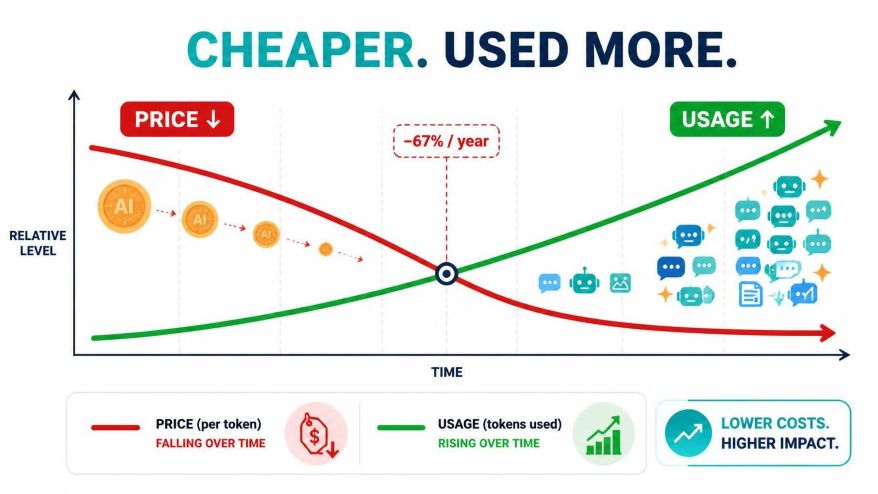
Fig. 3: Paradox of Cheap AI (AI Generated)
The part that confuses people is that the price per token keeps falling and the total bills keep rising, at the same time. Prices dropped about 67% in a single year, and most companies still went over budget. It happens because when something gets cheaper, people use far more of it. The cost of one question falls while the total you spend climbs, because you build bigger and lean on the model more, chaining it into “agents” that run for minutes instead of seconds.
That pulls AI into two separate worlds. One is cheap, ordinary, and everywhere: simple jobs like sorting, summarizing, and looking things up, and that world races toward free. The other is expensive and rare: deep reasoning, long tasks, the high-stakes work where being right matters more than being cheap, and that world stays pricey. The two do not meet in the middle. They keep drifting apart.
Real Cost of AI tools: What This Means for Your Habits and Future Skills
Here is where it touches you, even though you are probably spending little or nothing. That is exactly why it is easy to assume AI is simply free, and why knowing otherwise early is worth something. Free AI is a moment, not a law of nature, and it is being paid for by investors, so the tools you are learning on today could cost real money in a couple of years. It is worth building your habits with that in mind.
On a smaller, more practical level, not every task needs the biggest model. Most people reach for the smartest one every time, the way you would leave every light in the house on, and learning when a small, cheap model is good enough is a real skill that makes whatever you build cheaper and faster. On a bigger level, the plain ability to type into an AI and get an answer is going to keep getting cheaper, along with the easy layer it sits on. The harder, more valuable work is at the edges: making AI reliable, checking whether its answers are actually right, and building the systems underneath it. If you get to choose what to go deep on, that is the side worth aiming at.
Mastering the Machine Beyond the Magic Box
None of this means you should stop using the cheap tools. Use them all the time, because that is how you learn. What matters is what you practice while you do. If the only thing you get good at is typing a prompt and pasting the answer, you are getting good at the one skill that gets cheaper every year. The skills that hold their value are the ones the model still cannot do for you:
understanding a problem well enough to catch when the answer is wrong,
breaking a big messy task into steps a machine can actually follow,
and also knowing enough about what runs underneath to build something that does not fall over.
You can start on all of it right now, for free, on the same tools as everyone else. The only difference is whether you are paying attention to how the thing works, or just to what it gives back.
Conclusion: Real Cost of AI Tools
The easy way to see AI is as a magic box that hands you almost anything for almost nothing. It is a comfortable way to look at it, and it is about to catch a lot of people off guard. The more useful way, especially if you are going to build things, is to see the machine under the magic: the tokens, the real cost of a single answer, the investors quietly footing the bill, and the day that bill comes due. You do not need to know any finance for this. You just have to ask, every time something is suspiciously cheap, who is actually paying, and what happens to me when they stop. That question will not make AI any less exciting. If anything it makes it more interesting, because you start seeing the whole system instead of only the screen in front of you.
Rucha Gavaskar works in Treasury and Chief Investment Office engineering at JPMorgan, with a career rooted in both enterprise financial infrastructure and early-stage startup ecosystems across India and the United States. She is the co-host of Distilled, an invite-only artificial intelligence community based in New York City connecting founders, researchers, and technical operators.
As an independent researcher and writer, Rucha publishes Second Draft, exploring the economic structures, market dynamics, consumer adoption, and infrastructure costs shaping modern artificial intelligence.
In her article "Who’s Really Paying for Your Cheap AI?" for the October 2026 issue of ENTECH Magazine, Rucha breaks down the hidden unit economics, compute subsidies, and infrastructure trade-offs powering today's generative AI models.
Rucha Gavaskar works in Treasury and Chief Investment Office engineering at JPMorgan, with a career rooted in both enterprise financial infrastructure and early-stage startup ecosystems across India and the United States. She is the co-host of Distilled, an invite-only artificial intelligence community based in New York City connecting founders, researchers, and technical operators.
As an independent researcher and writer, Rucha publishes Second Draft, exploring the economic structures, market dynamics, consumer adoption, and infrastructure costs shaping modern artificial intelligence.
In her article “Who’s Really Paying for Your Cheap AI?” for the October 2026 issue of ENTECH Magazine, Rucha breaks down the hidden unit economics, compute subsidies, and infrastructure trade-offs powering today’s generative AI models.