Scientists now debate how the iron bar formed. Two main explanations exist so far. All things considered, both ideas remain possible.
Ring Nebula Iron Bar Discovery Stuns Astronomers
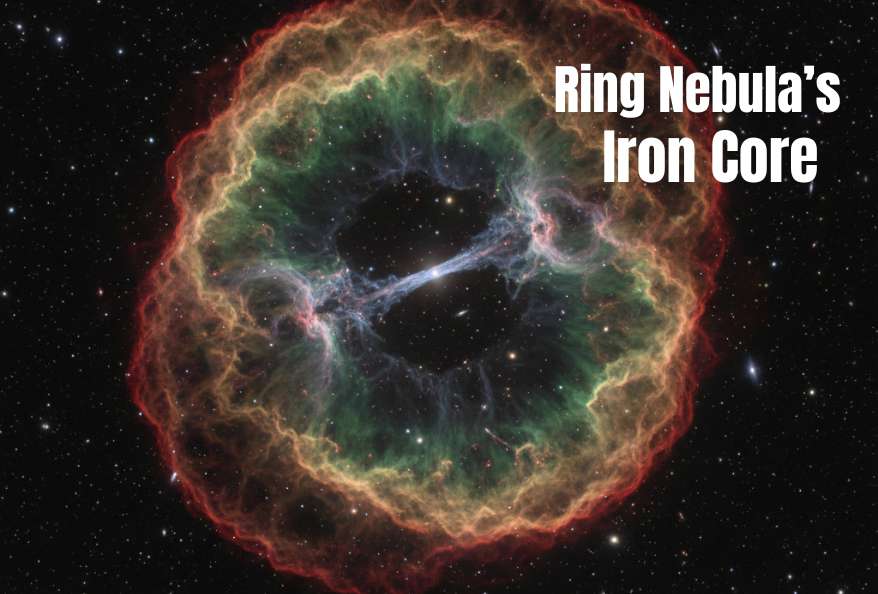
At the present time, the Ring Nebula iron bar discovery excites astronomers worldwide. This finding shows that space still holds unexpected structures. Above all, it reveals surprising details inside a well-known nebula.
The Ring Nebula lies about two thousand light-years from Earth. It appears as a glowing ring of gas. However, the iron structure changed what scientists expected to find.
This nebula formed after a Sun-like star died. After that, the star released gas into surrounding space. With this in mind, researchers carefully mapped the gas.
What Is the Ring Nebula Iron Bar?
The Ring Nebula iron bar is a long cloud of iron atoms. It stretches across the nebula like a narrow stripe. To put it differently, it looks like a metallic beam floating in space.
The structure contains iron equal to Mars’ mass. That amount surprised scientists. At least, no such feature had been seen before in this nebula.
At first, astronomers believed iron stayed evenly spread. In contrast, this iron formed a clear shape. As a result, researchers questioned old assumptions.
Why Iron Matters in Space
Iron forms inside stars during their final stages. When stars die, they release iron into space. In general, this iron helps create planets and future stars.
The Ring Nebula iron bar shows iron can behave differently. That is to say, elements may collect into unusual structures. In effect, this affects how scientists model star death.
How Scientists Found the Ring Nebula Iron Bar
Scientists used the WEAVE spectrograph on the William Herschel Telescope. This tool splits light into precise color patterns. To explain, each color reveals specific elements.
With attention to detail, researchers scanned thousands of nebula regions. As an illustration, they created a three-dimensional chemical map. All of a sudden, the iron bar became visible.
The data showed iron glowing differently than surrounding gases. With the result that, the structure stood out clearly. At this point, scientists confirmed the discovery.
Technology Behind the Discovery
WEAVE collects massive data quickly. It combines physics, engineering, and software. In like manner, modern astronomy depends on teamwork.
The Ring Nebula iron bar links many STEM fields. Astronomy uses physics, math, coding, and engineering. Together with creativity, these skills solve cosmic puzzles.
Possible Origins of the Ring Nebula Iron Bar
Scientists now debate how the iron bar formed. Two main explanations exist so far. All things considered, both ideas remain possible.
Idea One: Unusual Stellar Gas Flow
The dying star may have ejected gas unevenly. That process could form a long iron structure. Seeing that stars rotate, gas may follow narrow paths.
This idea fits known stellar physics. However, it does not explain the sharp shape fully. So far, more evidence is needed.
Idea Two: A Destroyed Rocky Planet
Another key point involves planets. The star may have destroyed a nearby rocky planet. As a result, iron from that planet spread outward.
The Ring Nebula iron bar may trace this debris. In short, it could be a planetary grave marker. Although this may be true, proof remains limited.
What Happens Next in Ring Nebula iron bar
Scientists plan follow-up observations soon. They want higher resolution data. With this purpose in mind, they will search similar nebulae.
They will also test planet destruction models. At length, these studies may change stellar theories.
Ring Nebula iron bar: Conclusion
The Ring Nebula iron bar discovery reshaped scientific understanding. It proved that space still surprises experts.
In summary, it also inspires future scientists and engineers. Findings like this reshape what we know about space research discoveries across the universe.
Additionally, to stay updated with the latest developments in STEM research, visit ENTECH Online. Basically, this is our digital magazine for science, technology, engineering, and mathematics. Further, at ENTECH Online, you’ll find a wealth of information.
Reference:
- Wesson, R., Drew, J. E., Barlow, M. J., García-Rojas, J., Greimel, R., Jones, D., … Walton, N. A. (2026). WEAVE imaging spectroscopy of NGC 6720: an iron bar in the Ring. Monthly Notices of the Royal Astronomical Society. https://doi.org/10.1093/mnras/staf2139
- Author
- Latest Posts

Kottauppari Venkat Raghava
I am an Information Technology graduate (B.Tech) and a technology writer specialising in artificial intelligence, robotics, automation, and space technologies. I analyse complex scientific research and convert it into clear, practical insights for students, tech enthusiasts, and professionals. My work bridges the gap between academic research and real-world understanding by simplifying findings from peer-reviewed journals into engaging, easy-to-follow content. Alongside my writing, I have hands-on experience developing real-world projects, showcased on my GitHub, including an Expense Tracker web application for managing and visualising spending, and a Simple Video Summariser that generates concise insights from video content using automation techniques. I also produce research-driven articles on topics such as AI-powered corrosion detection, deep learning in engineering, and advanced automation systems. I follow a research-driven approach, ensuring every article is grounded in verified sources, industry knowledge, and practical applications. My goal is to make advanced technology accessible and meaningful, helping readers stay informed about innovations shaping the future.