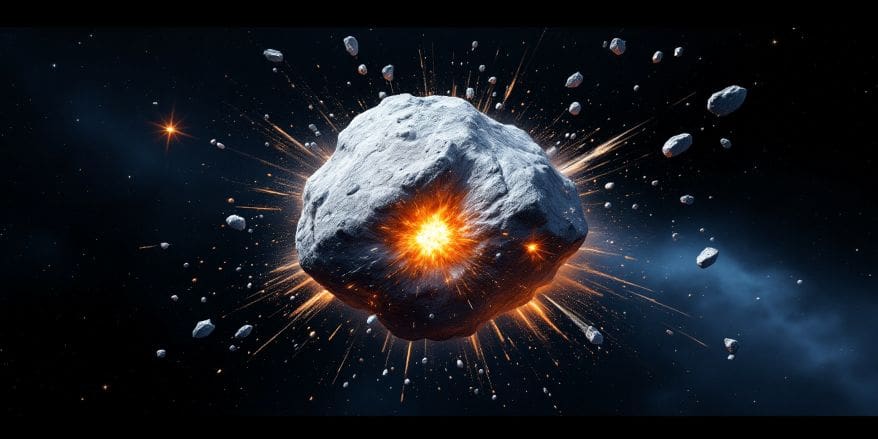
Astronomers notice asteroids spinning in strange ways, some slow while others dash. This is called Great Asteroid Spin Mystery.
The Great Asteroid Spin Mystery: Gaia Sheds New Light
Estimated reading time: 4 minutes
Space fans have long wondered why asteroids spin so differently. Some spin smoothly like tops, while others tumble wildly. This puzzling behavior, called the Great Asteroid Spin Mystery, has confused scientists for decades. But now, new data and smart models bring us closer to answers. Earlier studies have shown that many asteroids are not solid rocks but loose ‘rubble piles,’ which strongly affects how they spin.
The Cosmic Puzzle Spins On
Astronomers notice asteroids spinning in strange ways. Some asteroids roll slowly, others dash along in quick spins. This puzzling behavior is part of the Great Asteroid Spin Mystery that has puzzled scientists for years.
Recently, fresh data from ESA’s Gaia mission has helped explain this cosmic riddle. With their help, the Great Asteroid Spin Mystery comes into sharp focus as the cosmic dance of countless asteroids is uncovered. As a result, space enthusiasts everywhere join the conversation about this intriguing phenomenon.
Great Asteroid Spin Mystery: How Gaia Cracks the Case
Advanced Data Reveals Patterns
Gaia observes thousands of asteroids across our solar system. Its teams measure each asteroid’s size, shape, and rotation speed. Remarkably, they find a distinct gap. Smaller asteroids tend to tumble slowly, while larger asteroids spin rapidly
By analyzing light curves, scientists plot spin speed against diameter, and consequently, they uncover a “rotation gap.” Importantly, this gap represents a physical threshold caused by a delicate balance between collisions and internal friction acting over cosmic time. Furthermore, this discovery deepens the Great Asteroid Spin Mystery, revealing new insights into asteroid behaviour and structure.
Major Asteroid Rotation: Collisions vs. Friction Dynamics
Cosmic collisions hit asteroids, sending them into chaotic motion. Internally, friction works to smooth and stabilize their spin. Whenever these two forces balance, asteroids split into two groups. Some tumble gently for hours, while others whirl with steady speed. This balance is a key aspect of the Great Asteroid Spin Mystery, as revealed by data from ESA’s Gaia mission.
Researchers use artificial intelligence to model asteroid spin. Unlike prior ideas, the new findings show most asteroids resemble loose “rubble piles,” not solid stone. This matters a lot. Deflection missions, like NASA’s DART, now require new planning.
Also Read: A Journey Through Time

Implications for Planetary Defense
Planetary Protection Gets an Upgrade
Understanding how asteroids spin means experts improve planetary defense. When NASA or ESA sends a mission to deflect an asteroid, knowing its spin is key. The physical makeup directs how it reacts when struck. Fast spinners act differently from slow tumblers Knowledge matters for Earth’s safety. More data from upcoming observatories, including the Vera C. Rubin Observatory, promise deeper insight. The information collected today prepares us for tomorrow’s threats.
Also Read: Asteroid 2024 YR4 May Hit Earth!
The Road Ahead for Asteroid Science and the Great Asteroid Spin Mystery
Technology Expands Our Horizons
Future missions will observe tens of thousands more asteroids. As new tools combine observation and machine learning, fresh mysteries may appear. However, thanks to Gaia, space researchers now stand ready.
Dr Wen-Han Zhou, University of Tokyo, sums up: “By leveraging Gaia’s unique dataset, advanced modelling and A.I. tools, we’ve revealed the hidden physics shaping asteroid rotation, and opened a new window into the interiors of these ancient worlds.”
Scientists now look forward to using these discoveries to safeguard our planet. Because of Gaia’s work, the story of asteroids spins into a new chapter.
Additionally, to stay updated with the latest developments in STEM research, visit ENTECH Online. Basically, this is our digital magazine for science, technology, engineering, and mathematics. Also, at ENTECH Online, you’ll find a wealth of information.
Reference
- Ďurech, J., & Hanuš, J. (2023). Reconstruction of asteroid spin states from Gaia DR3 photometry. In Astronomy & Astrophysics (Vol. 675, p. A24). EDP Sciences. https://doi.org/10.1051/0004-6361/202345889
- James B. Pollack, Olenka Hubickyj, Peter Bodenheimer, Jack J. Lissauer, Morris Podolak, Yuval Greenzweig, Formation of the Giant Planets by Concurrent Accretion of Solids and Gas, Icarus, Volume 124, Issue 1, 1996, Pages 62-85, ISSN 0019-1035, https://doi.org/10.1006/icar.1996.0190.
- Author
- Latest Posts

Ashwini Kshirsagar holds a graduate degree in Chemistry and a postgraduate degree in Environmental Science from Shivaji University, Kolhapur. With a strong foundation in scientific principles and a creative flair, she blends her expertise in environmental science with skills in technical writing, graphic design, and video editing. Proficient in Adobe software, Ashwini excels at transforming complex scientific concepts into clear, engaging, and visually compelling content. Her unique ability to merge science and storytelling allows her to create impactful communication materials that are both informative and accessible to a wide audience.