It is one of the most extensive rotating structures that has ever been reported. This structure is a "razor-thin" chain...
One of the Largest Rotating Galaxy Filament Found In The Universe
Estimated reading time: 4 minutes
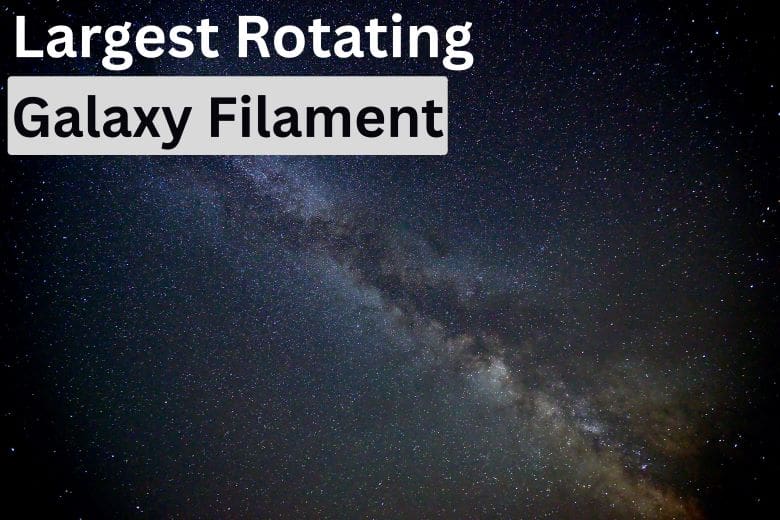
One of the largest rotating galaxy filament has been discovered by a research group led by the University of Oxford. It is one of the most extensive rotating structures that has ever been reported. This structure is a “razor-thin” chain of galaxies that is situated within a vast, spinning cosmic filament that is approximately 140 million light-years away from Earth. It is possible that the discovery will shed light on the process by which galaxies made their initial appearance in the early universe.
Madalina N Tudorache, et. al led this research and published it under the title “A 15 Mpc rotating galaxy filament at redshift z = 0.032” in December 2025.
ENTECH STEM Magazine has included this research in its list of the Top 10 Astronomy Discoveries of 2025
Potential Benefits Of The Discovery Of One Of The Largest Rotating Galaxy Filament
Better Technology Through Advanced Computing
Studying one of the largest rotating galaxy filament requires, firstly, extremely precise data analysis. Secondly, a high-performance computing and finally an advanced simulations and AI modeling.
These tools often spill over into everyday applications such as:
- Faster as well as more accurate weather forecasting
- Improved medical imaging (MRI, CT scans)
- More efficient data compression as well as cloud computing
Improved GPS, Navigation, and Timekeeping
This discovery of one of the largest rotating galaxy filament will help in understanding large-scale cosmic motion. This will help refine not only the models of gravity and spacetime but also the precision timing systems.
This research, therefore, indirectly supports improvements in:
- GPS accuracy on smartphones
- Satellite navigation for aviation as well as shipping
- Also, financial systems that rely on precise timing
Advances in Materials and Engineering
Astronomy research drives innovations not only in the ultra-sensitive sensors but also in low-noise detectors and high-precision instruments.
These technologies, therefore, can be adapted for:
- Better smartphone cameras
- Environmental monitoring sensors
- Also, medical diagnostic tools
Progress in Artificial Intelligence
To detect as well as analyze structures like largest rotating galaxy filament, scientists develop both pattern-recognition algorithms and also machine-learning systems for massive datasets.
These same AI techniques can, thus, help power:
- Fraud detection
- Image recognition apps
- Voice assistants as well as recommendation systems
Deeper Understanding of Cosmic Origins (Long-Term Impact)
By revealing how galaxies were formed and also organized themselves early in the universe, the discovery of one of the largest rotating galaxy filament, may not only improve models of matter, energy, and gravity but also influence future physics theories.
Education, Inspiration, and Economic Impact
Such high-profile discovery of one of the largest rotating galaxy filament, inspires students to pursue STEM careers. They also drive public investment in science and technology, therefore, supporting high-skill job creation in research as well as engineering.
Educational and Career Opportunities
New Teaching Material for Astronomy & Physics
- Real-world case studies for galaxy formation, cosmic filaments, as well as large-scale structure
- Updated curriculum content for both undergraduate astrophysics courses as well as graduate cosmology seminars
- Visualizations of the rotating filament can be used in lectures and labs to explain:
- Angular momentum in the universe
- Also, dark matter’s role in cosmic structure
Interdisciplinary Learning: Largest Rotating Galaxy Filament
This discovery of one of the largest rotating galaxy filament connects multiple disciplines including Physics (gravity, dark matter, relativity), Computer science (data science, machine learning) as well as Mathematics (statistical modeling, topology).
This, therefore, supports:
- Joint degree programs
- Cross-department research projects
- Training in transferable technical skills
Machine Learning & Big Data Research
Analyzing massive galaxy surveys requires new algorithms to detect subtle rotational patterns as well as AI tools for anomaly detection.
These methods can be also reused in:
- Medical research
- Earth observation
- Financial data analysis
Advances in Simulation & Modeling
- High-resolution simulations are needed to recreate such structures
- Drives development of:
- More accurate cosmological models
- Better numerical techniques
These improvements benefit:
- Climate modeling
- Fluid dynamics
- Complex system simulations beyond astronomy
Dark Matter & Dark Energy Studies
- Rotating filaments offer clues about:
- Dark matter distribution
- Large-scale gravitational behavior
Researchers can study whether:
- Rotation aligns with predictions of cold dark matter models
- Alternative gravity theories fit the observations
Testing Theories of Galaxy Formation
This structure provides a new natural laboratory to:
- Test models of early galaxy formation
- Examine how angular momentum emerges at cosmic scales
- Compare competing cosmological simulations
Public Education & Outreach: Rotating Galaxy Filament
- Due to the discovery of one of the largest rotating galaxy filament, planetariums and science museums can create exhibits explaining:
- How galaxies form and organize
- The “cosmic web” structure of the universe
- Simplified visualizations can be used in:
- School programs
- Science documentaries
- Public lectures
Additionally, to stay updated with the latest developments in STEM research, visit ENTECH Online. Basically, this is our digital magazine for science, technology, engineering, and mathematics. Also, at ENTECH Online, you’ll find a wealth of information.
Reference
Madalina N Tudorache, S L Jung, M J Jarvis, I Heywood, A A Ponomareva, A A Vărăşteanu, N Maddox, T Yasin, M Glowacki, “A 15 Mpc rotating galaxy filament at redshift z = 0.032″ , Monthly Notices of the Royal Astronomical Society, Volume 544, Issue 4, December 2025, Pages 4306–4316, https://doi.org/10.1093/mnras/staf2005
- Author
- Latest Posts

I am a Master’s qualified in Science with focus on Zoology and Entomology and am a passionate, curiosity-driven science enthusiast aiming to transform complex scientific ideas in a manner that are easy to understand hence, educate, and inspire.
I have an experience of working on the projects in the field of Entomology which has provided me hands-on experience with various research techniques. Besides, I have also gained experience of lab work as well as developed communication skills during the course of my bachelors and masters.
With a strong foundation in life sciences and a growing interest in Medical and Biological research, I have cultivated a writing style that merges scientific facts with creativity.
My experience in teaching has also taught me to develop an understanding of what are the interests of people and how to communicate them effectively.
I am committed to lifelong learning, actively engaging in Interdisciplinary learning, so as to broaden my perspective.