Renewable sector offers unprecedented opportunities. Shift toward a carbon-neutral economy is a massive economic engine.
The Science of Safety: Engineering Reliable Renewable Energy Systems for the Future
Estimated reading time: 5 minutes
As the world accelerates toward a post-carbon economy, the conversation often centers on the visible icons of green technology: the sprawling solar farms in deserts and the sleek wind turbines offshore. However, for STEM professionals and aspiring engineers, the true revolution isn’t just in how we generate power, but in how we design and control Renewable Energy Systems.
The Green Energy Revolution: Renewable Energy Systems beyond Panels and Turbines
The transition to renewable energy is the most significant overhaul of electrical infrastructure since the time of Edison and Tesla. While the Photovoltaic Effect allows us to harvest energy from the sun, integrating that energy into the grid requires a sophisticated web of power electronics.
The “face” of the industry may be the solar panel, but the “brain” and “muscle” are the transmission and protection systems. Without these often-overlooked engineering marvels, the raw energy generated would be unstable, unusable, and potentially dangerous. The engineering challenge of the next decade is not just efficiency – it is reliability and safety at scale.
Also Read: Careers in Energy Transition: Skill Stacking Approach
The Hidden Engineering Challenge: Managing DC Power
To understand the safety engineering involved, one must look at the physics of electricity. Traditional grid power is Alternating Current (AC), which naturally passes through zero voltage 50 or 60 times a second, making it relatively easy to interrupt if a fault occurs. Solar energy, however, is generated as Direct Current (DC).
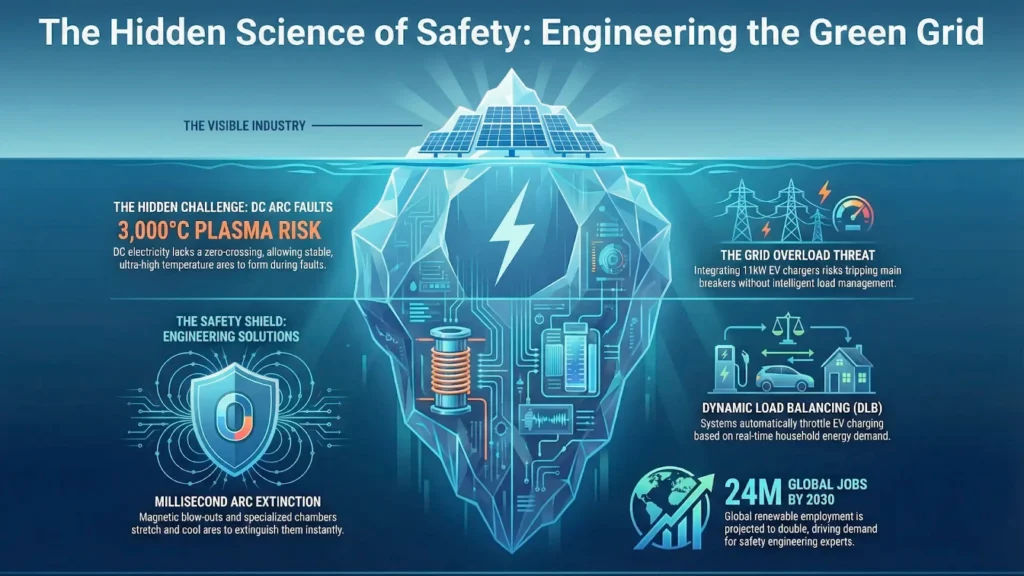
DC power provides a constant voltage that never crosses zero. If a switch is opened while high current is flowing, the electricity can jump across the gap, creating a stable, high-temperature plasma discharge known as a DC Arc Fault. This phenomenon can reach temperatures exceeding 3,000°C.
Handling high-voltage DC electricity requires precision engineering that goes beyond standard household wiring. The risk of DC arc faults means that regular circuit breakers are often insufficient. To mitigate these risks, engineers rely on specialized protection components designed to extinguish arcs instantly. Manufacturers like BENY are at the forefront of this safety engineering, providing DC isolators and rapid shutdown devices that meet stringent global standards (such as UL and IEC). These components serve as the critical first line of defense in preventing electrical fires in solar installations.
Critical Safety Components in Modern Infrastructure
Modern safety systems rely on rapid intervention. Two key technologies form the backbone of PV safety:
- Rapid Shutdown Devices (RSD): In the event of an emergency, these devices de-energize solar panels at the module level, dropping voltage to a safe level for firefighters and maintenance crews.
- DC Isolator Switches: These manual or automated switches physically disconnect the PV array from the inverter, ensuring total isolation during maintenance.
For a DC breaker to be effective, it must possess specific engineering features:
- Arc Extinguishing Chambers: Specialized internal geometry that stretches and cools the arc to force it to extinguish.
- Magnetic Blow-out Technology: Using magnetic fields to push the arc away from the contacts.
- High-Speed Actuation: Mechanisms that separate contacts in milliseconds to minimize arc duration.
Also Read: Eco-Friendly Tech: Innovations for a Sustainable Future in 2026
Integrating EV Charging into the Smart Grid
The engineering challenge extends beyond generation to consumption. As electric vehicles (EVs) become commonplace, the home is transforming into a micro-grid. The challenge here is Load Management.
Connecting a 7kW or 11kW EV charger to a home already powering HVAC systems and appliances risks overloading the main service panel. To solve this, engineers utilize Dynamic Load Balancing (DLB).
Also Read: Ensuring Battery Safety in Electric Vehicles
DLB systems constantly monitor the total energy draw of the building. If the household load increases (e.g., the oven and dryer turn on), the system automatically reduces the current available to the EV charger. Once the household load drops, the charger ramps back up. This ensures the main breaker never trips, creating a seamless integration between the solar array, the home battery, and the electric vehicle.
Key Takeaways: Renewable Energy Systems
| Area | Key Takeaway | Impact/Data |
| Risk | Mitigate DC arc fault risks | Temps exceed 3,000°C |
| Safety | Mandate Rapid Shutdown (RSD) systems | Module-level de-energization |
| Hardware | Deploy magnetic blow-out breakers | Millisecond actuation speed |
| Grid | Implement Dynamic Load Balancing (DLB) | Prevents main service overload |
| Talent | Recruit system integration specialists | Global jobs doubling by 2030 |
Renewable Energy Systems: The Future Landscape of Energy Tech Careers
For aspiring engineers and tech enthusiasts, the renewable sector offers unprecedented opportunities. The shift toward a carbon-neutral economy is not just an environmental imperative but a massive economic engine.
We are moving away from simple installation toward complex system integration. The industry needs minds capable of understanding power electronics, grid stability, and IoT connectivity.
According to the International Renewable Energy Agency (IRENA), the renewable energy sector employed over 12 million people globally last year, with that number expected to double by 2030. This growth creates a high demand for skilled professionals in electrical safety, grid management, and sustainable engineering.
Additionally, to stay updated with the latest developments in STEM research, visit ENTECH Online. Basically, this is our digital magazine for science, technology, engineering, and mathematics. Further, at ENTECH Online, you’ll find a wealth of information.
References: Renewable Energy Systems
- Renewable energy jobs have reached 12 million globally. (2024, April 19). International Labour Organization. https://www.ilo.org/resource/news/renewable-energy-jobs-have-reached-12-million-globally
- Ma, B., & Wang, A. (2025). Exploring the role of renewable energy in green job creation and sustainable economic development: An empirical approach. Energy Strategy Reviews, 58, 101642. https://doi.org/10.1016/j.esr.2025.101642
- Bachir, T., Zineb, H., Aicha, G., Louetri, T., & Bekkari, S. (2025). Renewable energy transitions as a catalyst for economic growth and job creation in MENA. Journal of Ecohumanism, 4(4). https://doi.org/10.62754/joe.v4i4.7081
- Author
- Latest Posts

Charudatta Pathak was a student at St. Aloysius High School in Bhusawal, established in 1874, making it one of India’s oldest convent institutions. He earned his bachelor’s degree in mechanical engineering from SSVPS College of Engineering, Dhule in 1995, demonstrating exceptional academic achievement. Thereafter, he launched his career as a CNC programmer in a toolroom. He has utilized FANUC, Deckel, Maho, and Mikron controllers to operate 2-axis and 3-axis machines for the fabrication of jigs, fixtures, dies, and molds. He commenced his career as an academic in 1996, when he assumed the role of lecturer at SSVPS College of Engineering, Dhule. Additionally, he earned his post-graduate degree in CAD/CAM from L. D. College of Engineering, Ahmedabad, in 2000, and then acquired a Ph.D. from COEP in 2011 while concurrently engaged in teaching. Until 2023, he occupied many academic roles, including lecturer, assistant professor, professor, dean, principal, director, and vice chancellor at both public and private universities throughout India. From 2008 to 2010, he served as the project lead in the CAE department of a European multinational firm. During his 28-year professional tenure, he identified a need for dependable books targeted at students in grades 8 to 12, particularly for nascent career planning. He founded ENTECH Digital Magazine, a free monthly publication available on entechonline.com and magzter.com. Teens with a strong interest in Science, Technology, Engineering, and Mathematics (STEM) who aspire to pursue careers in these fields may find ENTECH Digital Magazine beneficial.
- Author
- Latest Posts

A driven and dedicated IT professional specializing in web development and research. Backed by a strong academic foundation and extensive hands-on experience at Coneixement INDIA, I consistently deliver innovative, high-quality digital solutions that enhance user experience and drive measurable business growth.
With a passion for continuous learning and advancing my technical expertise, I am eager to take on new challenges in dynamic, larger organizations where I can contribute to transformative projects, optimize digital strategies at scale, and help elevate the company’s online presence. My commitment to excellence, combined with a results-oriented approach, makes me a valuable asset ready to support business objectives and future-proof digital initiatives in competitive markets.