Explore the science behind the ELISA test kit and why it is the gold standard for detecting proteins and hormones.
What is an ELISA Test Kit? A Comprehensive Guide to How They Work
Estimated reading time: 5 minutes
In the world of medical diagnostics and biochemical research, few tools are as versatile or as ubiquitous as the ELISA test kit. Whether it’s detecting food allergens, screening for infectious diseases, or monitoring hormone levels, this laboratory staple has revolutionized how we identify specific substances in complex samples.
But for those outside the lab coat, the terminology can be daunting. In this comprehensive guide, we will break down what an ELISA test kit is, the science behind how it works, and why it remains the gold standard in diagnostic testing.
What is an ELISA Test Kit?
ELISA stands for Enzyme-Linked Immunosorbent Assay. At its core, it is a plate-based assay technique designed for detecting and quantifying substances such as peptides, proteins, antibodies, and hormones.
The “magic” of an ELISA kit lies in its use of antibodies. Because antibodies are programmed to bind to very specific antigens (like a key fits into a lock), they allow scientists to “hunt” for a specific molecule within a liquid sample—even if that sample contains thousands of other types of molecules.
The Components of a Standard Kit
Most commercial ELISA kits come with a set of pre-packaged components to ensure consistency:
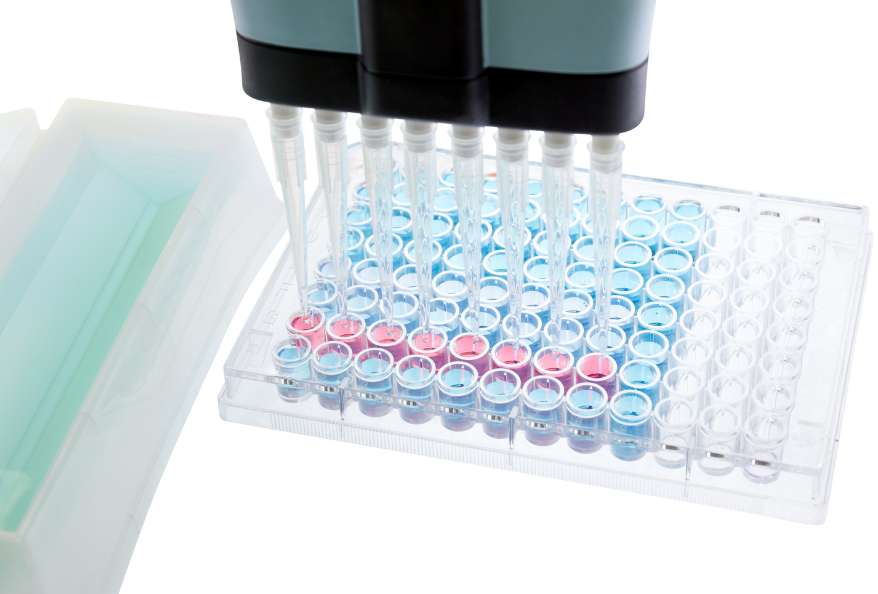
- Microplate: Usually a 96-well plate coated with a specific antibody or antigen.
- Standards: Known concentrations of the target substance to create a reference curve.
- Detection Antibody: Often conjugated (linked) to an enzyme.
- Substrate: A chemical that changes color when it reacts with the enzyme.
- Stop Solution: A reagent used to end the chemical reaction.
How Does an ELISA Test Work? The Step-by-Step Process
The fundamental principle of an ELISA test kit is the antigen-antibody reaction. To understand how this works in a practical setting, we can look at the general workflow of a standard “Sandwich” ELISA, the most common type used in diagnostics.
1. Coating and Capture
The process begins with a microplate where the wells have been “pre-coated” with a capture antibody. When the user adds their sample (such as blood, serum, or urine), the target antigen binds to these antibodies and becomes “stuck” to the bottom of the well.
2. Washing
After incubation, the plate is washed. This is a critical step. It removes any unbound proteins or contaminants, ensuring that only the target antigen remains in the well.
3. Detection
A second antibody is added. This antibody also targets the antigen but “sandwiches” it from the top. This second antibody is linked to an enzyme (the “Enzyme-Linked” part of the name).
4. Substrate Addition and Color Change
Finally, a substrate is added to the wells. The enzyme attached to the detection antibody reacts with this substrate, typically causing a visible color change. The more antigen present in the sample, the more enzyme-linked antibodies will stick, and the more intense the color change will be.
The Four Main Types of ELISA
While the goal is always detection, the method can vary depending on what the researcher is looking for.
Direct ELISA
The fastest and simplest method. The antigen is immobilized directly on the plate and a labeled antibody binds to it. It’s quick but less specific than other methods.
Indirect ELISA
Commonly used to detect antibodies in a patient’s blood (like testing for HIV or COVID-19 antibodies). It involves two steps: a primary antibody binds to the antigen, and then a labeled secondary antibody binds to the primary one.
Sandwich ELISA
As mentioned above, this is the most sensitive and robust type. It requires two antibodies that “sandwich” the antigen. It is ideal for samples with low concentrations of the target substance.
Competitive ELISA
This is a more complex version used when the target antigen is very small. In this version, the presence of the target substance actually decreases the signal intensity.
Why are ELISA Kits the Gold Standard?
Despite the rise of newer technologies like PCR (Polymerase Chain Reaction) or rapid lateral flow tests, ELISA remains a cornerstone of laboratory work for several reasons:
- High Sensitivity and Specificity: Because of the lock-and-key nature of antibodies, ELISA can detect minute amounts of a substance with incredible accuracy.
- Quantitative Results: Unlike a simple “positive/negative” test, ELISA provides a numerical value. By comparing the color intensity of the sample to the “Standards” provided in the kit, researchers can determine exactly how much of a substance is present.
- High Throughput: A standard 96-well plate allows for dozens of samples to be tested simultaneously, making it highly efficient for clinical labs.
- Cost-Effectiveness: Compared to mass spectrometry or other advanced imaging, ELISA kits are relatively affordable and do not require highly specialized, million-dollar machinery.
Common Applications of ELISA Testing
You likely interact with the results of ELISA testing more often than you realize. Some of the most common applications include:
- Infectious Disease Screening: Testing for HIV, Hepatitis B, and Lyme Disease.
- Allergy Testing: Detecting traces of peanuts, milk, or gluten in food products.
- Hormone Monitoring: Pregnancy tests (which detect hCG) and thyroid function tests.
- Drug Testing: Screening for the presence of illicit substances in sports or employment contexts.
- Cancer Biomarkers: Identifying specific proteins that may indicate the presence of certain tumors.
Summary
The ELISA test kit is a testament to the power of biochemistry. By harnessing the natural precision of our immune systems (antibodies) and pairing them with measurable chemical reactions (enzymes), we have created a tool that is as reliable as it is versatile. Whether you are a student, a researcher, or simply someone curious about medical science, understanding the ELISA process provides a fascinating window into the “invisible” work that keeps us healthy and safe.
Additionally, to stay updated with the latest developments in STEM research, visit ENTECH Online. Basically, this is our digital magazine for science, technology, engineering, and mathematics. Further, at ENTECH Online, you’ll find a wealth of information.
- Author
- Latest Posts

Ramya Dobbala is a pharmacist and science communicator dedicated to bridging the gap between complex pharmaceutical research and public understanding. A 2024 B.Pharmacy graduate, Ramya has a strong foundational background in formulation science, having spearheaded research into the evaluation and formulation of anti-acne creams. Her work focused on optimizing topical delivery systems to enhance treatment efficacy and skin health.
Transitioning from the laboratory to the forefront of scientific discourse, she now leverages her technical expertise to translate intricate healthcare concepts into accessible, engaging content. As an author and communicator, Ramya is passionate about empowering audiences with evidence-based insights, particularly in the realms of dermatology and pharmaceutical innovation.
- Author
- Latest Posts

I am an inspirational writer and emerging science blogger with a deep-rooted passion for understanding and sharing the wonders of the world around us. My journey began with a Bachelor of Science in Chemistry from AKI’s Poona College of Arts, Commerce and Science, where I developed not only a strong foundation in scientific principles but also a mindset that values curiosity, observation, and critical thinking. Studying chemistry has taught me to approach problems with logic, to look beyond the obvious, and to see patterns where others might only see complexity. These experiences have shaped the way I perceive life and influence the way I express my thoughts, both scientifically and creatively.
I have always believed that knowledge is only as powerful as the way it is shared. This belief has guided me to create content that bridges the gap between science and everyday life. I aim to simplify complex scientific ideas so they become approachable, relatable, and engaging for everyone—whether someone has a formal background in science or is simply curious about the world. Science, in my view, is not confined to textbooks and laboratories; it is a way of thinking, understanding, and connecting with the world around us. By making science accessible, I hope to inspire curiosity, ignite learning, and encourage people to see the beauty and relevance of scientific discovery in their daily lives.
Alongside my love for science, I am deeply passionate about motivational writing. I believe words carry the power to transform perspectives, encourage self-reflection, and inspire action. By combining analytical thinking with creativity, I create content that is intellectually stimulating yet emotionally resonant. Whether I am breaking down a chemical concept, exploring a scientific phenomenon, or crafting motivational narratives, my goal is to communicate ideas in a way that is clear, meaningful, and impactful.
Through my work, I strive to empower my readers – not just by helping them understand the science around them, but by inspiring them to grow, learn, and realize their full potential. Every article, post, or story I write reflects my commitment to turning knowledge into inspiration. I want to spark curiosity, encourage self-improvement, and show that learning and personal growth are deeply connected. For me, writing is not just a craft; it is a way to touch minds, connect hearts, and make ideas come alive in a way that truly resonates.