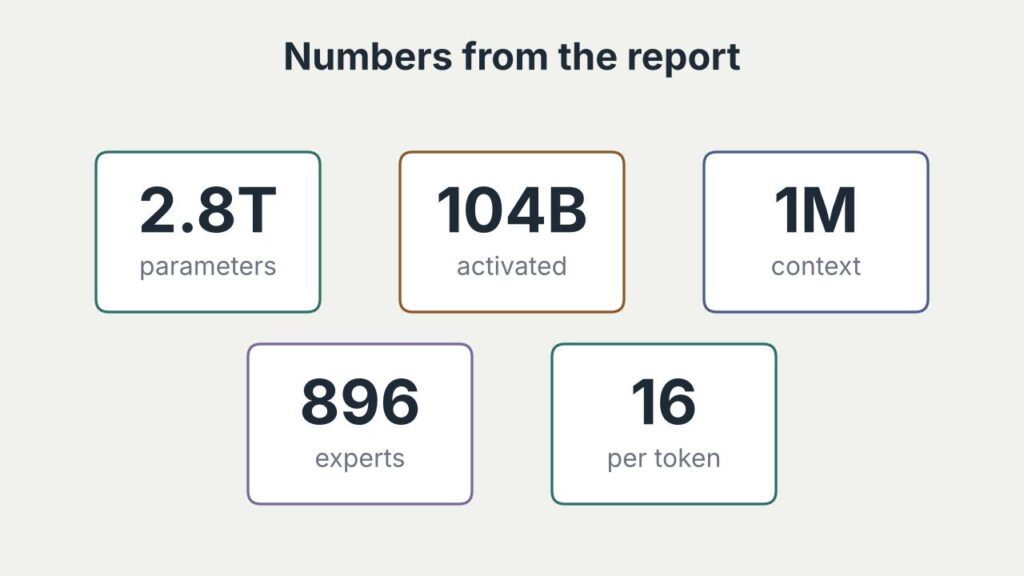
Kimi AI is a family of large language models built by Moonshot AI. This article sets out what Kimi AI is, and what it does. Moonshot builds them in Beijing and releases the finished weights publicly. The company’s technical report describes Kimi K3. That report gives 2.8 trillion total parameters and 104 billion activated for any single token. It also gives a context window of one million tokens. Moonshot describes K3 as the first open 3T-class model. Open weights matter here, because anyone may download and run the files. This explainer sets out the architecture, the published numbers, and the parts that stay unproven. Numbers come from Moonshot’s own documents, so the company is both builder and scorekeeper. That is worth holding in mind throughout.
From K1.5 to K3.1 Pro
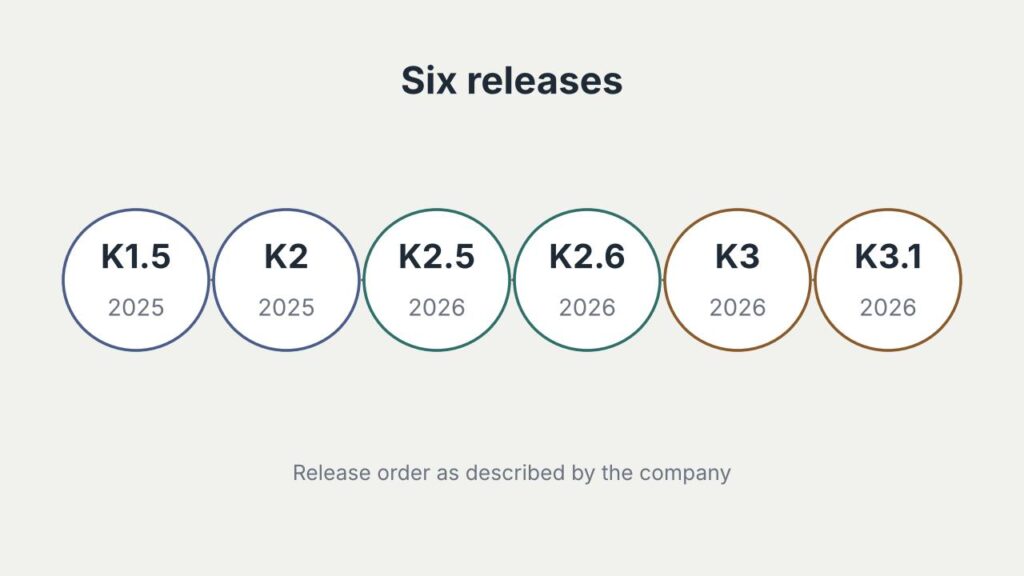
Moonshot has shipped quickly, and the pace explains why older write-ups age badly. The company released Kimi K1.5 in January 2025, then Kimi K2 that July. K2.5 followed in January 2026, and K2.6 in April. The company released Kimi K3 in July 2026, with a technical report alongside. A blog post dated 23 October 2026 describes the newer K3.1 series. Moonshot calls K3.1 Pro its most capable 3T-class open-weight model to date. The post also announces K3.1 Pro Highspeed, said to run two to three times faster. Six releases in under two years can make any single description temporary. A version number therefore matters more than the product name. Readers checking a Kimi claim may want to confirm which model it describes.
Fig. 1: Six releases, two years
Inside the Architecture
The report describes a design built to move information three ways. It names sequence length, network depth, and model width. Kimi Delta Attention handles long sequences, with Gated MLA layers placed at intervals. The report says those interleaved layers preserve interaction across the whole sequence. Attention Residuals let each layer draw on representations from every layer before it. Ninety-three layers sit in the stack, of which 69 use Kimi Delta Attention. A vision encoder called MoonViT-V2 adds 401 million parameters for images. Moonshot states that vision is native rather than attached afterwards. The report also claims roughly 2.5 times better scaling efficiency than Kimi K2. That figure describes training economics, and the report does not translate it into user-visible speed.
A mixture-of-experts model splits part of its network into many smaller subnetworks. Each subnetwork is an expert, and a router picks which ones handle a given token. Cai and colleagues at the Hong Kong University of Science and Technology (Guangzhou) survey the approach. Their survey presents it as a way to raise model capacity while holding computation low. Only the relevant experts run for any input, so cost may stay flat. The router itself is a small network compared with the experts. Memory capacity is the trade, set against computation at every step. All the experts must be stored, while only a few run per token. That is why a 2.8-trillion-parameter model can report 104 billion activated parameters. Sparsity, not raw size alone, is what makes such a model practical to serve.
Why Only 16 Experts Run at Once
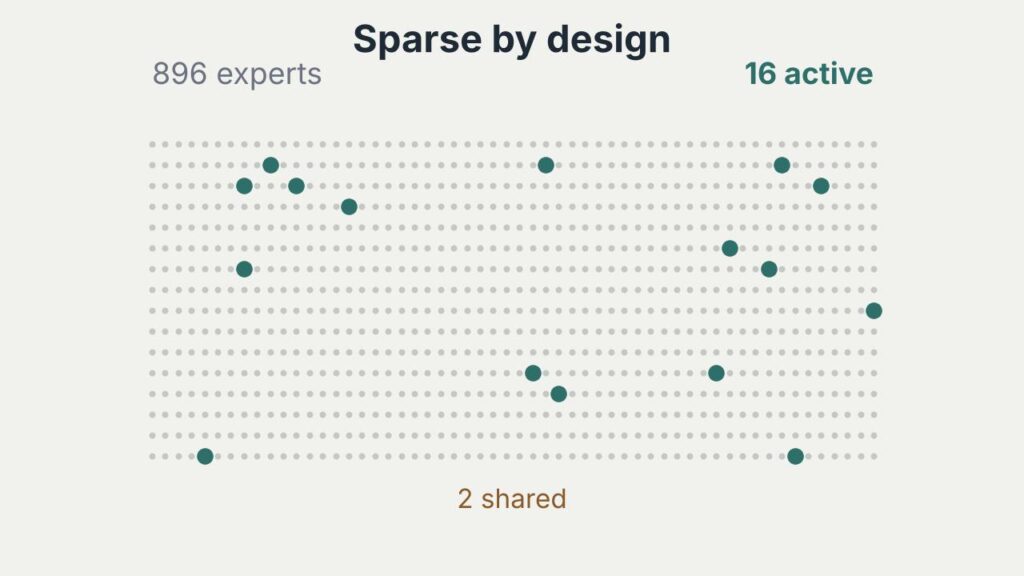
Moonshot’s report describes a routed expert space of 896 experts. Sixteen of them activate per token, under a scheme the report calls Stable LatentMoE. Two further experts are shared across all tokens. The report says normalization, SiTU-GLU and Quantile Balancing hold training stable at that sparsity. Extreme sparsity can make optimization unstable, which is the problem those parts may address. The numbers in the report make this more concrete. Sixteen of 896 is under two percent of the routed pool for any single token. The report gives MXFP4 weights with MXFP8 activations, a low-precision format that may cut memory. Each choice appears there as a design decision, not a measured gain.
Fig. 2: Sparse by design
A Million Tokens of Context
Context length sets how much text a model may consider at once. The report gives 1,048,576 tokens, which Moonshot rounds to one million. A token is roughly a short word or part of one. One million tokens may therefore cover a technical manual or a large codebase. The K3.1 Pro post gives the same one-million figure for that model. Moonshot pairs the window with post-training aimed at long sessions. The report describes trajectories that can run to thousands of tool calls. Accumulated context across such a session may reach millions of tokens. Whether a model uses a long window well is a separate question from having one. The report does not claim uniform quality across the full window.
Fig. 3: Numbers from the report
How the Model Learns After Pre-Training
Pre-training produces a model that predicts text, and more is needed for agent work. The report describes reinforcement learning across coding, general agents, reasoning and knowledge tasks. Each domain ran at several reasoning-effort levels. Training environments included software engineering, kernel optimization and web development. Verifiable search and persistent assistant workflows appear on the same list. The report says these environments train a loop of reasoning, acting, observing, verifying and adapting. Moonshot then consolidated the specialized policies into one model. It calls that step multi-teacher on-policy distillation. Several teachers, one student, is the plain description of the method. It presents this as its approach, without isolating each stage’s contribution.
What the Published Benchmarks Report
Moonshot publishes benchmark tables in the technical report and the blog post. The report says K3 reached 88.3 on Terminal-Bench 2.1 and 81.2 on FrontierSWE. It gives 77.8 on ProgramBench, 67.5 on DeepSWE and 42.0 on SWE-Marathon. On BrowseComp the report gives 91.2, and on AutomationBench 30.8. For the GDPval-AA v2 Elo table it gives K3 a score of 1686. The report attributes those Elo figures to Artificial Analysis, as of 23 July 2026. Every number here comes from the company that built the model. Independent evaluation may place the same model differently. Benchmark versions matter, since one name may cover different test sets.
Fig. 4: Scores as published
Where K3 Sits in Its Own Tables
The report is unusually direct about the comparison, and that is worth quoting carefully. Moonshot writes that K3 trails the strongest proprietary systems overall. It names Claude Fable 5 and GPT-5.6 Sol as those systems. The report then says K3 stayed ahead of the other open and proprietary models it evaluated. So the company places its own model behind two rivals and ahead of the rest. A vendor conceding second or third place is less common than a vendor claiming first. On DeepSWE the report gives GPT-5.6 Sol 73.0 against K3’s 67.5. FrontierSWE puts Claude Fable 5 at 86.6, against K3’s 81.2. These are the figures as the report published them at release. Readers may weigh those gaps for themselves.
Reading Benchmark Numbers Carefully
Benchmark scores describe a test, not a model in general. The report notes that coding results were run at maximum thinking effort. A different effort setting may produce different numbers. Test versions matter too, and the report names Terminal-Bench 2.1 rather than Terminal-Bench alone. Harnesses differ, and the report states which harness produced each coding figure. Three variables therefore sit behind any single score. They are the test version, the effort level and the harness. Two published numbers may not be comparable unless all three match. The report supplies those details, which makes checking possible for anyone who wants to.
Open Weights, and What They Allow
Moonshot states that it releases the full Kimi K3 model weights. The K3.1 Pro post said that model’s weights would follow by 4 November. Open weights change who can study a model. A university group may download the files and inspect behavior without asking permission. Smaller teams may fine-tune a released model instead of training one. The report frames the release as a contribution to research and wider deployment. Moonshot’s own introduction notes that open models had mostly stayed near the 1T-parameter mark. It presents K3 as an attempt to move that ceiling. Weights alone are not the whole story, since training data and recipes may stay unpublished.
How Students and Researchers Use It
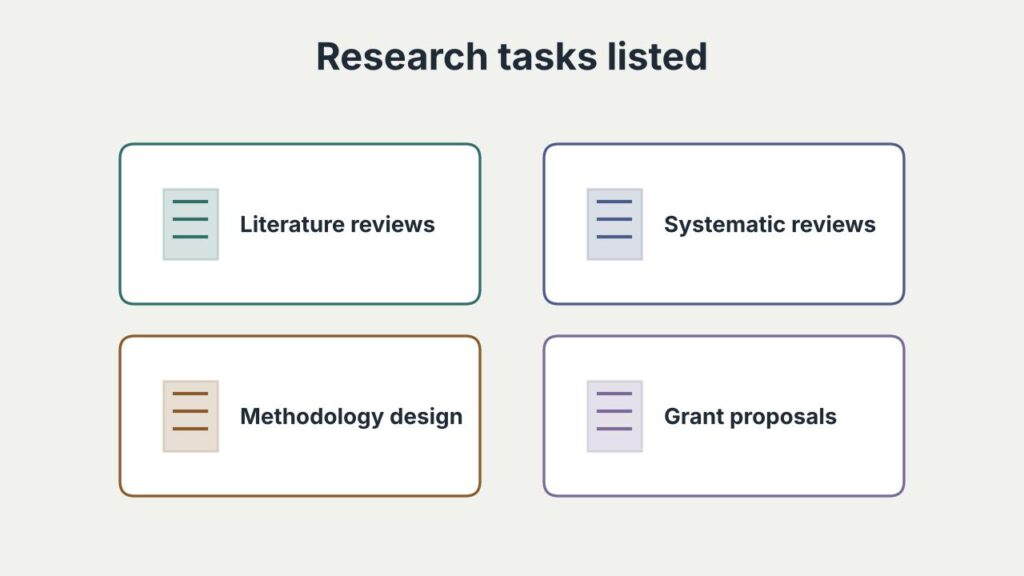
Moonshot’s own pages describe the everyday side, away from architecture. The product page offers deep research, document work, slides, 3D creation and building. A use-case page covers academic research specifically. That page says Kimi Deep Research may help find papers, weigh evidence and draft literature reviews. It lists systematic reviews, research proposals, methodology design, meta-analysis and grant proposals. Moonshot describes citation-backed reports as the output. A citation-backed draft still needs checking against the cited papers. Our explainer on OpenAI’s coding agent covers the same delegation pattern in software. Students comparing options may also read our pieces on DeepSeek R1 and GPT-5.
Fig. 5: Research tasks listed
Careers Behind Models at This Scale
A 2.8-trillion-parameter model needs more than model designers. The report devotes whole sections to infrastructure, and the roles follow from that. It describes fused kernels, context parallelism and prefix caching for the attention design. A system called MoonEP handled balanced expert execution during pre-training. Resumable microVM sandboxes kept environment state alive through million-token training runs. Systems engineering, compiler work and distributed training sit alongside machine learning here. The US Bureau of Labor Statistics groups these roles with computer and information technology occupations. On its May 2025 figures, their pay sits above that group’s average. The Bureau labels projected growth through 2035 much faster than average. A master’s degree is listed as typical entry-level education. That occupation held 38,600 jobs in 2025, on the same page.
What Is Settled, and What Is Not
What Kimi AI is rests on published documents, not on marketing. Settled, because the documents state it: the parameter counts, the context length and the released weights. The architecture is described in detail, and the benchmark figures are published with their test versions. Moonshot’s own placement of K3 behind two proprietary systems is also on the record. Not settled: how the model performs under independent evaluation. The scaling-efficiency figure of roughly 2.5 times rests on the company’s own measurement. Long-context quality across the full million tokens is not characterized in the report. Neither is the contribution of each post-training stage. Six releases in two years also means this description may date quickly. What a reader makes of all that is for the reader to decide.
References
Cai, W., Jiang, J., Wang, F., Tang, J., Kim, S., & Huang, J. (2024). A survey on mixture of experts in large language models. arXiv. https://arxiv.org/abs/2407.06204
The article reports what the published documents state, and it keeps the company's own figures separate from independent measurement. A later revision may benefit from independent benchmark results as they appear, and from a closer look at how the attention design behaves at long context lengths.
Editorial note
Open-weight models can be downloaded and run by anyone, which makes their design unusually open to study. This family is useful for that reason: its builders published both the architecture and the numbers behind it. The sources carry far more detail than a short explainer can hold, and they are listed in the references. Readers are encouraged to open them and to verify any claim independently. ENTECH accepts no responsibility for claims made in this article or in the works it cites. The material is informational and educational, and is not professional advice.
Deven Nandapurkar is a Software Engineer, Project Lead; working at the strategic intersection of software engineering, productivity science, and emerging technologies. Driven by a core philosophy of "building things worth building," he leads cross-functional teams and drives end-to-end technical strategy—from early-stage conceptualization through production-grade deployment.
A Computer Engineering graduate from Pune University, Deven brings a sharp systems-thinking approach to technical leadership, honed by years of managing high-stakes engineering projects and leading teams to top placements in national and international hackathons, including the NASA Space Apps Challenge and the Peerlist GenAI Hackathon.
Deven explores how human cognition and emerging technology converge. He regularly writes about cognitive performance optimization, attention management, AI integration, and the evolving dynamics of the modern workforce - offering actionable frameworks for professionals seeking to maximize their productivity and thrive alongside intelligent systems.