Google's Gemini 4 Neon agent model came with dozens of benchmark results. This explainer covers how AI agents work, what the scores measure and what remains untested.
A chatbot answers a question and then waits for the next one. An AI agent, by contrast, can take a goal and work until it is done. Google presents Gemini 4 Neon agentic AI as a model of that second kind. The company announced it on November 18, 2026, alongside a long list of test scores. Most of those scores, however, come from Google’s own announcement. So this explainer does two things for you. First, it shows how agent models plan, use tools and work in teams. It also explains what the numbers can and cannot tell us. Along the way, it also introduces a security problem that two government agencies have described. Finally, we cover skills, classroom ideas and careers.
The National Institute of Standards and Technology, or NIST, offers a handy definition. Its technical blog on agent security says agents automate complex tasks on a user’s behalf. In practice, an agent typically plans steps, calls tools and reads the results. When something fails, it can simply try again. That loop may then run for minutes or for hours. Stanford’s 2026 AI Index reports quick progress as well. The index says agents rose from roughly 5% to 66.3% on one computer-use test. It also lists a human baseline of 72.35% for the same test. Agents therefore scored below people on that test. That gap may thus be useful background for any new model’s scores. ENTECH discussed a related shift in why proof is now the hard part of science.
How an Orchestrator Directs Subagents
Large jobs are often split among several agents working in parallel. One model then acts as the orchestrator and hands out the subtasks. Afterward, it checks what comes back and decides the next step. Google says Neon can work alone or direct subagents built on a faster sibling. That teamwork happens inside Antigravity, which is the company’s own agent tool. The announcement says Neon also avoids rereading files it has already seen. Google adds that it reports progress and trims its working memory in long sessions. Where does it sit in the family? Google places it between two siblings, since each targets a different job. The company aims Carbon at the hardest long projects and Hydrogen at quick everyday work. It therefore describes Neon as a balance between depth and efficiency.
Fig. 1: An Orchestrator Model Hands Subtasks to Helper Agents and Checks the Results
Explainer: Context Windows, Tokens and Thinking Levels
Language models read and write in small pieces of text called tokens. The context window is the amount a model can hold in view at once. Google lists a window of one million tokens for Neon. The company says spreadsheets, PDFs, charts, audio and video can fit in one session. Its model card adds that a normal reply can run to 64,000 tokens. Pricing also follows that unit, so costs are quoted per million tokens. The company sets output tokens at a higher rate than input tokens. Reused input, it adds, costs less than fresh input. Such prices can change, however, so this article quotes none of them. Readers are advised to visit the official company page for current pricing. Why do prices matter to a student? Because cost can affect which tools a school club or small startup can afford.
Thinking levels are the second dial that users can turn. Google names four of them: low, medium, high and xhigh. The company says each step up may buy deeper reasoning for more tokens. Teams can therefore use a light setting for routine steps. They can then save the deepest one for the hardest problems. Google reports a lower cost per task than Carbon at the default high level. It aims the top level, xhigh, at the toughest engineering and science work. It’s a familiar trade from everyday life. A quick job and a delicate job, after all, rarely get the same care. Similarly, choosing a level for each task may be part of working with such a model.
Fig. 2: The Four Thinking Levels Listed for the Model, From Low to Xhigh
What Google Claims for Gemini 4 Neon Agentic AI
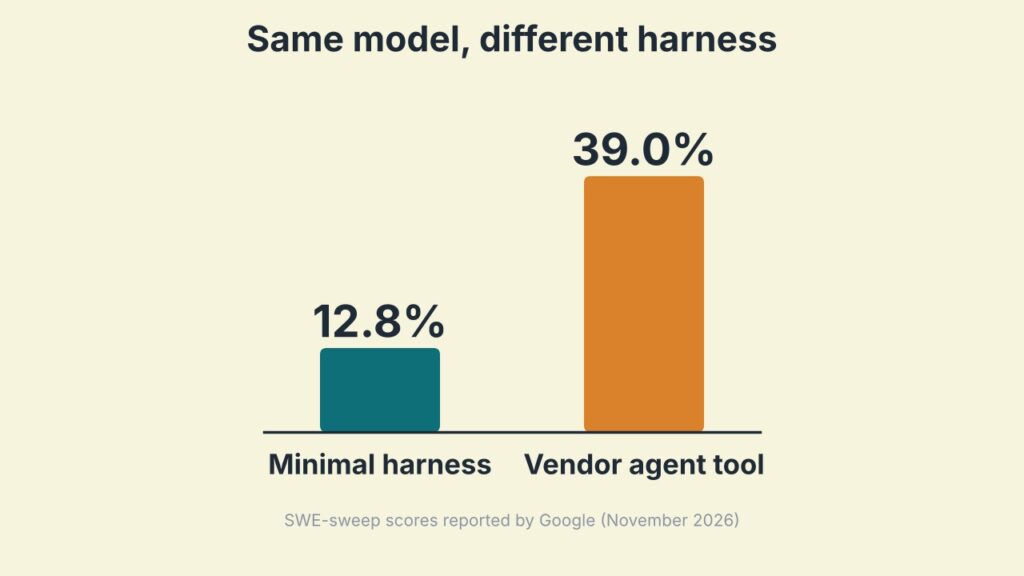
Coding tests come first here, since several of Google’s scores concern code. Researchers presented a widely used exam, SWE-bench, at a 2024 machine learning conference. Their paper describes 2,294 real problems drawn from 12 popular Python projects. The authors add that the top-scoring model then solved under 2% of them. Google also cites a newer coding test called SWE-sweep. The company reports 12.8% for Neon on that test with a minimal setup. Its figure for the same model inside Antigravity, however, is 39.0%. That jump may illustrate a general point about such scores. The surrounding software, known as the harness, can matter as much as the model. A score may therefore describe a whole system, not a brain in a jar. Google also reports 58.6 points on an independent coding-agent index at launch.
Science Scores and the Fine Print
Science and mathematics results appear in the same announcement. Google lists 70.5% on a terminal-based science test and 84.0% on a mathematics benchmark. The company also cites a third-party intelligence index, where Neon scored 61 at launch. Some context accompanies these figures, though. First, most figures appear in a table that Google itself compiled. Moreover, that same table lists higher scores for other models on a few rows. Two coding tests and one chart-reading test are examples. The sources used here also include no independent repeat of the full set. Until one appears, the percentages remain claims reported by the vendor. Independent checking is also the theme of checking code with formal verification.
Fig. 3: Google’s Reported SWE-sweep Scores for the Same Model in Two Harnesses
Why Security Matters More When AI Can Act
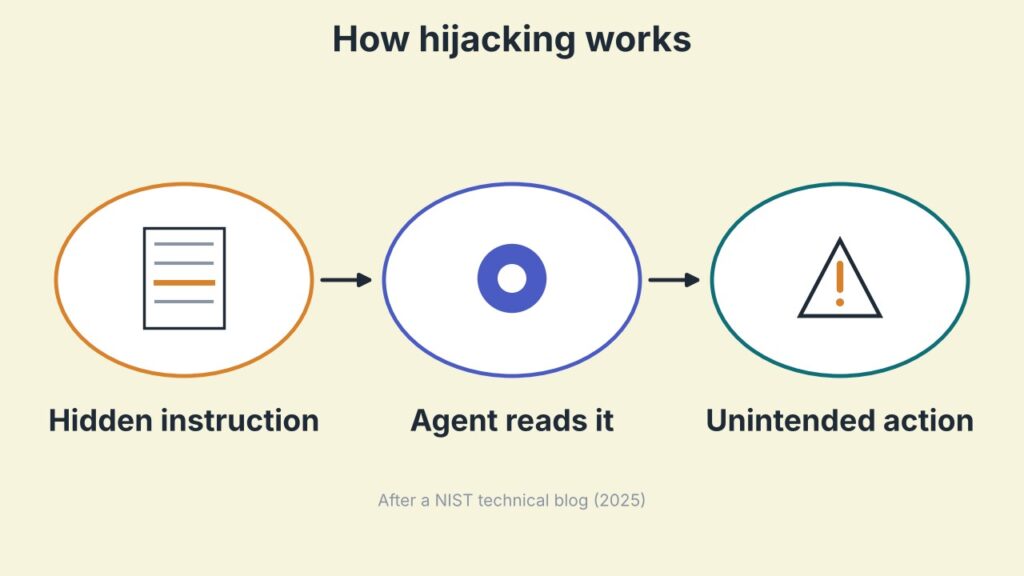
Web pages and emails can also fool an agent that reads them. Attackers can hide instructions inside ordinary content, and the agent may then obey. NIST calls this agent hijacking, a form of indirect prompt injection. One explanation comes from a government agency in Britain. The National Cyber Security Centre says models draw no firm line between instructions and data. David C, a technical director there, says the problem “may never be totally mitigated”. His 2025 blog post therefore tells designers to assume that the model can be confused. The post also advises limiting what an agent may touch and logging what it does. Safeguards outside the model, written as ordinary code, can add another layer. The centre states the aim as reducing the risk, since removing it may not be possible.
Google’s security claims for the new model are specific. The company cites one outside benchmark, run with safeguards on and thinking at maximum. It reports that Neon resisted every attack there, a 0.0% attack success rate. NIST’s own experiments, however, may add context to single-run results. Its staff found that average success rose from 57% to 80% over 25 repeated attacks. Those tests used other models, so the numbers aren’t directly comparable. NIST still concluded that repeated attempts may give a more realistic estimate of risk. Google also cites 90.5% on a vulnerability-finding test for the defensive side. Its figure for patching flawed code is 70.7%. Google is offering a cyber-defense version first to vetted security teams. Other users, meanwhile, receive the standard version of the model.
Fig. 4: Agent Hijacking in Three Steps, After the Description by NIST
Limits and Open Questions
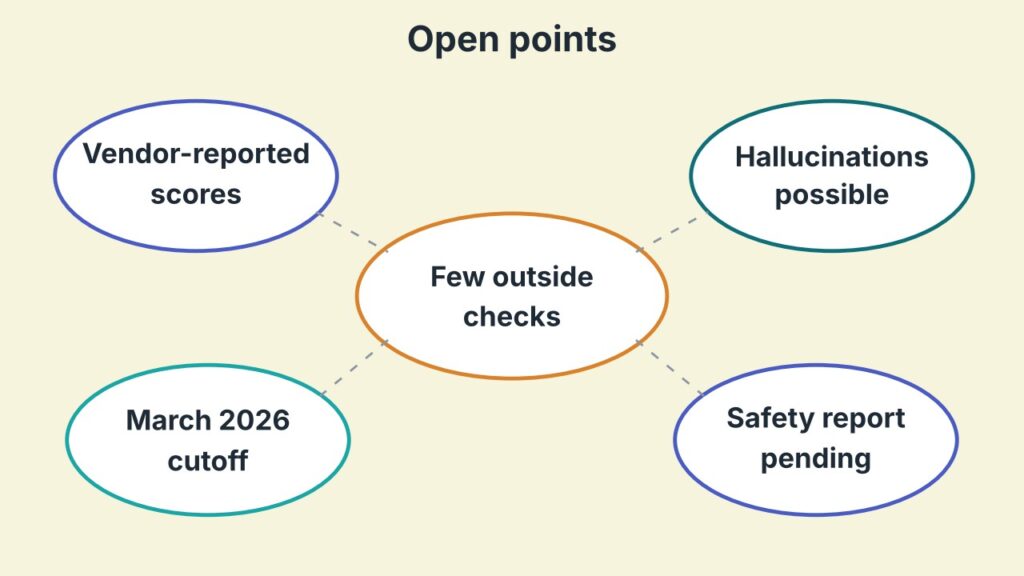
Every performance figure quoted above traces back to Google. The model card, meanwhile, also sets out weaknesses. It lists hallucinations as a general limitation of the model. The card adds that Google is still improving jailbreak resistance. It gives March 2026 as the model’s knowledge cutoff. The card also marks a full safety and security report as coming soon. One line in it concerns security directly. The DeepMind card says a critical cybersecurity threshold “cannot be ruled out”. Google says mitigations are in place for such risks. Benchmarks may also differ from messy real work, where goals shift. The AI Index, separately, counted a record 362 reported AI incidents in 2025. How the new model behaves in independent tests is, in short, still open.
Fig. 5: Five Open Points Discussed in This Article
What It Means for Work, Classrooms and Careers
For businesses, the practical change may be easier access. Google offers Neon through its developer tools, business plans and paid consumer app. Token pricing may also let a small team estimate costs before committing. Still, the announcement gives no independent data on productivity. Any claim about jobs saved or lost would therefore be guesswork. What we can say is narrower. When agents write more code, people may spend more time specifying, reviewing and testing it. Those tasks tend to draw on clear reasoning as well as typing. Budgets may matter too, as our piece on who really pays for cheap AI tools discussed. Whether that shift saves time is not measured in these sources. It therefore remains an open question for each team.
Lessons for Students and Teachers
The same habits can also be practiced at home or in class. One exercise is to write the tests first, then let an AI tool attempt the code. Students then run the tests, read every failure and ask why it happened. In that exercise, the tool acts as a sparring partner instead of an answer machine. Teachers can also build a whole lesson around one statistic. Google, for example, reports a 99.2% pass rate on its agent honesty evaluation. A class could then discuss what the remaining 0.8% means across thousands of tasks. That discussion can lead naturally to verification. Checking sources, rerunning experiments and reading documentation are long-established skills. They may apply equally to work done with AI agents.
Careers and Startup Ideas Around AI Agents
Several career paths may grow out of this shift toward agents. Software developers research, design and build the software that such agents run in. O*NET, a United States occupational database, marks that occupation with its “Bright Outlook” label. It describes projected growth for 2025 to 2035 as much faster than average. Cedefop, a European Union agency, covers the wider group of ICT professionals. Its 2023 analysis projects about 30% employment growth there between 2022 and 2035. Both projections describe their own regions, however, and may only hint at trends elsewhere.
Security specialists, likewise, test agents against hijacking. Evaluation may be a third path, since someone has to design and maintain each benchmark. Related foundations include programming, statistics, networking, and careful technical writing. For entrepreneurs, one possible area is independent testing services for small firms. Another is safety tooling that logs and limits what agents do. Both ideas are untested, however, and are listed here only as possibilities. For Gemini 4 Neon agentic AI, the published scores and stated limits are what is established. Its performance in independent tests and in everyday work is what remains open.
Jimenez, C. E., Yang, J., Wettig, A., Yao, S., Pei, K., Press, O., & Narasimhan, K. (2024). SWE-bench: Can language models resolve real-world GitHub issues? International Conference on Learning Representations (ICLR 2024). https://iclr.cc/virtual/2024/oral/19757
This explainer reports a product announcement neutrally and shows readers what vendor-reported scores do and do not measure, which suits a student audience. The harness example and the repeated-attack finding from NIST make the open points concrete, and a later update could add independent test results once they are published. A short glossary line for the benchmark names would help younger readers. Readers are encouraged to consult the original announcement and the model card for the full list of figures.
Editorial note
This article is an ENTECH explainer on how agentic AI models work and how to read the benchmark claims that accompany a new release, written for students, teachers and early-career readers. It draws on the developer's own announcement and model card, and on four further sources from government bodies, a university and a peer-reviewed conference; the in-article diagrams are original graphics prepared for ENTECH. ENTECH has no commercial relationship with the developer, and all performance figures are reported by the company unless stated otherwise.
Deven Nandapurkar is a Software Engineer, Project Lead; working at the strategic intersection of software engineering, productivity science, and emerging technologies. Driven by a core philosophy of "building things worth building," he leads cross-functional teams and drives end-to-end technical strategy—from early-stage conceptualization through production-grade deployment.
A Computer Engineering graduate from Pune University, Deven brings a sharp systems-thinking approach to technical leadership, honed by years of managing high-stakes engineering projects and leading teams to top placements in national and international hackathons, including the NASA Space Apps Challenge and the Peerlist GenAI Hackathon.
Deven explores how human cognition and emerging technology converge. He regularly writes about cognitive performance optimization, attention management, AI integration, and the evolving dynamics of the modern workforce - offering actionable frameworks for professionals seeking to maximize their productivity and thrive alongside intelligent systems.