The lone scientist in an isolated laboratory is quickly becoming a thing of the past. Today, STEM fields operate as highly connected global ecosystems. Industries now rely on distributed workforces spread across many locations. As a result, navigating advanced digital workspaces matters as much as technical knowledge. Students who learn unified platforms like Webex gain hands-on experience early. They practise messaging, video conferencing, and secure file sharing every day. Therefore, mastering these enterprise technologies becomes the first step toward lasting career success.
The modern technology sector has changed dramatically in just a few years. According to the Tech Council of Australia, the national tech workforce reached about 977,000 people by late 2025. Notably, more than half of these professionals now work outside traditional tech firms. They work across finance, healthcare, and advanced manufacturing instead. Each of these industries depends on constant remote collaboration.
In fact, this shift is clearly not a temporary trend. A 2024 peer-reviewed study found that hybrid work models now cover around 100 million employees globally. Furthermore, those hybrid setups showed a 33% reduction in quit rates. The data confirms that flexibility has become a permanent fixture in the modern economy. A recent STEM Women survey also found that 79% of female graduates prefer hybrid arrangements. Consequently, educational institutions must adapt to prepare graduates for this new reality.
Advanced Digital Workspaces: Essential Skills for Future Innovators
To thrive in distributed teams, students must combine their foundational engineering knowledge with the right collaborative intelligence and modern tech setups. Research from RMIT University underscores this urgency, noting that a staggering 87% of all jobs in Australia now require baseline digital literacy skills. This requirement goes far beyond simple word processing or conducting basic internet research. It involves mastering the sophisticated, cloud-based environments that professionals use to build, design, test, and securely share innovative ideas.
In the real world, fragmented communication can severely disrupt complex projects. A 2025 enterprise survey found that 63% of employees report wasting time at work due to disjointed collaboration tools. This highlights the urgent need for unified systems. Early exposure to these advanced digital workspace environments ensures that young professionals do not feel overwhelmed when they step into their first enterprise role, allowing them to focus on innovation rather than troubleshooting communication barriers.
Core Capabilities Taught by Enterprise Tech
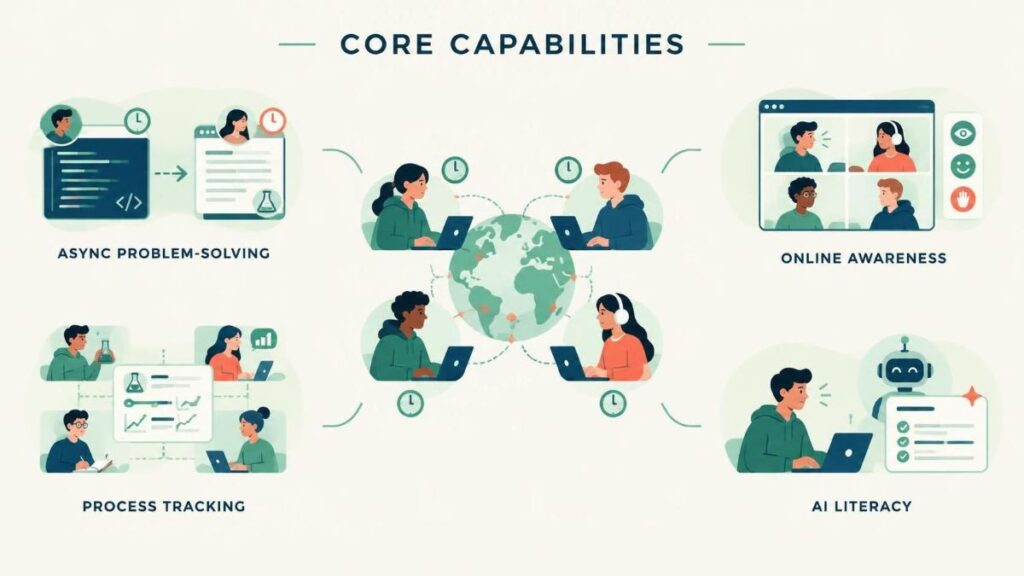
When education providers mimic real-world tech environments, students develop a specific set of highly sought-after soft and hard skills. Integrating advanced communication software into the curriculum helps build several core capabilities.
Fig. 1: Core Capabilities for Digital Workforce (illustration – AI Generated)
Firstly, students practice asynchronous problem solving in their daily coursework. They document code and scientific findings clearly for colleagues in different time zones. As a result, distributed team members continue the work seamlessly without interruption.
Secondly, virtual meetings teach young professionals to read digital cues carefully. A 2026 study on engineering students highlighted that modern education must prioritize adaptability. In practice, interpersonal online awareness shapes how teams build trust. Employees must maintain engagement without physical proximity, and virtual settings make that harder. Consequently, students who join online discussions early build a stronger professional presence.
Also, structured virtual collaboration using breakout spaces significantly improves scientific creativity. Programs like the ExxonMobil Young Engineers initiative demonstrate this benefit clearly. These digital workspaces help students track their methodologies more effectively. Moreover, learners can document every step of an experiment as it happens. Therefore, scientific process tracking becomes measurable, transparent, and far easier to review.
Finally, modern communication platforms introduce students to automated workflows and intelligent meeting summaries. This matters because LinkedIn ranks artificial intelligence literacy as a top skill for digital professionals. Such exposure builds genuine AI literacy before students enter the workforce. Furthermore, advanced digital workspaces let learners experiment with these tools safely. In turn, graduates arrive ready to use AI responsibly from day one.
Bridging the Gap Between Education and Employment
Despite the clear need for these capabilities, the Jobs and Skills Australia roadmap recently highlighted a severe ongoing deficit in digital readiness. Nearly 70% of Information and Communication Technology occupations face talent shortages. The gap is often not about a lack of theoretical knowledge, but rather a lack of practical fluency in the tools that businesses actually use.
The Australian Government’s Digital Skills Organisation pilot identified systemic barriers in how these subjects are taught. They emphasised that to close the employer demand gap, schools and universities must simulate modern enterprise environments. Students need opportunities to practice running virtual project scrums, sharing technical documents securely, and managing their time across hybrid schedules.
Ultimately, preparing the next generation of STEM professionals requires more than just updated textbooks. It demands a holistic approach to connectivity. By embedding advanced digital workspaces into daily educational routines, we can provide young innovators with the confidence and collaborative skills they need to shape the future.
FAQs
What are advanced digital workspaces?
Advanced digital workspaces are cloud-based platforms that bring messaging, video meetings, and secure file sharing together in one place. STEM professionals use them to collaborate across teams, time zones, and devices.
Why do STEM students need to learn a digital workspace early?
Most modern STEM teams work in distributed, hybrid setups rather than in one building. Early practice with a digital workspace helps students enter their first enterprise role with confidence instead of feeling overwhelmed.
Which skills do students build by using advanced digital workspaces?
Students develop asynchronous problem solving, online interpersonal awareness, scientific process tracking, and AI literacy. They also learn to document and share technical work clearly with remote colleagues.
Do employers actually look for digital collaboration skills?
Yes, and demand is growing quickly. Nearly 70 per cent of Australian ICT occupations face talent shortages, and employers increasingly value practical fluency over theory alone.
How can universities and schools prepare students for hybrid STEM careers?
Schools can simulate real enterprise environments inside their courses. Embedding advanced digital workspaces into daily routines gives students hands-on practice before they graduate.
References:
Elliott, K. (2026, August 12). Tech jobs Report August 2026. Tech Council of Australia. https://techcouncil.com.au/newsroom/tech-jobs-report-august-2026/
Bloom, N., Han, R., & Liang, J. (2024b). Hybrid working from home improves retention without damaging performance. Nature, 630(8018), 920–925. https://doi.org/10.1038/s41586-024-07500-2
New report reveals Australia’s major digital skills gap. (n.d.). RMIT University. https://www.rmit.edu.au/news/all-news/2021/feb/digital-skills-gap-report
Communication Statistics 2025 | Project.co. (n.d.). Project.co. https://project.co/communication-statistics-results-2025/
Yu, J. (2026). Educating Engineers for Future Changes: A tripartite framework of hard, soft, and meta competencies. International Journal of Chinese Education, 15(2). https://doi.org/10.1177/2212585×261473496
Sadler, D. (n.d.). Nearly 70% of Aussie IT jobs are in shortage. Information Age. https://ia.acs.org.au/article/2023/nearly-70–of-aussie-it-jobs-are-in-shortage.html
Ishika Tawar is a biotechnology researcher and science enthusiast with a curiosity for understanding how life works at the molecular and cellular level. That curiosity started somewhere around school, wandered through a lot of unrelated corners of science and physics, and eventually settled on something she actually wants to spend her life on: aging and longevity. She supports transhumanism and believes that science and technology should be explored seriously as tools to overcome some of the biological limitations of the human body.
Ishika holds a Master's degree in Biotechnology and has experience in both wet-lab and computational research. At ACTREC, she worked on a project studying the interaction of the TG2 protein with the ribosome, where she gained experience in cloning, site-directed mutagenesis, transformation, and gene knockdown. She was also involved in studying ribosomal heterogeneity using R and publicly available single-cell RNA sequencing datasets from different cancers. As a Research Assistant at SafeWright, she worked on client-based projects involving microbial culturing, biochemical tests, and analysis, along with literature research, report writing, and preparation of laboratory protocols. She has also worked with Python-based analysis to study differential DNA methylation in breast cancer.
Her current areas of interest include epigenetics, genomics, gene therapy, stem cell biology, computational biology, and the use of AI in biological research. She is particularly interested in how these areas can contribute to understanding aging and developing ways to extend healthy human lifespan. She has explored this interest through research projects and hackathons focused on AI, aging, and longevity. She enjoys following ideas across biology, technology and physics, and she believes in evidence, questioning ideas and staying curious about things that are not yet understood.
Outside research, Ishika enjoys reading and talking about science and scientific ideas. She loves travelling and is especially fond of mountains. She also enjoys science communication and hopes to make scientific topics easier to understand without making them inaccurate or oversimplified.