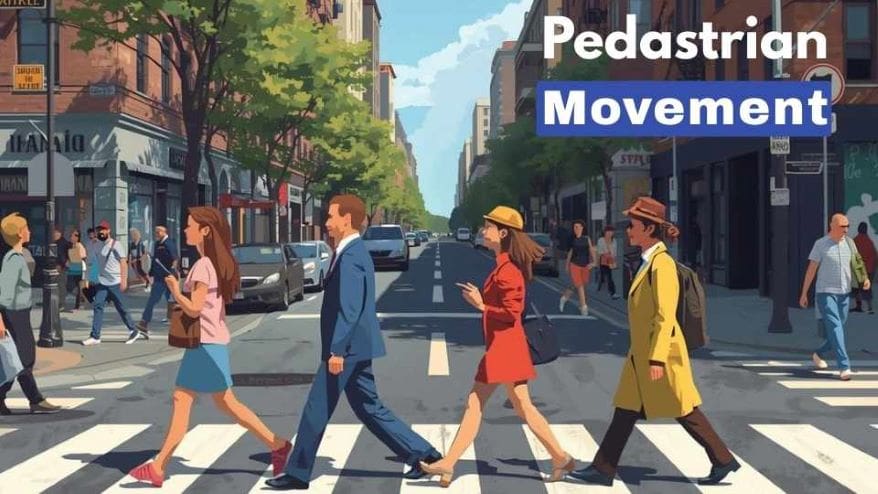
AI predicts pedestrian movement by combining visual cues with contextual understanding. OmniPredict analyzes body posture, gaze direction, surrounding objects, and environmental conditions to forecast what a person is likely to do next.
AI Predicts Pedestrian Movement for Safer Self-Driving Cars
Imagine a world where cars don’t just react to people they anticipate what they’ll do next. This future is now closer to reality because AI predicts pedestrian movement using advanced reasoning instead of simple reaction. A new system called OmniPredict, developed by researchers at Texas A&M University and the Korea Advanced Institute of Science and Technology, is making autonomous vehicles smarter and safer.
OmniPredict uses a Multimodal Large Language Model (MLLM) to understand and predict pedestrian behavior in real time. As a result, self-driving cars can respond more intelligently in complex traffic situations.
Why AI Predicts Pedestrian Movement Better Than Current Systems
Traditional self-driving systems rely heavily on computer vision. They detect pedestrians only after movement occurs, which limits reaction time especially in busy urban areas. In contrast, AI predicts pedestrian movement by combining visual cues with contextual understanding. OmniPredict analyzes body posture, gaze direction, surrounding objects, and environmental conditions to forecast what a person is likely to do next.
According to project lead Dr. Srinkanth Saripalli, “This system is a glimpse into a future where machines anticipate human actions rather than just respond.” This shift from reaction to anticipation is critical for safer autonomous driving.
How OmniPredict Works
To ensure accurate predictions, the system blends multiple data sources:
- Wide-angle scene images
- Close-up pedestrian views
- Vehicle speed data
- Bounding boxes around moving objects
The artificial intelligence system is able to forecast the movement of pedestrians by categorizing their behaviors into many categories. These categories include crossing intent, gaze direction, occlusion (which occurs when parts of a pedestrian are hidden), and specific actions.
Through the utilization of this multimodal technique, OmniPredict is able to determine whether a pedestrian will cross the road or remain motionless, even in places that are densely populated or have poor visibility conditions.
Testing Accuracy in Real-World Scenarios
The researchers tested OmniPredict using challenging benchmarks like the JAAD and WIDEVIEW datasets, which simulate real-world pedestrian behavior. Without additional specialized training, the system achieved 67% accuracy, outperforming leading models by nearly 10%. These results confirm that AI predicts pedestrian movement more reliably than traditional approaches, even when pedestrians are distracted, partially hidden, or behaving unpredictably.
Broader Impact Beyond Traffic Safety
A New Level of Street Intelligence
Because AI predicts pedestrian movement instead of merely detecting it, autonomous vehicles can reduce accidents caused by sudden crossings or unexpected behavior. This leads to smoother traffic flow, fewer near misses, and greater trust between humans and autonomous systems.
Imagine standing at a crosswalk knowing that an AI-powered vehicle understands your intent before you step forward.
Applications Beyond Self-Driving Cars
The ability to anticipate human behavior has uses far beyond road safety:
- Military and emergency operations: Detect stress or posture changes quickly
- Security monitoring: Identify early signs of threatening behavior
- Personal safety systems: Predict risks before they escalate
In all these scenarios, AI predicts pedestrian movement and human intent to support faster, safer decision-making.
A Smarter Future Where AI Partners With Humans
The goal of OmniPredict is not to replace human judgment but to support it. When AI predicts pedestrian movement, autonomous systems gain a deeper understanding of complex environments and human behavior.
As Dr. Saripalli explains, “We envision AI becoming a partner that understands human behavior intuitively.”
By anticipating dangers instead of reacting to them, this new generation of AI could transform traffic safety and reshape how cities manage autonomous mobility.
Additionally, to stay updated with the latest developments in STEM research, visit ENTECH Online. Basically, this is our digital magazine for science, technology, engineering, and mathematics. Further, at ENTECH Online, you’ll find a wealth of information.
Reference:
Ham, J.-S., Huang, J., Jiang, P., Moon, J., Kwon, Y., Saripalli, S., & Kim, C. (2025). Multimodal understanding with GPT-4o to enhance generalizable pedestrian behavior prediction. Computers & Electrical Engineering. https://doi.org/10.1016/j.compeleceng.2025.110741
- Author
- Latest Posts

I’m a web developer and science writer with a Master’s degree in Computer Applications (MCA) from Pune University.
I work in tech, building websites and staying updated with the latest developments. I also love writing about physics, chemistry, technology, robotics, mathematics, and breakthrough innovations. My passion is breaking down complex scientific topics into simple, easy-to-understand stories.
My goal is to help everyone stay informed about the exciting changes happening in science and technology. I believe understanding science shouldn’t be complicated—it should be accessible to all.