Scientists recently made a significant breakthrough in understanding how ice changes before it melts. This study focuses on a process called ice premelting,
Discovering the Amorphous Ice Layer: A New Chapter in Ice Premelting Research
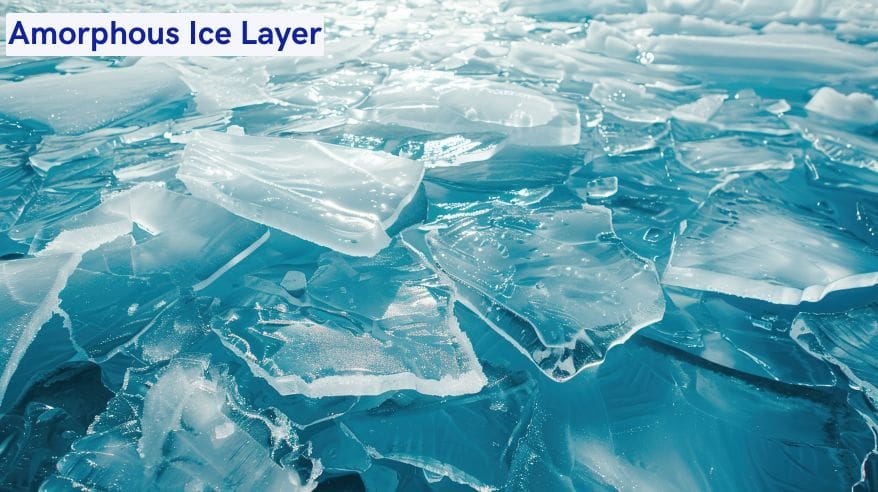
This study focuses on a process called ice premelting, where a thin layer called the Amorphous Ice Layer forms on ice surfaces below the melting point. As a result, this layer plays a crucial role in various phenomena such as cloud formation, cryopreservation, and more. Therefore, understanding ice premelting helps explain how ice behaves in both natural and controlled environments..
Understanding Ice Premelting and Its Importance
Ice premelting means a thin liquidlike layer forms on ice surfaces below freezing. This happens well ahead of melting, in temperatures between 121 and 180 K. Scientists have studied this for over 170 years because it impacts areas like cloud formation, cryopreservation, and even planetary science. Despite many studies, the detailed atomic structure of premelted ice remained unclear until now.
The Limits of Traditional Methods
Most tools offer only two-dimensional views or average results, missing fine details needed to fully understand these layers. For example, methods like x-ray absorption spectroscopy or electron diffraction reveal some information but cannot resolve tiny surface features very well.
The Power of Combining AI with Microscopy
A team from Peking University developed a new approach that blends machine learning (ML) with advanced imaging methods called atomic force microscopy (AFM). As a result, this combination overcomes previous problems by reconstructing three-dimensional structures from surface images.
This approach includes two key models:
- An object detection network that finds the topmost surface structure from AFM images.
- A structure generation network that predicts deeper layers where direct signals are weak or missing.
The entire system was trained using simulated data enhanced by machine learning techniques to resemble real experimental noise. As a result, researchers achieved detailed mapping of ice layers at temperatures difficult to access experimentally.
Discovering the Amorphous Ice Layer (AIL)
The most exciting finding was identifying an amorphous ice layer (AIL), which forms before the previously known quasiliquid layer during premelting. This AIL exists between 121 K to 180 K (-152°C to -93°C) and shows unique features:
- A disordered hydrogen-bond network unlike crystalline ice.
- Solidlike dynamics, differing from liquid layers traditionally expected in premelting.
- This challenges old ideas about how ice melts and grows at its surfaces.
Why This Finding Matters
This study improves our understanding of phase transitions at surfaces and has broad implications. It can influence research in atmospheric science by explaining cloud formation better. It also benefits areas like materials science and cryopreservation technology where surface behavior is crucial.
This work marks a significant leap in exploring disordered interfaces with unprecedented precision, said one lead scientist involved in the project.
A General Framework for Complex Surfaces
The new machine learning framework goes beyond just ice surfaces; it offers tools useful for studying many complex materials. For example:
- Molecular recognition processes
- Catalyst surface reactions
- Ionic solvation behaviors
- Nanoscale material growth
Impacts Beyond Ice: Broader Scientific Applications
This research doesn’t stop at studying ice alone. Moreover, the novel machine learning framework can be applied across many fields involving complex surfaces—from catalysts to biomolecular recognition systems. Consequently, scientists anticipate it will help explain the mysteries behind disordered materials’ structures and behaviors in multiple disciplines.
Additionally, to stay updated with the latest developments in STEM research, visit ENTECH Online. Basically, this is our digital magazine for science, technology, engineering, and mathematics. Also, at ENTECH Online, you’ll find a wealth of information.
Reference
- Tang, B., Lo, C., Liang, T., Hong, J., Qin, M., Song, Y., Cao, D., Jiang, Y., & Xu, L. (2025). Unveiling the Amorphous Ice Layer during Premelting Using AFM Integrating Machine Learning. Physical Review X, 15(4). https://doi.org/10.1103/9fzf-y9n9
- Author
- Latest Posts

Ashwini Kshirsagar holds a graduate degree in Chemistry and a postgraduate degree in Environmental Science from Shivaji University, Kolhapur. With a strong foundation in scientific principles and a creative flair, she blends her expertise in environmental science with skills in technical writing, graphic design, and video editing. Proficient in Adobe software, Ashwini excels at transforming complex scientific concepts into clear, engaging, and visually compelling content. Her unique ability to merge science and storytelling allows her to create impactful communication materials that are both informative and accessible to a wide audience.