Algorithms form the backbone of coding, providing step-by-step instructions and logical solutions to complex problems. These algorithms act as the building blocks for designing efficient and optimized software solutions. Developing algorithms is key for tasks…
Introduction to Computer Engineering: Degrees, Careers, and Future Impact

Estimated reading time: 9 minutes
If you like both coding and building things, this introduction to computer engineering is for you. Basically, it is a field where software meets hardware. As a matter of fact, you might write code for a robot, design a circuit, or debug a smart device. Because of that mix makes the major exciting and practical. However, in grade 11 or 12, you do not need to know everything yet. Indeed, you just need curiosity, patience, and a willingness to try. Computer engineering rewards students who like solving real problems. It also opens doors to many careers. If you enjoy making things work together, you may already be thinking like a computer engineer.
Key Takeaways
- Computer engineering blends hardware, software, and systems thinking.
- You learn about circuits, programming, microcontrollers, and digital logic.
- Hands-on projects make the subject easier to understand.
- The field connects to IoT, robotics, smart systems, and embedded devices.
- You can start preparing now with math, physics, coding, and small projects.
What Computer Cngineering Is
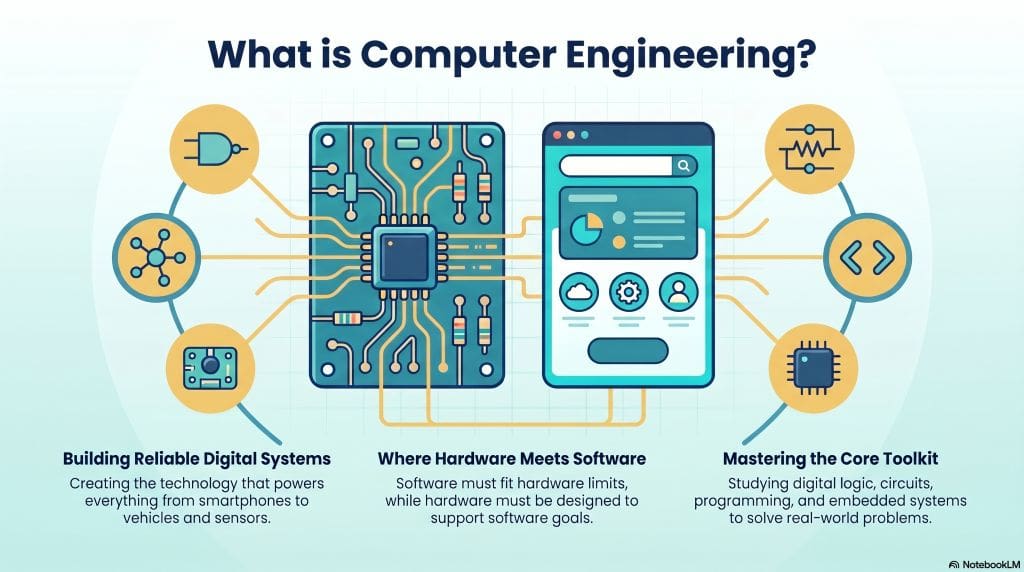
Computer engineering is about building reliable digital systems. Generally, these systems can power phones, sensors, tools, vehicles, and control networks. The field is not only about writing code. It is also about making that code work inside real hardware. That is why the major feels so practical.
You learn how hardware and software depend on each other. Certainly, software must fit hardware limits. Also, hardware must support software goals. Neverthless, that connection is a big part of the field. It also explains why computer engineering matters in safety, performance, and reliability.
What You Study in the Degree
In a computer engineering degree, you usually study:
- digital logic
- circuits
- programming
- microcontrollers
- embedded systems
- systems design
You also build problem-solving habits. Additionally, you learn to test ideas, fix mistakes, and improve your design. Thus, that process is a big part of the journey.
Why Students Like Both Hardware and Software
Computer engineering attracts students who enjoy both sides of technology. For that reason, you might like programming one day and wiring a device the next. That mix is what makes the field stand out.
Research on embedded-programming education shows that students learn better when they work with physical devices like sensors, motors, and displays alongside code. Early engineering labs also use Arduino and hands-on circuit work to help students connect abstract ideas to real systems.
That is why this major often feels active. You do not just read about technology. You build it, test it, and then you see what happens. That makes learning feel more real, which can boost confidence.
A Simple Way to Think About It
Think of it like this:
- computer science is often more software-focused
- electrical engineering is often more hardware-focused
- computer engineering sits in the middle
That middle space is where many modern devices live.
What You Learn in Computer Engineering Classes
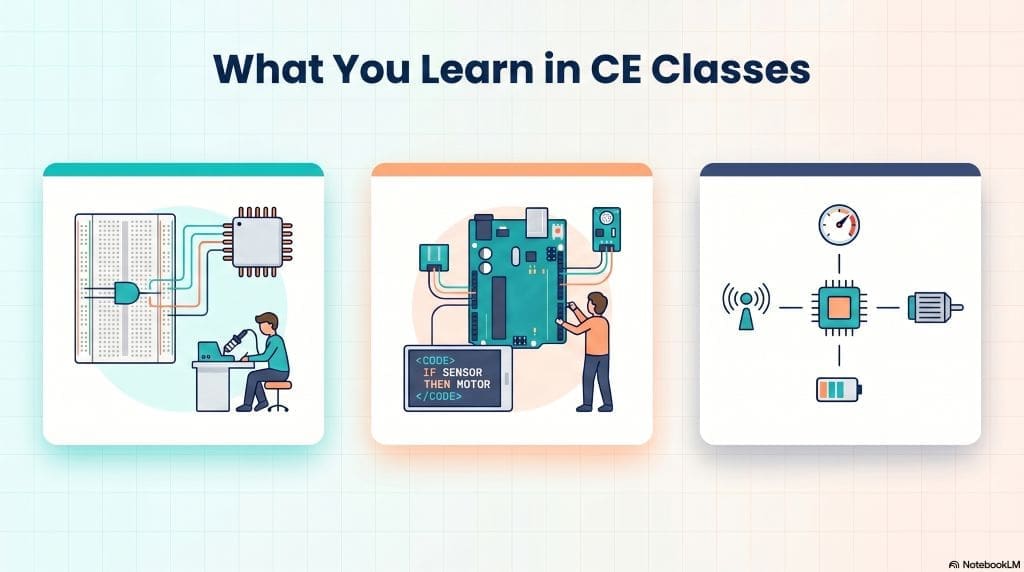
In general, a strong introduction to computer engineering should include the main skills you will meet in class. Particularly, these classes often begin with the basics of digital systems. Additionally, students learn binary, logic gates, and circuit behavior. They also learn how to move from a simple idea to a working design.
In essence, a review of digital-systems education notes that teaching has shifted from older chip-based labs toward FPGA-based design and hardware description languages like VHDL. That matters because it shows how the field keeps evolving.
Digital Logic and Circuits
Digital logic is the foundation. Basically, it helps you understand how computers make decisions using 0s and 1s. Secondly, circuits show how those decisions become real electrical behavior.
Students often learn better when they can see the hardware in action. SPecifically, first-year labs with benchtop tools, Arduino boards, and simple electronic parts help students explore motors, power conversion, and logic.
Programming for Devices
Programming in computer engineering is not only about apps and websites. In reality, it often means writing code for physical devices. In that case, the code might read a sensor, move a motor, or light up a display.
Studies on embedded learning report gains in programming skill, algorithm understanding, motivation, and confidence when students work with Arduino and Raspberry Pi projects. That is a strong sign that hands-on coding matters.
Systems Thinking
Systems thinking means seeing the whole picture. You ask:
- What goes in?
- What gets processed?
- What comes out?
- What limits the design?
This mindset helps you solve problems step by step. It also helps you stay calm when a project fails, because failure becomes data, not defeat. Particularly, that habit builds resilience.
Real-World Uses of Computer Engineering
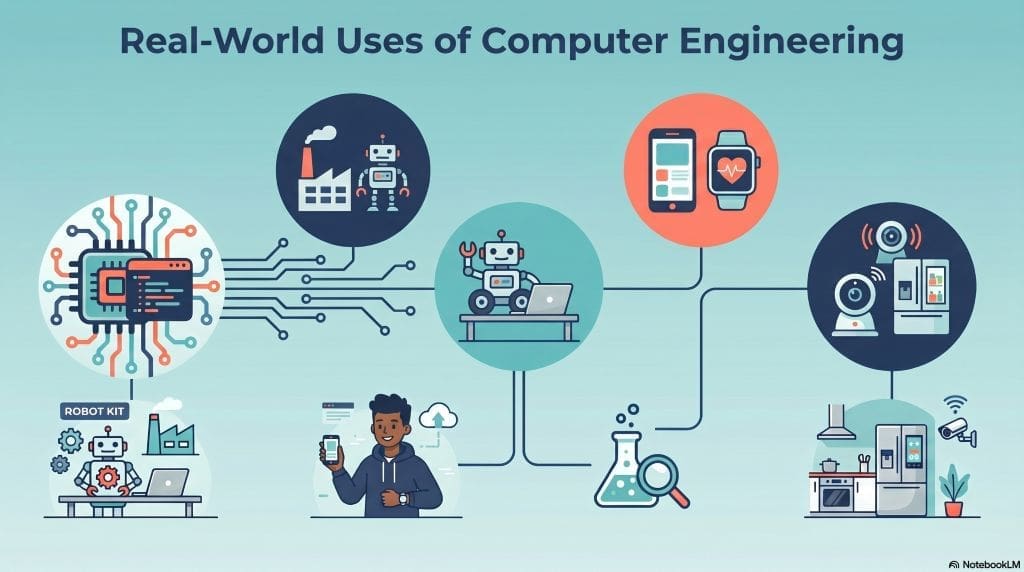
Computer engineering shows up in more places than most students notice. For example, it is in smart tools, connected devices, robotics, and IoT systems. It is also part of larger areas like health care, infrastructure, industry, and research.
Everyday Examples
You already interact with computer engineering when you use:
- phones
- wearables
- smart appliances
- home security devices
- robot kits
These products work because hardware and software are designed to work together. That is the core idea of the field.
Smart Systems and IoT
Many computer engineering projects now focus on IoT and smart systems. For example, in undergraduate capstones, students often build projects that connect sensors, processors, and cloud tools. These projects are useful because they mirror real-world technology.
How to start preparing in grade 11 or 12
You do not need to wait until university to begin. You can start now with small steps. These steps help you build a strong foundation before you apply.
What to Focus on
Try to strengthen:
- math
- physics
- basic programming
- communication
- problem-solving
Math helps with modeling and logic. Physics helps with hardware and circuits. Programming helps you understand how devices behave. Communication matters too, because engineers must explain their ideas clearly.
Easy First Projects
You can start small. Try one of these:
- build a simple sensor project
- learn basic coding logic
- join robotics club
- practice explaining how your project works
These kinds of activities match the hands-on learning style used in computer engineering education.
Career Paths after Computer Engineering
A computer engineering degree can lead to many directions. In fact, some jobs are hardware-focused. Some are software-focused. Others combine both.
Common Career Directions
You may move toward:
- embedded systems
- hardware testing
- digital design
- IoT development
- systems integration
- robotics support
This field is especially useful if you like building things that must work in the real world. That is why it can feel purposeful.
Why the Field Stays Relevant
The demand for smart systems keeps growing. Open-access sources in the provided material show growing attention to IoT, edge AI, and embedded programming. That does not guarantee one exact job outcome. But it does show that the skill set stays useful.
FAQ about Introduction to Computer Engineering
What is computer engineering in simple words?
It is the study of how to build computers and smart digital systems using both hardware and software.
Is computer engineering only about coding?
No. It also includes circuits, digital logic, microcontrollers, embedded systems, and hardware design.
Do I need to be a genius in math?
No. You need a solid math base and a willingness to practice. Growth matters more than perfection.
Is computer engineering good for students who like robotics?
Yes. Robotics often uses sensors, controllers, code, and hardware together.
What subjects should I study before university?
Focus on math, physics, programming basics, and communication skills.
Is computer engineering harder than computer science?
It depends on you. If you like both hardware and software, computer engineering may feel natural. If you prefer only software, computer science may fit better.
Can I start learning computer engineering in high school?
Yes. You can begin with coding, electronics kits, robotics clubs, and simple project work.
What kind of person fits computer engineering?
A curious person who likes solving problems, testing ideas, and building useful things often does well.
Final thoughts
Computer engineering is a strong choice if you want a field that feels real and useful. It blends code, circuits, and problem-solving. It also connects to modern tools like embedded systems, IoT, and smart devices. If you are in grade 11 or 12, you can start preparing now. Learn the basics. Try small projects. Ask questions. Keep building.
This is the heart of an introduction to computer engineering: you learn how technology works, then you help shape what it can do next. That makes the path exciting, practical, and full of potential.
References
Ariza, J. Á., & Baez, H. (2021). Understanding the role of single‐board computers in engineering and computer science education: A systematic literature review. In Computer Applications in Engineering Education. Wiley. https://doi.org/10.1002/cae.22439
Borovský, D., Hanč, J., & Hančová, M. (2023). Scientific Computing with Open SageMath not only for Physics Education. arXiv (Cornell University). https://doi.org/10.48550/arxiv.2308.07199
Dizdarevic, J., & Jukan, A. (2021). Engineering an IoT-Edge-Cloud Computing System Architecture: Lessons Learnt from An Undergraduate Lab Course. In 2021 International Conference on Computer Communications and Networks (ICCCN) (pp. 1–11). IEEE. https://doi.org/10.1109/icccn52240.2021.9522268
Islam, M. R. (2024). Parallel Computing Architectures for Robotic Applications: A Comprehensive Review. arXiv (Cornell University). https://doi.org/10.48550/arxiv.2407.01011
Latina, A. (2021). Tools for Scientific Computing. arXiv (Cornell University). https://doi.org/10.48550/arxiv.2108.13053
Marić, T., Gläser, D., Lehr, J.-P., Papagiannidis, I., Lambie, B., Bischof, C., & Bothe, D. (2022). A Research Software Engineering Workflow for Computational Science and Engineering. arXiv (Cornell University). https://doi.org/10.48550/arxiv.2208.07460
Milewicz, R., Carver, J. C., Grayson, S., & Atkison, T. (2022). A Secure Future for Open-Source Computational Science and Engineering. arXiv (Cornell University). https://doi.org/10.48550/arxiv.2211.06343
Papagiannakis, G., Kamarianakis, M., Protopsaltis, A., Angelis, D., & Zikas, P. (2023). Project Elements: A computational entity-component-system in a scene-graph pythonic framework, for a neural, geometric computer graphics curriculum. arXiv (Cornell University). https://doi.org/10.48550/arxiv.2302.07691
Saligrama, A., Ho, C.-T., Tripp, B., Abbott, M. B., & Kozyrakis, C. (2024). Teaching Cloud Infrastructure and Scalable Application Deployment in an Undergraduate Computer Science Program. arXiv (Cornell University). https://doi.org/10.48550/arxiv.2410.01032
Tahir, N., & Parasuraman, R. (2025). Edge Computing and Its Application in Robotics: A Survey. In Journal of Sensor and Actuator Networks (Vol. 14, Issue 4, p. 65). MDPI AG. https://doi.org/10.3390/jsan14040065
Vergés, P., Heddes, M., Nunes, I., Givargis, T., & Nicolau, A. (2023). HDCC: A Hyperdimensional Computing compiler for classification on embedded systems and high-performance computing. arXiv (Cornell University). https://doi.org/10.48550/arxiv.2304.12398
Wen, J., Chen, Z., & Liu, X. (2022). Software Engineering for Serverless Computing. arXiv (Cornell University). https://doi.org/10.48550/arxiv.2207.13263
- Author
- Latest Posts

Deven Nandapurkar is a Software Engineer, Project Lead; working at the strategic intersection of software engineering, productivity science, and emerging technologies. Driven by a core philosophy of “building things worth building,” he leads cross-functional teams and drives end-to-end technical strategy—from early-stage conceptualization through production-grade deployment.
A Computer Engineering graduate from Pune University, Deven brings a sharp systems-thinking approach to technical leadership, honed by years of managing high-stakes engineering projects and leading teams to top placements in national and international hackathons, including the NASA Space Apps Challenge and the Peerlist GenAI Hackathon.
Deven explores how human cognition and emerging technology converge. He regularly writes about cognitive performance optimization, attention management, AI integration, and the evolving dynamics of the modern workforce – offering actionable frameworks for professionals seeking to maximize their productivity and thrive alongside intelligent systems.




Insightful
Thanks for your comment!
Keep visiting https://entechonline.com/ to read the latest news and articles on Science, Technology, Engineering and Mathematics STEM. ENTECH Online is more than just a magazine; it’s a gateway to a world of possibilities for teenagers passionate about Science, Technology, Engineering, and Mathematics (STEM).
Regards
Dr. Charudatta S Pathak
Editor
ENTECH Magazine
Great article
Thanks for your comment!
Keep visiting https://entechonline.com/ to read the latest news and articles on Science, Technology, Engineering and Mathematics STEM. ENTECH Online is more than just a magazine; it’s a gateway to a world of possibilities for teenagers passionate about Science, Technology, Engineering, and Mathematics (STEM).
Regards
Dr. Charudatta S Pathak
Editor
ENTECH Magazine
Nice information
Thanks for your comment!
Keep visiting entechonline.com to read the latest news and articles on Science, Technology, Engineering and Mathematics STEM. ENTECH Online is more than just a magazine; it’s a gateway to a world of possibilities for teenagers passionate about Science, Technology, Engineering, and Mathematics (STEM).
Very nice and amazing Article.
Thanks for your comment!
Keep visiting entechonline.com to read the latest news and articles on Science, Technology, Engineering and Mathematics STEM. ENTECH Online is more than just a magazine; it’s a gateway to a world of possibilities for teenagers passionate about Science, Technology, Engineering, and Mathematics (STEM).
This is very attention-grabbing, Yoou are an excessively skilled blogger.
I have joined your rrss feed andd stay up for in search
of extra off your magnificent post. Also, I have shared
your site in my social networks.
Amazing😍👍
Thanks for your comment!
Keep visiting entechonline.com to read the latest news and articles on Science, Technology, Engineering and Mathematics STEM. ENTECH Online is more than just a magazine; it’s a gateway to a world of possibilities for teenagers passionate about Science, Technology, Engineering, and Mathematics (STEM).
Nice Article
Thanks for your comment!
Keep visiting entechonline.com to read the latest news and articles on Science, Technology, Engineering and Mathematics STEM. ENTECH Online is more than just a magazine; it’s a gateway to a world of possibilities for teenagers passionate about Science, Technology, Engineering, and Mathematics (STEM).
Very good Article, such an amazing😍
Thanks for your comment!
Keep visiting entechonline.com to read the latest news and articles on Science, Technology, Engineering and Mathematics STEM. ENTECH Online is more than just a magazine; it’s a gateway to a world of possibilities for teenagers passionate about Science, Technology, Engineering, and Mathematics (STEM).
👍👍💯
Thanks for your comment, keep visiting entechonline.com for more articles related to your interests.