Balanoglossus is an animal that lives in the sea. It is an invertebrate...
Balanoglossus Evolution and the History of Animal Life
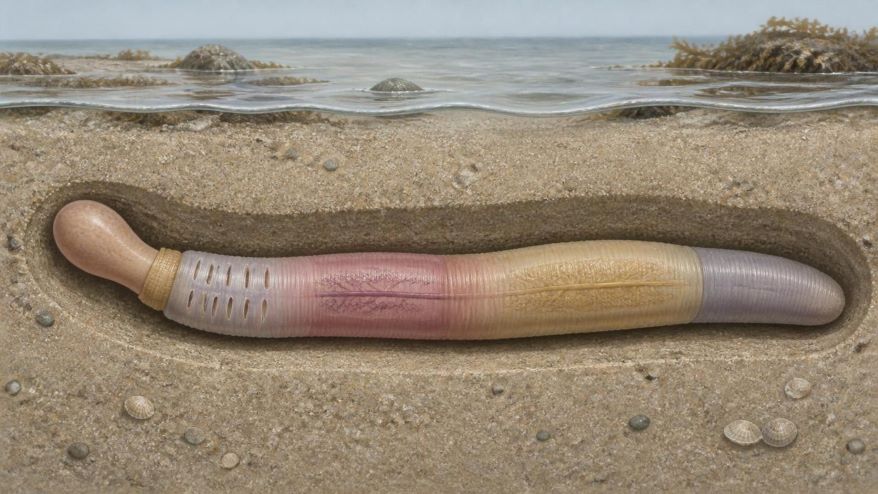
The story of evolution contains many fascinating chapters. Among them, the phylum Hemichordata presents an intriguing group of marine animals that offers valuable insights into the development of complex life on Earth. For more than a century, scientists have examined and debated the evolutionary relationships of these organisms. In particular, the genus Balanoglossus’ evolution has attracted considerable scientific attention. Although these worm-like animals lack a true backbone, they share certain developmental and anatomical features with chordates. Furthermore, these similarities help researchers investigate the evolutionary relationships among major animal groups. As a result, scientists study Balanoglossus to better understand the evolutionary history of deuterostomes and the origins of vertebrate characteristics. In addition, recent research continues to provide new perspectives on these ancient marine organisms.
Key Takeaways: Balanoglossus evolution
- Hemichordata represents a crucial evolutionary position between invertebrates and chordates.
- Balanoglossus shows three body regions: proboscis, collar, and trunk.
- These animals have a stomochord, once thought to be related to the notochord.
- Cephalodiscus and Rhabdopleura are other important hemichordate groups.
- Molecular studies now place Hemichordata closer to echinoderms than chordates
What Are Hemichordata?
Hemichordata is a small phylum of marine invertebrates. Scientists have described about 130 living species so far. These animals live in shallow coastal waters worldwide. Some species burrow in sand or mud. Others live in tubes they build themselves. The name “Hemichordata” means “half-chordate”. This name hints at their dual nature. They show chordate-like features in their larval stage. But adults lack a true backbone. This makes them a fascinating group for evolutionary studies. The phylum includes three main classes: Enteropneusta, Pterobranchia, and the extinct Graptolithina. Enteropneusts are the acorn worms, with Balanoglossus as a key genus. Pterobranchs are small, colonial animals. Graptolites are only known from fossils. All hemichordates share some basic body plans. They have a three-part body division. They also possess a unique structure called the stomochord.
The Three Body Regions of Hemichordates
Hemichordates possess a distinctive body plan consisting of three main regions. First, the proboscis, or protosome, forms the anterior part of the animal. It plays an important role in burrowing and feeding, thereby helping the organism interact with its marine environment. Next, the collar, or mesosome, connects the proboscis to the trunk. In addition, this region contains the mouth opening and supports feeding activities. Finally, the trunk, or metasome, forms the longest body region and contains most of the internal organs. For example, it houses the digestive system and reproductive organs. Furthermore, the trunk can become considerably elongated in certain species.
Balanoglossus Evolution: The Acorn Worm
Balanoglossus belongs to the class Enteropneusta, whose members are commonly known as acorn worms. Interestingly, this name comes from the acorn-like shape of their proboscis. Typically, these marine animals inhabit shallow waters, where they construct U-shaped burrows in sandy or muddy sediments. Furthermore, some species can grow remarkably long, reaching up to approximately 2.5 metres. Despite their size, they move slowly through the sediment and generally lead a sluggish lifestyle.
The Stomachord and Its Evolutionary Significance
The stomochord has remained a central topic in evolutionary discussions. First, this structure develops from the roof of the buccal cavity and extends backward into the collar region. Because it has a rod-like shape and follows the body axis, early researchers considered a possible relationship between the notochord and the stomochord. Furthermore, the notochord serves as a defining structure of chordates, including vertebrates. However, modern developmental studies show that the two structures are not homologous. In particular, the notochord develops from the endoderm associated with the digestive tract, whereas the notochord develops from the mesoderm. In addition, their structural and molecular characteristics differ. For example, the stomochord contains collagen and other proteins, while the notochord has a distinctive organisation involving vacuolated cells
Balanoglossus Evolution as a Missing Link
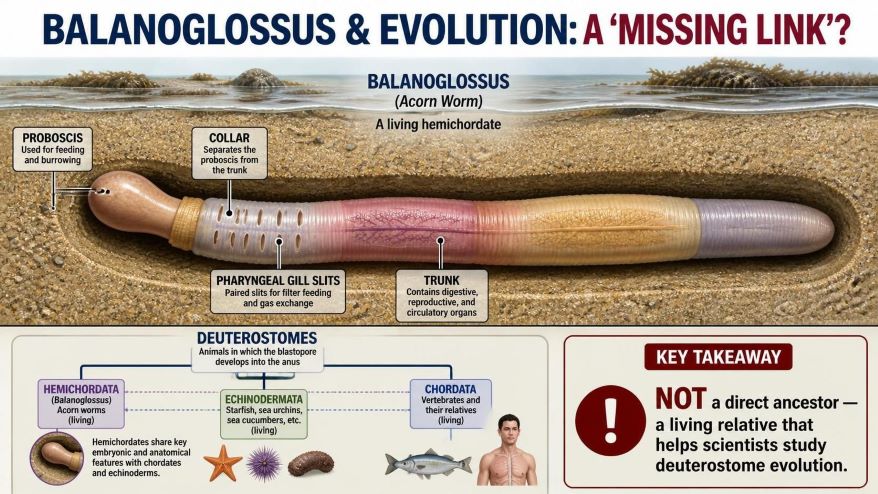
For many years, Balanoglossus was considered the missing link between invertebrates and chordates. This idea came from several anatomical similarities. Both have a post-anal tail in some stages. Scientists placed them at the base of the chordate family tree. But recent molecular evidence has changed this view. DNA studies now show hemichordates are closer to echinoderms. Echinoderms include starfish, sea urchins, and sea cucumbers. This new placement surprised many researchers.
The New Evolutionary Tree
Scientists now have a clearer view of where hemichordates fit in animal evolution. First, older ideas placed hemichordates close to chordates. However, newer studies place them closer to echinoderms, such as sea stars and sea urchins. In addition, both groups belong to the larger group called deuterostomes.
| Feature | Old View | New View |
|---|---|---|
| Closest relatives | Chordates | Echinoderms |
| Evolutionary position | Near the base of chordates | Within deuterostomes |
| Stomach chord | rudimentary notochord | Support structure linked to feeding |
| Gill slits | Chordate-like feature | An old deuterostome feature |
Next, the new evolutionary tree shows that hemichordates and echinoderms share a common ancestor. At the same time, chordates follow a different branch of the deuterostome family tree. Therefore, scientists do not consider hemichordates to be direct ancestors of vertebrates. Instead, they help us understand some features that may have been present in early deuterostomes.
Furthermore, hemichordates have a mix of body features that gives scientists useful clues about early animal evolution. For example, their gill slits, body regions, and other traits help researchers compare them with echinoderms and chordates. As a result, studying hemichordates can help us better understand how major animal groups changed over time. Overall, the new evolutionary tree places hemichordates within deuterostome history rather than directly on the path to vertebrates.
The Life Cycle of Balanoglossus
Balanoglossus evolution has a life cycle with many clear steps. First, the cycle starts with a fertilised egg. Next, the egg grows into a free-swimming larva called a trochone. This larva looks much like the larvae of echinoderms, such as sea stars and sea urchins. In addition, the tunicate uses tiny hair-like parts called cilia to swim and feed on plankton.
After some time, the larva goes through metamorphosis, which means that its body changes into a new form. Then, it settles on the seafloor and starts to develop its main body parts. As a result, the proboscis, collar, and trunk form as the larva changes into a young worm. Next, the young worm grows slowly and becomes an adult
Frequently Asked Questions: Balanoglossus evolution
What makes Balanoglossus special in evolution?
It connects simple and complex animals. It has traits from both groups therefore, scientists study it to learn how animals changed.
Does Balanoglossus have a backbone?
No, it does not have a backbone. Its body is soft. It uses a tube called a stomochord instead.
Where can someone find Balanoglossus?
People find it in shallow ocean water. It likes sandy places thus, digs and hides under the sand.
Why do scientists watch Balanoglossus numbers?
Scientists watch this to find ocean problems early. Fewer animals can mean pollution or changes in water.
How does Balanoglossus help with science today?
Researchers use it to learn about genes as well as animal growth. New studies show how simple animals became complex.
References
- Stach, T. (2008). Chordate phylogeny and evolution: a not so simple three‐taxon problem. Journal of Zoology, 276(2), 117-141. https://doi.org/10.1111/j.1469-7998.2008.00497.x
- Lowe, C. J., Terasaki, M., Wu, M., Freeman, R. M., Runft, L., Kwan, K., … & Kirschner, M. (2006). Dorsoventral patterning in hemichordates: insights into early chordate evolution. PLoS Biol, 4(9), e291. https://doi.org/10.1371/journal.pbio.0040291
- Miyamoto, N., & Saito, Y. (2007). Morphology and development of a new species of Balanoglossus (Hemichordata: Enteropneusta: Ptychoderidae) from Shimoda, Japan. Zoological Science, 24(12), 1278–1285. https://doi.org/10.2108/zsj.24.1278
- Author
- Latest Posts

I am a Master’s qualified in Science with focus on Zoology and Entomology and am a passionate, curiosity-driven science enthusiast aiming to transform complex scientific ideas in a manner that are easy to understand hence, educate, and inspire.
I have an experience of working on the projects in the field of Entomology which has provided me hands-on experience with various research techniques. Besides, I have also gained experience of lab work as well as developed communication skills during the course of my bachelors and masters.
With a strong foundation in life sciences and a growing interest in Medical and Biological research, I have cultivated a writing style that merges scientific facts with creativity.
My experience in teaching has also taught me to develop an understanding of what are the interests of people and how to communicate them effectively.
I am committed to lifelong learning, actively engaging in Interdisciplinary learning, so as to broaden my perspective.
- Author
- Latest Posts
I completed my Master of Science from the University of Allahabad in 2017 with a strong academic background in life sciences and chemistry. My specialization included Molecular Biology, Microbiology, Genetics, Plant Breeding, Phycology, Paleobotany, and Bioinformatics, along with Organic Chemistry, Inorganic Chemistry, and Physical Chemistry. This multidisciplinary training provided me with a comprehensive understanding of biological systems and analytical scientific approaches.
After completing my postgraduate studies, I gained valuable professional experience in both the education and social development sectors. I worked at A.M. Oxford Public School, where I was actively involved in guiding students toward academic excellence. In this role, I focused on creating an engaging learning environment, encouraging critical thinking, and nurturing students’ curiosity for scientific learning. My experience as an educator strengthened my communication, mentoring, and classroom management skills.
In addition to my teaching experience, I worked with Jeevan Jagriti Foundation, where I contributed to community-based initiatives aimed at improving educational access and awareness among underprivileged sections of society. Through this work, I participated in programs designed to support social development and promote the value of education in marginalized communities.
These professional experiences helped me develop strong interpersonal, leadership, and organizational skills while reinforcing my commitment to education and community service.