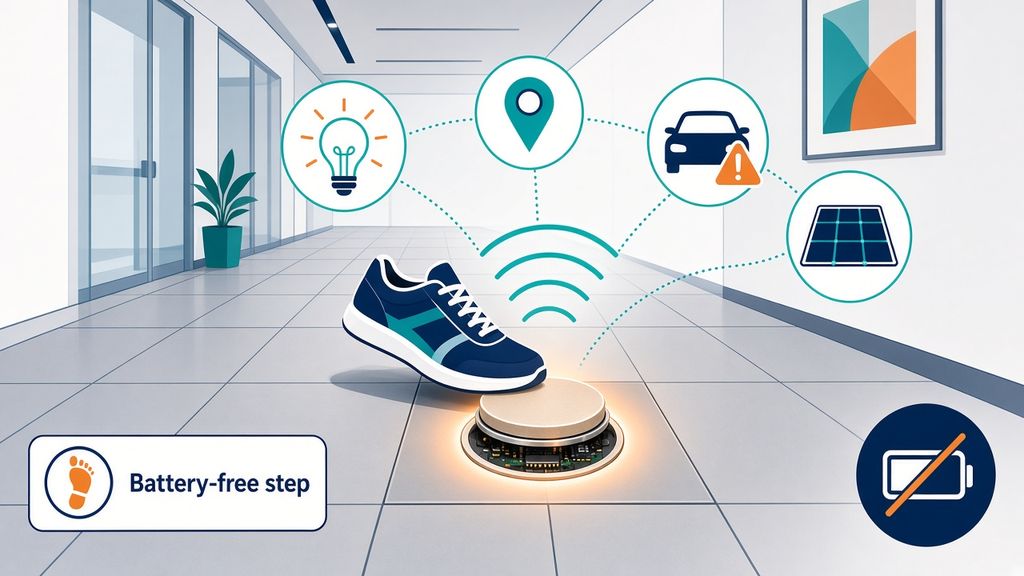
Every day, you press light switches, doorbells, and elevator buttons without much thought. Now picture the floor itself doing that job while you walk. Engineers in China and Singapore have built exactly that: a battery-free smart floor tile. Each step powers a tiny circuit, which then sends a standard Bluetooth Low Energy message. Yaozi Zheng, Yawei Wang and Yizhou Li led the work as equal first authors. Guobiao Hu of the Hong Kong University of Science and Technology (Guangzhou) is corresponding author. In addition, partners joined from Nanyang Technological University, Hohai University and Yunnan University. Across real tests, 97 out of 100 footsteps sent at least one valid wireless packet. The team reported its results in Microsystems & Nanoengineering (DOI: 10.1038/s41378-026-01486-9).
Why Battery-Free Smart Floor Tiles Matter
Smart buildings rely on thousands of small sensors that react to people. Our guide to the Internet of Things explains how such devices share data. Floors, in particular, make a natural home for these sensors. After all, people walk, turn and pause on them all day long. A floor sensor can therefore support lighting control, indoor navigation and safety alerts. On the other hand, most wireless sensors still need batteries that eventually run down. Replacing those batteries across a large building costs time, money and labor.
The new paper also lists high activation thresholds and bulky radio modules as problems. As a result, many smart floors never move past the demonstration stage. A self-powered floor node would remove the battery problem at its source. Each step would supply the energy, while the floor reports the step itself. In short, a battery-free smart floor tile acts as both sensor and power plant.
The Knowledge Gap for Battery-Free Floor Tiles
Scientists have studied footstep energy harvesting for many years. Even so, earlier piezoelectric floors often relied on large tiles or strong stomps. Many designs also stored energy over several steps before sending anything. In contrast, a useful floor switch must react to one light step. It must speak a standard protocol too, so phones and hubs can hear it. Bluetooth Low Energy, or BLE, fits that need but demands a sizable energy burst. In fact, a BLE chip needs about 17 microjoules just for a cold start. For single-step BLE triggers, electromagnetic and triboelectric designs have appeared more often. Hu previously co-authored a buzzer-based Bluetooth floor tile, described in a conference paper. Still, nobody had shown a coin-sized piezoelectric node that sends BLE from one gentle step. That mix of small size, low force and standard radio defines the gap.
Challenges and Motivation Behind the Research
A footstep makes a messy power source. It lasts only a fraction of a second, and no two steps feel alike. Under a single impact, a piezoelectric element gives a short, sharp pulse. That pulse can reach a high voltage, but it carries little total charge. By comparison, a BLE chip needs a steady supply above a set voltage. If the supply sags too early, the chip shuts down before the packet leaves. In other words, raw harvested energy and radio needs do not match. A review of piezoelectric harvesting circuits describes similar rectifier and start-up problems. Commercial power chips can help, although most use fixed switching thresholds. Meanwhile, more active circuits add sensing, switches and losses of their own. For this reason, the team made co-design the core of its plan. Material, mechanics and circuit in a self-powered floor node had to work together.
Why the Team Chose a Piezoelectric Design
The researchers compared three main ways to turn motion into electricity. Triboelectric generators give high voltage, but they produce little current. Electromagnetic generators give more current; however, they need magnets, coils and space. In contrast, piezoelectric devices stay thin, fast and simple to build. Our overview of emerging materials science covers similar smart materials. Such devices respond quickly under sudden compression and produce high voltage pulses. At the same time, piezoelectric ceramics crack if they bend too far. So the team had to protect the disc while squeezing out enough charge. They also wanted a design cheap enough to place under many floor tiles. With this in mind, they set four goals for the node. These were small size, low trigger force, single-step operation and standard BLE output. Every later design choice in the paper serves one of these four aims.
How a Self-Powered Floor Tile Works
Certain crystals produce electricity when you squeeze them. Scientists call this effect piezoelectricity, from a Greek word meaning to press. Inside the crystal, positive and negative charges sit slightly apart. Pressure bends the crystal, so those charges shift and a voltage appears. Gas grill lighters, for example, use the same effect to make a spark. Engineers rate these materials with a number called the charge constant, d33. A higher d33 means more charge for the same push. In addition, a voltage constant, g33, shows how strongly voltage builds up. A one-step trigger needs not only high charge but also fast voltage build-up. For that reason, this self-powered floor tile uses a textured ceramic called PMN-PZT. Its grains line up in one direction, much like neatly stacked bricks. That alignment boosts the material’s response to pressure. Similar ultra-low-power energy harvesters also run small farm sensors.
Store First, Then Release on Cue
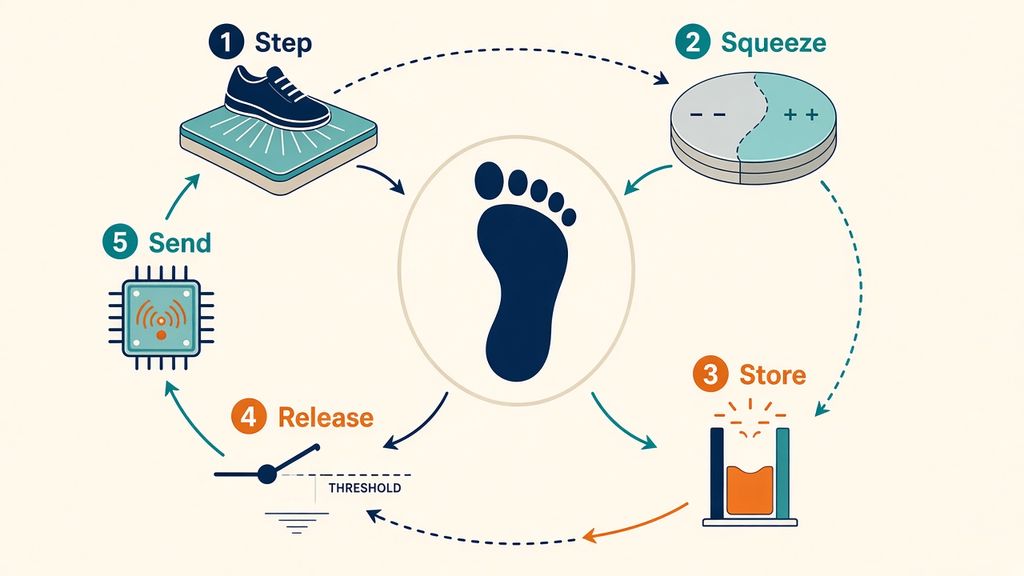
Harvesting energy is only half the job. The other half is delivering it to the radio at the right moment. To this end, the team built a threshold-regulated circuit on an 18-by-40-millimeter board. First, a bridge rectifier turns the back-and-forth pulse into one-way current. Next, a storage capacitor collects that charge while the radio stays disconnected. As soon as the capacitor reaches about 3.6 volts, two transistors snap on. Then the circuit feeds the BLE chip a steady output near 2.5 volts. When the stored voltage falls to about 1.8 volts, the switch turns off. The paper compares this behavior to undervoltage lockout in power electronics. In effect, the circuit works like a dam that opens only when full. Its BLE chip, an InPlay IN100, runs on 1.1 to 3.6 volts. As a result, the delivered window of about 1.1 to 2.5 volts suits it well.
Fig. 1: Illustration: how a footstep becomes a wireless signal.
Key Findings From the Footstep Trials
The textured PMN-PZT reached a charge constant of 962 picocoulombs per newton. That beat four common commercial ceramics, including PZT-5H, in direct tests. Its harvesting score, d33 times g33, hit 42.55 units compared to 11.68 for PZT-5H. Moreover, the material kept a stable output over 5,000 loading cycles. The team bonded a 30-millimeter disc, under 0.5 millimeters thick, to a spring-steel plate. They tested steel and beryllium copper plates from 0.05 to 0.20 millimeters thick. Overall, a 0.10-millimeter steel plate balanced output and durability best. By comparison, beryllium copper kept more permanent bending after each press. In particular, a 1.25-millimeter press kept output steady over 1,500 cycles. With a 4.7-microfarad capacitor, the circuit then released 22.84 microjoules per event. That amount clears the 17 microjoules needed for a BLE cold start. However, deeper 1.5-millimeter presses cracked the ceramic within 150 cycles.
97 Percent Success Across 100 Real Steps
Lab machines are one thing, but real feet are another. So the team asked 10 adults, five men and five women, to step on it. Each person stepped 10 times, for 100 trials in total. On average, each step produced 2.39 Bluetooth packets, with up to four. Overall, 97 of the 100 steps sent at least one valid packet. Both pressing down and lifting off can trigger a packet, which adds redundancy. Results also showed no clear link to body weight. Successful charging took roughly 0.1 to 0.8 seconds per step. In fact, a local force of about 12 newtons on the disc can trigger transmission. After that, the team ran four demonstrations of these smart floor tiles. One step switched a room light, while four steps formed four digital-twin events. Finally, a roadside node warned a car of pedestrians at estimated 13.0 and 5.0 meters.
Fig. 2: Illustration: key results from the smart floor study.
What Smart Floor Tiles Mean for Careers and Business
One prototype node needs under five US dollars of core hardware. That figure, however, covers only lab-stage parts for a single node. As the study stresses, real projects also pay for hubs, packaging, and installation. Even so, many tiles can share one receiver hub, so costs do not grow linearly. For building-automation firms, this suggests a market for battery-free switches. Airports and malls could also test step-based indoor positioning without battery upkeep. Transport agencies might later explore crosswalk alerts like the roadside demonstration. Still, the authors call that warning system a feasibility test, not a certified device. Software firms, for instance, could build tools that merge repeated packets into clean events. In the long run, floors, stairs and sidewalks could form self-powered sensor networks. For entrepreneurs, the clearest early niche is maintenance-free switching in new buildings. That niche needs little data, yet it saves real labor costs.
What to Study and Next Steps for Smart Floor Tiles
This project blends several fields, which means several career doors. For example, electrical engineers design the energy-management circuits and circuit boards. Materials scientists develop ceramics like textured PMN-PZT and test how they crack. Similarly, mechanical engineers model stress, bending and fatigue with simulation software. Embedded-systems engineers, as well as IoT developers, program the radios and process packets. Students drawn to this work can study electrical, mechanical, materials or computer engineering. In high school, physics, coding and basic circuit courses give a strong head start. Meanwhile, the paper lists clear next steps for smart floor tiles. In addition, large arrays will need randomized advertising intervals to avoid packet collisions. They will also need sealed packaging, long durability tests and outdoor signal calibration. Beyond that, the authors suggest adding temperature, humidity or pressure sensors. Because PMN-PZT contains lead, lead-free options and material recovery also matter.
Conclusion: Small Steps Toward Battery-Free Buildings
This study shows that one light step can power a standard Bluetooth message. The key was not one breakthrough part but careful teamwork between parts. A strong textured ceramic made the charge, while a thin steel plate shaped stress. Then a threshold circuit timed the release, and a low-power chip sent the packet. Together, these choices produced a coin-sized battery-free smart floor tile. It worked in 97% of real footstep trials, with core parts under five dollars. Large-scale use still needs durability, packaging and collision tests; even so, the path looks practical.
For students, the work shows how materials, mechanics and electronics connect in one product. At the same time, businesses gain sensors that never need a battery swap. In time, sidewalks and buildings could respond quietly to the people using them. Sooner or later, every footstep could become a small, useful piece of data. That future begins with simple, low-cost designs like this one.
References:
Wang, G., Hu, G., & Liang, J. (2024). Low-cost and compact piezoelectric energy harvesting floor tile for battery-free Bluetooth smart pavement. In Sensors and Smart Structures Technologies for Civil, Mechanical, and Aerospace Systems 2024 (Proc. SPIE 12949, 129491E). SPIE. Author copy: https://metal.shanghaitech.edu.cn/publication/C73.pdf
Yang, Y., Chen, Z., Kuai, Q., Liang, J., Liu, J., & Zeng, X. (2022). Circuit techniques for high efficiency piezoelectric energy harvesting. Micromachines, 13(7), 1044. https://doi.org/10.3390/mi13071044
Zheng, Y., Wang, Y., Li, Y., Zhang, Y., Tang, H., Zhao, C., Lan, C., Mao, Y., & Hu, G. (2026). From footsteps to wireless events: Infrastructure-native battery-free interfaces for human–environment interactions. Microsystems & Nanoengineering, 12, 353. https://doi.org/10.1038/s41378-026-01486-9
The work is well integrated: it compares five ceramics, tests two substrate metals at four thicknesses, maps where the ceramic cracks, and measures the circuit's switching points of about 3.6 V and 1.8 V. The article reports the numbers accurately and correctly says the 12 N trigger force acts on the harvester disc, not the whole footstep. Readers should know that the 12 N figure was measured at 0.5 mm deformation, while the 22.84 µJ output comes from the 1.25 mm working setting. The results come from one node, 10 people and 100 steps, and durability was tested for 1,500 cycles. Packaging, packet collisions between nodes and outdoor use remain untested, and the ceramic contains lead. Fix: change "each footstep" in the headline, since 97% of steps succeeded.
Aditya Joshi is a Frontend Associate at Coneixement India, the company behind ENTECH STEM Magazine and STEMQuiz. He is a Computer Engineering graduate from Savitribai Phule Pune University (SPPU), with honours in Machine Learning and Data Science. His academic background and hands-on project experience have developed his interest in artificial intelligence, emerging technologies, software development, and the practical applications of computing.
His areas of technical interest include Artificial Intelligence (AI), Generative AI, Machine Learning, Data Science, Large Language Models (LLMs), Natural Language Processing (NLP), Retrieval-Augmented Generation (RAG), GraphRAG, and knowledge graphs. Through projects involving locally hosted language models, Neo4j knowledge graphs, multilingual chatbots, and AI-powered analytics, he has explored how emerging technologies can be used to solve practical problems.
Aditya's professional experience includes work in frontend development, AI/ML application development, and full-stack software projects. During his internships at Maharashtra Knowledge Corporation Limited (MKCL) and Hilwitz Solutions, he worked on applications involving web technologies, Python, Flask, and AI-driven functionality. He has also developed projects such as SalesCope, an AI-assisted sales analytics platform, and a multilingual chatbot designed to help users explore Indian government schemes.
At ENTECH STEM Magazine and STEMQuiz, Aditya brings a technology-focused perspective shaped by his engineering education and practical experience with AI and software systems. He is interested in making complex science and technology concepts easier to understand through clear explanations, relatable everyday examples, and an emphasis on how emerging innovations work and affect real-world applications.
His broader goal is to help bridge the gap between technical concepts and public understanding, encouraging curiosity about artificial intelligence, computing, and the technologies shaping the future.