Ultra-low-power energy harvesters represent a major shift in how smart systems are powered. Battery-free power generators improve sustainability.
Ultra-Low-Power Energy Harvesters for Smart Farming
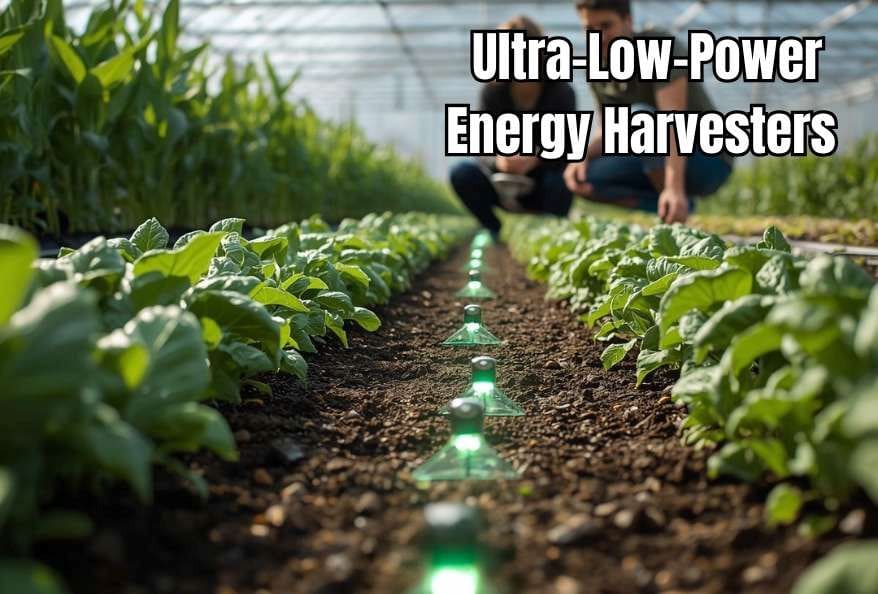
Ultra-low-power energy harvesters are emerging as a breakthrough solution that could replace batteries in smart farming sensors. As a result, this energy harvesting technology enables long-term operation by drawing power directly from the surrounding environment.
A New Era for Smart Farming
Today, smart sensors play a vital role in modern agriculture. For example, farmers rely on them to monitor soil moisture, temperature, humidity, and plant growth in real time. However, most of these systems still depend on batteries, which drain quickly. Consequently, frequent battery replacement becomes both costly and time-consuming.
To address this challenge, scientists have introduced Ultra-Low-Power Energy Harvesters designed for ultra-low energy use. In particular, these compact devices capture energy from natural sources such as light, heat, or motion. As a result, smart farming sensors can operate continuously without manual battery changes. Therefore, farms become more efficient and easier to manage.
What Is Energy Harvesting Technology?
In simple terms, energy harvesting technology works like a miniature power system. Specifically, it converts small amounts of environmental energy – such as sunlight, vibrations, or temperature differences—into usable electricity for low-power electronic devices.
Although the concept seems simple at first, designing reliable Ultra-Low-Power Energy Harvesters is a major engineering challenge. For instance, the devices must be small, affordable, durable, and efficient at the same time. To overcome these limitations, researchers tested fifteen different harvesting devices from five manufacturers. As a result, they were able to identify the most practical and efficient solutions.
How Scientists Evaluated Ultra-Low-Power Energy Harvesters
To ensure fair comparison, the research team applied a structured multi-criteria analysis. In particular, each system was evaluated based on power output, size, cost, reliability, and durability.
Before this study, engineers lacked a standardized method to compare energy harvesting technology. Consequently, selecting the right solution was difficult. With this new decision framework, however, designers can now choose the most suitable option for IoT and agricultural applications more easily.
Why Battery-Free Power Matters for Smart Farming
Battery-free power generators are especially valuable for IoT-based germination and crop monitoring systems. For example, in greenhouses and open fields, sensors continuously measure soil and air conditions. When powered by energy harvesting technology, these sensors can function for years without battery replacement. As a result, maintenance efforts are greatly reduced.
Moreover, this approach benefits the environment. By reducing battery use, electronic waste decreases. In addition, farmers save money while adopting more sustainable farming practices.
Real-World Applications Students Can Explore
Beyond agriculture, energy harvesting technology is widely used in environmental monitoring. For instance, sensors placed in remote locations can track air and water quality without external power sources. Therefore, long-term data collection becomes possible even in harsh environments.
Meanwhile, for students, these systems clearly demonstrate how physics converts light or heat into electricity. Similarly, materials engineering plays a key role in improving device efficiency. Overall, this technology connects classroom science to real-world innovation.
Engineering Challenges and Smart Design Solutions
Designing effective battery-free power generators requires balancing multiple factors. On one hand, engineers aim for high power density. On the other hand, they must keep costs low while maintaining compact size and long-term durability.
Fortunately, the researchers’ evaluation framework supports smarter design choices. As a result, engineers can select the right harvesting solution for each application. Consequently, smart systems become more reliable and longer-lasting.
A Greener Future Powered by Energy Harvesting Technology
Looking ahead, this research could reshape how small electronic devices are powered. In the near future, battery-free sensors may become common in farms, smart cities, and homes. As a result, dependence on traditional batteries will decrease.
For example, smart cities rely on sensors for traffic control, pollution monitoring, and public safety. By using energy harvesting technology, these systems can operate for years. Consequently, resources are conserved and waste is reduced.
Why This Innovation Matters for Students
Overall, this innovation highlights how physics, chemistry, and engineering work together to solve real-world problems. Furthermore, as careers in renewable energy and IoT continue to grow, understanding battery-free power systems opens exciting opportunities.
Therefore, students who explore these technologies today can play an active role in building a cleaner and smarter future.
Conclusion: The Future Is Battery-Free
In conclusion, ultra-low-power energy harvesters represent a major shift in how smart systems are powered. By reducing dependence on batteries, battery-free power generators improve sustainability, reliability, and long-term performance.
As energy harvesting technology continues to advance, it will play a key role in shaping the future of agriculture, smart cities, and environmental monitoring.
Additionally, to stay updated with the latest developments in STEM research, visit ENTECH Online. Basically, this is our digital magazine for science, technology, engineering, and mathematics. Further, at ENTECH Online, you’ll find a wealth of information.
Reference:
- García-Gutiérrez, E., Aguilar-Torres, D., Jiménez-Ramírez, O., Carvajal-Quiroz, E., & Vázquez-Medina, R. (2026). Ultra-low-power energy harvesters for IoT-based germination systems: A decision framework using multi-criteria analysis. Technologies, 14(2), 82. https://doi.org/10.3390/technologies14020082
- Author
- Latest Posts

Kottauppari Venkat Raghava
I am an Information Technology graduate (B.Tech) and a technology writer specialising in artificial intelligence, robotics, automation, and space technologies. I analyse complex scientific research and convert it into clear, practical insights for students, tech enthusiasts, and professionals. My work bridges the gap between academic research and real-world understanding by simplifying findings from peer-reviewed journals into engaging, easy-to-follow content. Alongside my writing, I have hands-on experience developing real-world projects, showcased on my GitHub, including an Expense Tracker web application for managing and visualising spending, and a Simple Video Summariser that generates concise insights from video content using automation techniques. I also produce research-driven articles on topics such as AI-powered corrosion detection, deep learning in engineering, and advanced automation systems. I follow a research-driven approach, ensuring every article is grounded in verified sources, industry knowledge, and practical applications. My goal is to make advanced technology accessible and meaningful, helping readers stay informed about innovations shaping the future.