How Software Actually Gets Built: What Developers Do Beyond Writing Code
Writing code is under half the job. What professional software teams actually spend their time on, and what to learn if you want to do this work.

How Software Actually Gets Built: What Developers Do Beyond Writing Code


What is Stakeholder Mapping and Why Does It Matter in Project Management?

Top Open-Source Tools for Developers in 2026

Why Does PI Planning Matter So Much In SAFe?

Best Agile-Friendly Feedback Tool for Web Sprint Reviews

Bluesky Social Network : Where You Choose Your Algorithm!

Navigation App Error Causes Fatal Crash

Impact of Microsoft Outage on Critical Infrastructure: A Technical Analysis
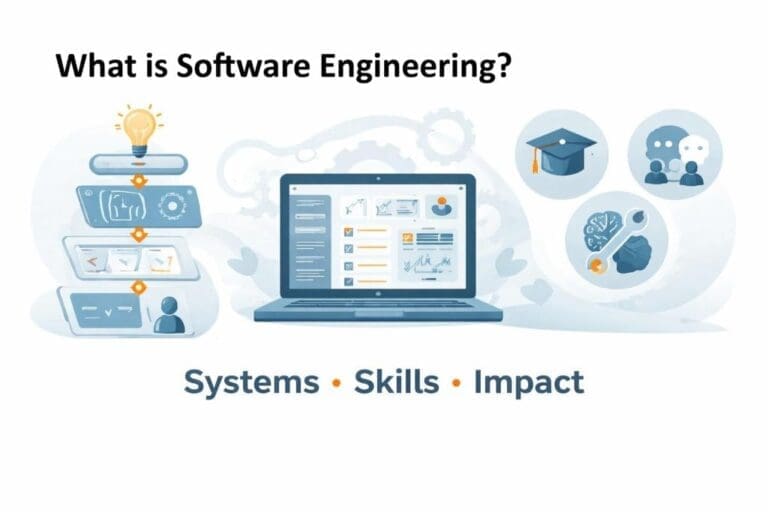
What is Software Engineering? A Teen-Friendly Guide to Degrees, Jobs, and Real Uses
Software is part of almost every aspect of modern life. From mobile applications and websites to banking platforms, healthcare systems, autonomous technologies and artificial intelligence, software helps people and organisations solve problems and perform complex tasks.
Software Engineering is the branch of engineering that applies systematic methods and technical principles to the design, development, testing, deployment and maintenance of software systems. It goes beyond writing code. It involves understanding user requirements, planning solutions, designing system architecture, ensuring software quality and improving applications throughout their life cycle.
Software engineers work on everything from small applications to large-scale systems used by millions of people. They combine programming knowledge, mathematics, computer science, engineering practices and teamwork to create software that is reliable, secure, efficient and easy to maintain.
At ENTECH STEM Magazine, this category introduces students and STEM enthusiasts to software development concepts, engineering practices, emerging technologies and career opportunities in the software industry.
Software Engineering is the systematic approach to building and maintaining software products and systems. It uses engineering principles to make software development more organised, predictable and dependable.
A software project usually begins with identifying a problem or understanding what users need. Engineers then define requirements, design the system, develop its components, test its behaviour and prepare it for use. After deployment, software may need updates, security improvements, bug fixes and new features.
This process is known as the Software Development Life Cycle (SDLC). It helps development teams manage the different stages of a project and maintain software quality.
Software Engineering is used in many computing areas, including web development, mobile applications, cloud platforms, enterprise software, embedded systems and artificial intelligence applications.
Before building an application, engineers need to understand what the software must do. Requirements engineering involves identifying, analysing, documenting and validating user and system requirements.
Requirements may describe the features an application should provide, its expected performance, security needs and other constraints. Clear requirements help development teams understand the problem and reduce confusion during the project.
Software design determines how an application or system will be structured. Engineers divide complex systems into smaller components and decide how those components will interact.
Software architecture describes the high-level organisation of a system, including its major components, interfaces and communication patterns. Design principles such as modularity, reusability and maintainability help create systems that can be improved over time.
Software development involves translating requirements and designs into working programs. Engineers use programming languages, frameworks, libraries and development tools to build applications.
Common programming languages include Python, Java, C, C++, JavaScript and C#. The choice of language depends on the project, its technical requirements and the environment in which the software will run.
This area includes web development, mobile application development, desktop software, backend systems and embedded software.
Software testing checks whether an application behaves as expected and identifies problems that need to be corrected.
Different testing approaches examine different parts of a system:
Quality assurance also involves reviews, development standards, documentation and processes that help teams maintain software quality.
Software development does not end when an application is released. Applications need regular maintenance to fix defects, improve performance, address security issues and support changing requirements.
Software evolution involves modifying existing systems as technology and user needs change. Engineers may update older applications, replace outdated components or introduce new features while maintaining compatibility and reliability.
Large software projects often involve teams of developers, designers, testers, project managers and other specialists.
Software project management helps organise these activities. It includes project planning, task allocation, time estimation, resource management, risk assessment and progress tracking.
Development methodologies such as Agile, Scrum and traditional plan-driven approaches provide different ways to organise software projects.
Software security focuses on protecting applications, systems and information from unauthorised access and other digital threats.
Secure software development considers security throughout the development life cycle. Engineers apply practices such as secure coding, access control, data protection, vulnerability assessment and security testing.
This is particularly important for applications used in banking, healthcare, education, government and other sectors that handle sensitive information.
Modern applications often run on cloud platforms rather than relying entirely on individual computers or local servers.
Cloud-based software can use remote computing resources for application hosting, storage, databases and processing. DevOps brings development and IT operations practices together to support reliable software delivery.
Continuous integration and continuous delivery (CI/CD) help teams automate parts of the process of building, testing and releasing software updates.
Software Engineering supports almost every major industry.
Websites, online platforms and mobile applications are developed using software engineering principles. These systems support communication, education, shopping, entertainment and many other everyday activities.
Banks and financial technology companies depend on software for digital payments, online banking, transaction processing, financial analysis and customer services. Reliability, security and data protection are especially important in these systems.
Healthcare software supports electronic health records, appointment management, medical imaging, diagnostic tools and hospital operations. Software engineering also contributes to the development of specialised medical applications and connected devices.
AI applications depend on software systems that collect and process data, run models and deliver results. Software engineers help integrate AI capabilities into products and services while considering performance, reliability and security.
Modern vehicles and aircraft use software for navigation, monitoring, communication, control and other functions. Software engineering is important in developing and testing these systems, where reliability and safety are essential.
Learning platforms, digital libraries, scientific applications and research tools are built using software engineering methods. These systems help students, educators and researchers access information and work with data.
Software engineering continues to evolve as new technologies change how applications are designed and developed.
Students interested in Software Engineering can explore undergraduate and postgraduate programmes in software engineering, computer science, information technology and related disciplines.
The field combines programming, data structures, algorithms, mathematics, software design, databases, computer networks and engineering practices. Students also develop practical skills through coding projects, laboratory work, internships and collaborative assignments.
Career opportunities may include:
Software engineers work across technology companies, financial services, healthcare, manufacturing, education, government and research organisations. With experience, professionals may move into technical leadership, architecture, project management or specialised research roles.
Software Engineering plays an important role in building the digital systems that support modern society. From everyday mobile applications to complex industrial and scientific platforms, software engineers turn ideas and requirements into practical technology.
As artificial intelligence, cloud computing, cybersecurity and connected devices continue to develop, the discipline offers new opportunities for learning and innovation.
Explore ENTECH STEM Magazine for educational articles, programming concepts, software development practices, emerging technologies and career insights related to Software Engineering. Discover how engineers design, build and improve the software systems shaping our digital future.