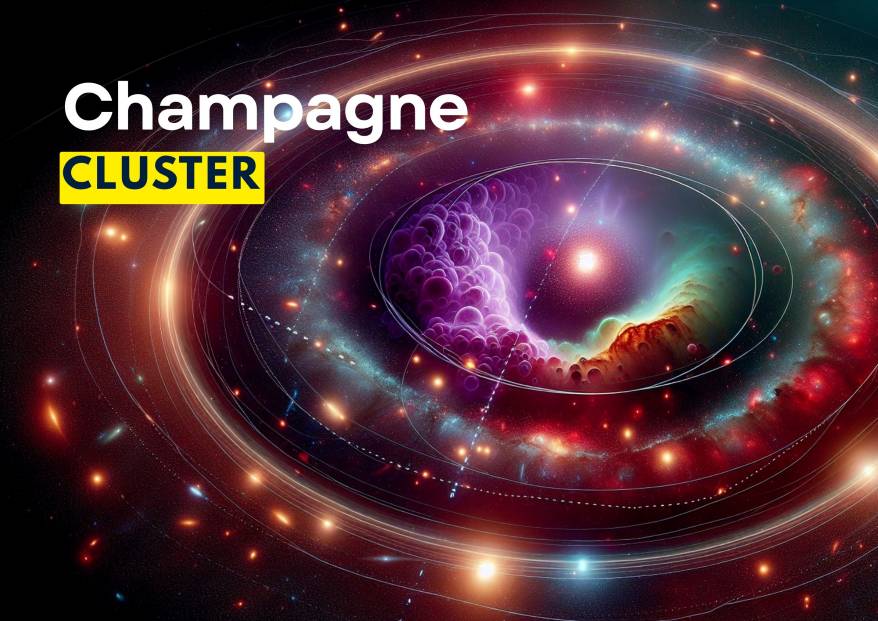
Chandra’s X-ray data and visual data from the Legacy Surveys compose the picture. Purple areas reveal hot gas cooked to millions of degrees. In the Champagne Cluster, areas that are red, green, and blue show…
Exploring the Champagne Cluster: A Cosmic Collision in Space
It’s amazing how many incredible things happen in the universe. NASA’s Chandra X-ray Observatory photographed the Champagne Cluster, a spectacular cosmic collision. In this remarkable system, two enormous galaxy clusters collide and gradually combine into a single, more substantial structure. The Champagne Cluster presents a once-in-a-lifetime chance to investigate the behavior of dark matter and galactic collisions.
A New Year Celebration in the Cosmos
Astronomers discovered the Champagne Cluster on December 31, 2020. Researchers named it the Champagne Cluster due to its bubbly gas structure that resembles rising champagne and the timing of its discovery. Its full catalog name is RM J130558.9+263048.4.
Chandra’s X-ray data and visual data from the Legacy Surveys compose the picture. Purple areas reveal hot gas cooked to millions of degrees. In the Champagne Cluster, areas that are red, green, and blue show places with many galaxies.
Two Clusters in Collision
Two distinct galaxy clusters compose the Champagne Cluster, creating a pattern that resembles bubbling champagne when they meet. In most cases, the heated gas in galaxy clusters appears spherical. On the other hand, the Champagne Cluster exhibits a vertical stretching of the gas, which is indicative of a collision that is both swift and forceful. A further confirmation of the occurrence of two collision clusters is provided by the presence of two different galaxy groups near the core.
The Hot Gas and Dark Matter Mix
Astronomers estimate that the superheated gas contained within the Champagne Cluster possesses a mass that is greater than the sum of all of its galaxies. This tremendous heat indicates a collision event that is full of energy.
The Champagne Cluster’s proximity to a substantial quantity of dark matter is even more significant. Even though it is believed by scientists to make up the majority of the cosmos, dark matter continues to be invisible. Researchers are able to gain a better understanding of the true nature of dark matter by seeing how it reacts during collisions such as this one.
Shooting for Answers: Understanding Dark Matter Through Collisions
Beyond its striking appearance, this serves as a valuable testing ground for theories about dark matter behavior during cosmic impacts.
Like the Famous Bullet Cluster
The Champagne Cluster belongs to a rare group of systems called dissociative mergers. In these mergers, hot gas slows down after impact, while dark matter continues moving with little resistance. The famous Bullet Cluster showed similar behavior and reshaped scientific understanding of dark matter interactions.
Two Possible Collision Stories
To gain a deeper comprehension of the Champagne Cluster, astronomers contrasted the data obtained from observations with the results of computer simulations. Based on this investigation, two potential outcomes were identified:
Scenario One: During the collision that occurred more than two billion years ago, the clusters were fractured; however, gravity is now pulling them back together as they make ready for a second collision in the future.
Scenario Two: There was just one instance of the clusters colliding some 400 million years ago, and they are continuously moving apart to this day.
Ongoing studies of the Champagne Cluster continue to refine these models. Each insight improves our understanding of cosmic structure formation and reveals processes hidden deep within the universe.
Reference
Bouhrik, F., Stancioli, R., & Wittman, D. (2025). Discovery and multiwavelength analysis of a new dissociative galaxy cluster merger: the Champagne Cluster. The Astrophysical Journal, 988(2), 166. https://doi.org/10.3847/1538-4357/ade67c
- Author
- Latest Posts

I’m a web developer and science writer with a Master’s degree in Computer Applications (MCA) from Pune University.
I work in tech, building websites and staying updated with the latest developments. I also love writing about physics, chemistry, technology, robotics, mathematics, and breakthrough innovations. My passion is breaking down complex scientific topics into simple, easy-to-understand stories.
My goal is to help everyone stay informed about the exciting changes happening in science and technology. I believe understanding science shouldn’t be complicated—it should be accessible to all.