Discover how blockchain technology revolutionizes data tracking and digital identity. Start your introduction to blockchain today.
Complete Introduction to Blockchain Technology: A Beginner’s Guide

Estimated reading time: 11 minutes
The digital world is changing faster than ever before. New technologies reshape how we share data and track assets. At the center of this revolution sits one major innovation. That innovation is blockchain technology. Many people associate it only with cryptocurrencies (likes of bitcoin). However, the scope of blockchain technology goes far beyond digital money. It is transforming finance, supply chains, and digital identity across the globe.
This exhaustive guide provides a clear introduction to blockchain technology. We will break down how it works, why it matters, and where it is going. If you want to explore blockchain as a beginner, you are in the right place. Let us look at the foundation of this world-changing tech.
What is Blockchain Technology?
To understand blockchain, we must first look at standard data storage. Most applications use a centralized database to store information. A single entity manages that database, such as a bank or a tech company. In contrast, blockchain uses a completely decentralized network to store data.
How is it different?
Traditional databases have a central authority. For example, take the case of a bank that manages your account. A company controls its servers. Blockchain technology removes the middleman. Trust comes from math and code. Not from a person or institution.
At its core, a blockchain is a shared, unchangeable ledger. It records transactions across many computers. Each record is a block. This forms a chain. Hence the name “blockchain”. No single entity has control over blockchain. Rather all participants share the data. This not only makes it transparent, but also more secure. To explain this simply, think of a digital notebook. This notebook is copied across thousands of computers simultaneously. When someone adds a entry, every single computer updates its copy at the same time.
As a matter of fact, you cannot alter any block once it joins the chain. This design makes the data permanent and secure.
Introduction to Blockchain Technology: Architecture and Key Pillars
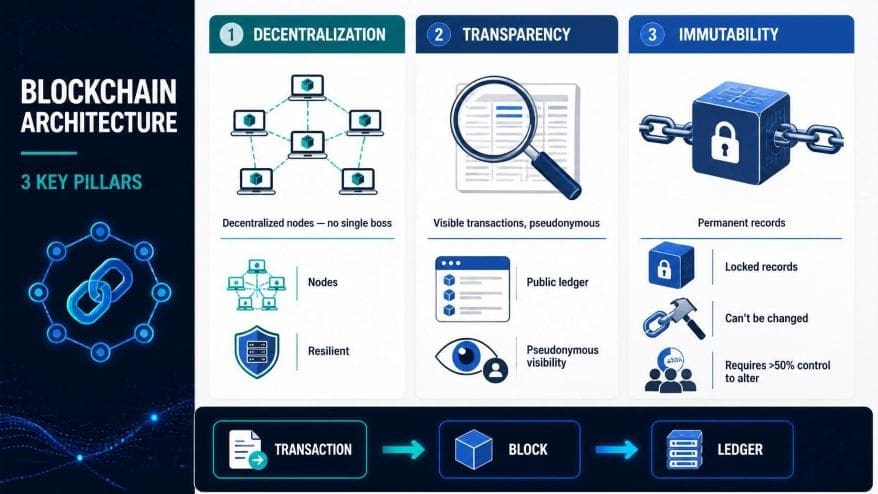
Understanding the architecture requires looking at its three core pillars. These pillars make the system reliable without needing a central boss.
1. Decentralization
Traditional systems rely on centralized authorities, such as a central bank. In contrast, blockchain technology distributes power across a whole network of computers. Each computer on this network is called a node. No single node has total control over the data. As a result, the system remains up and running even if several nodes fail.
2. Transparency
All transactions on a public network are visible to every participant. Anyone can view the transaction history using a network explorer tool. While this may be true, the system still protects user privacy. It uses cryptographic addresses instead of real names. To put it another way, you see the transaction detail but not the identity of the person.
3. Immutability
Immutability means that something cannot be changed or destroyed. Once a block is written to the ledger, changing it becomes nearly impossible. Altering old data requires rewriting every single block that follows it. To do that, an attacker needs to control more than half of the network power. At the present time, that feat is too expensive and difficult to achieve.
Also Read: Top 5 Innovations Making Healthcare More Accessible Today
How Blockchain Technology Works: Step-by-Step
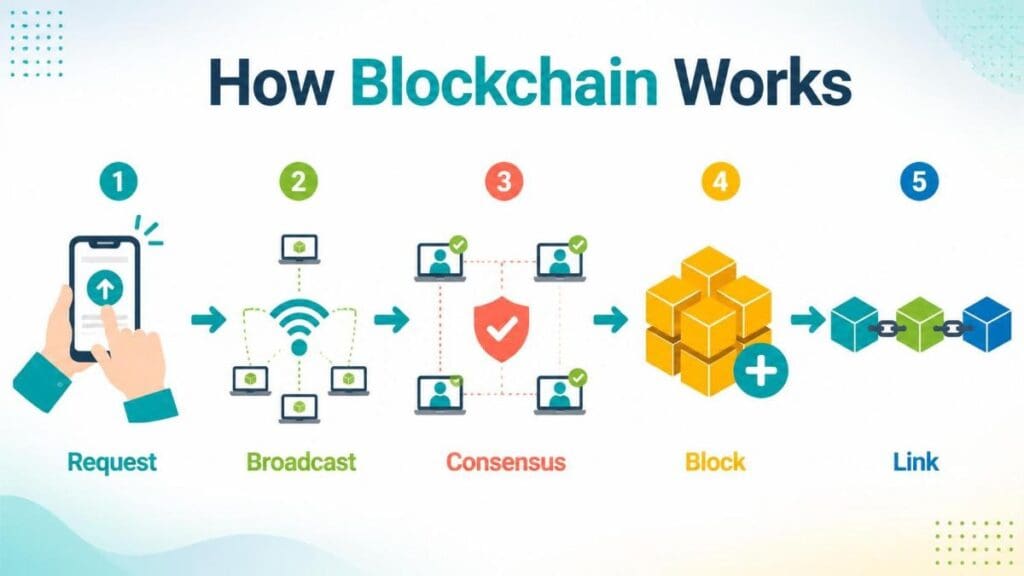
The inner workings of a distributed ledger seem complex at first glance. However, the step-by-step process follows a very logical sequence. Let us trace a transaction from start to finish.
Step 1: Requesting a Transaction
At first, a user initiates a transaction. This request could involve sending digital currency, transferring a property title, or logging a piece of data. The user signs the request with a private cryptographic key to prove ownership.
Step 2: Broadcasting to the Network
After that, the requested transaction broadcasts to the peer-to-peer network. Every available node receives the transaction details for inspection.
Step 3: Validation Through Consensus
The nodes must agree that the transaction is valid. They check if the sender has the funds or rights to make the transfer. To list the methods used, networks rely on consensus mechanisms. The two most common types are:
- Proof of Work (PoW): Nodes solve complex math puzzles to validate blocks.
- Proof of Stake (PoS): Nodes validate blocks based on the number of coins they hold.
Step 4: Forming a New Block
Provided that the transaction is valid, it combines with other transactions. Together, they form a new block of data. This block receives a timestamp and a unique identification code called a cryptographic hash.
Step 5: Linking to the Chain
The new block attaches itself to the end of the existing chain. At this instant, the ledger updates across the entire network permanently. The transaction is complete, and the asset moves to its new owner.
Key Features of Blockchain
Several features make blockchain technology unique.
- Decentralization: No central authority controls the network. Power is distributed among users.
- Transparency: All transactions are visible to everyone. Anyone can verify them.
- Immutability: Once recorded, data cannot be changed. This builds trust.
- Security: Cryptography protects the data. Hacking a blockchain is extremely difficult.
- Anonymity: Users can interact without revealing their real identity.
To illustrate, consider a supply chain. A company can track a product from factory to store. Every step is recorded. What’s more, customers can verify its authenticity. This prevents counterfeiting.
Major Benefits of Blockchain
Using a distributed ledger offers massive advantages over old databases. Industries are adopting this tech seeing that it solves classic security problems.
High-Level Security
The system uses advanced cryptography to secure data against hackers. Each block connects to the one before it using a unique mathematical code. For the most part, a hacker cannot alter data without breaking the whole chain. This makes the system incredibly resilient against cyberattacks.
Lower Costs and Speed
Traditional transactions involve middle-party organizations, such as brokers or clearinghouses. These intermediaries charge fees and slow down processing times. By comparison, blockchain enables direct peer-to-peer transfers. Eliminating the middleman lowers costs and speeds up global transactions.
Complete Traceability
Every asset movement leaves a permanent digital audit trail. Take the case of a supply chain tracking medicine. Companies can trace the product from the factory floor straight to the pharmacy shelf. In short, this transparency prevents fraud and ensures quality control.
Introduction to Blockchain Technology: Real-World Applications
This tech is moving far beyond its early roots in cryptocurrency. Today, various sectors use distributed ledgers to improve efficiency.
Financial Services and DeFi
Banking is the most obvious industry disrupted by this technology. Decentralized Finance (DeFi) apps allow people to borrow, lend, and trade assets without banks. To illustrate, cross-border payments that used to take days now settle in minutes.
Smart Contracts
A smart contract is a self-executing digital agreement. The terms of the contract are written directly into lines of code.
“Smart contracts allow the performance of credible transactions without third parties. These transactions are trackable and irreversible.” — National Institute of Standards and Technology (NIST)
So far, these contracts automate insurance claims, legal agreements, and real estate sales seamlessly.
Supply Chain Management
Logistics companies use the tech to track goods globally. Every party in the chain updates the ledger when receiving a shipment. In like manner, consumers can verify if their food is organic or ethically sourced.
Digital Identity and Healthcare
Governments and companies are exploring decentralized identity systems. This tech allows you to control your personal data securely. At the same time, hospitals use it to share patient health records without risking privacy leaks.
Voting Systems
Blockchain technology can make voting secure. Votes are recorded immutably. Results are transparent. Fraud becomes extremely difficult. Some countries are testing this now.
Real Estate
Property transfers are complex. Smart contracts automate the process. Buyers and sellers can transact directly. The title is recorded on the blockchain. This reduces paperwork and fraud.
To list more, we see uses of blockchain technology in music royalties, gaming, and even carbon credits. The potential is huge.
Key Challenges of Blockchain Technology
While this tech is powerful, it faces significant hurdles. We must analyze these challenges to understand the domain completely.
1. Scalability Issues
Public networks often slow down when too many people use them. For example, Bitcoin handles fewer than ten transactions per second. In contrast, traditional payment processors handle tens of thousands per second. Network developers are working hard to fix this speed bottleneck.
2. Energy Consumption
Certain consensus mechanisms require vast amounts of electricity. Specifically, Proof of Work systems need massive computer warehouses to solve puzzles. Then again, newer networks are adopting Proof of Stake to cut energy use by over 99 percent.
3. Regulatory Uncertainty
Governments around the world are still figuring out how to regulate decentralized networks. Some countries embrace digital assets, while others place strict bans on them. All things considered, clear rules are necessary for widespread adoption.
4. Complexity
The technology is hard to understand for beginners. This is a barrier to adoption. User-friendly interfaces are improving. But the gap remains.
5. Security Risks
While blockchain is secure, surrounding systems are not. Exchanges get hacked. Users lose their keys. Smart contracts can have bugs. These are real threats.
After all, no technology is perfect. Each challenge has potential solutions.
Common Myths About Blockchain Technology
A lot of hype surrounds this topic, leading to confusion. Let us clear up the most common myths.
Myth 1: Myth: Blockchain and Bitcoin are the exact same thing.
Reality: Bitcoin is simply the first cryptocurrency. Blockchain is the underlying technology that powers it.
Myth 2: The technology is completely anonymous and hides criminal activity.
Reality: This is partly false. Most public ledgers are actually pseudonymous. Transactions are tied to public addresses, making them fully traceable by law enforcement.
Myth 3: It is only useful for financial industries.
Reality: It can secure voting systems, track supply chains, and manage copyrights across various fields.
Myth 4: Blockchain is unhackable.
Reality: This is false. The blockchain itself is hard to hack. But apps and wallets on top can be compromised.
Myth 4: Blockchain replaces all intermediaries.
Reality: While this may be true in some cases, many middlemen still add value. Lawyers and auditors may adapt, not disappear.
So as to clarify, blockchain is a tool. It is not a magic solution. It has strengths and weaknesses.
Future of Blockchain Technology
Looking ahead, the integration of distributed ledgers will likely become invisible. It will run quietly in the background of everyday applications.
Enterprise Adoption and Central Bank Digital Currencies
Major corporations are building private ledgers to handle internal logistics. At the same time, central banks are developing Central Bank Digital Currencies (CBDCs). These digital currencies use ledger principles to update national fiat money.
Integration with AI and IoT
Sooner or later, this tech will merge with Artificial Intelligence (AI) and the Internet of Things (IoT). Autonomous devices can use smart contracts to buy data or electricity from each other safely. With this intention, the technology becomes the financial infrastructure for machines.
Emerging Trends:
- Interoperability: Different blockchains will talk to each other.
- DeFi 2.0: Improved financial services with better security.
- Non-Fungible Tokens (NFTs): Digital ownership of art and collectibles. This has many uses beyond speculation.
By and large, blockchain technology will integrate into daily life. Sooner or later, using it will feel normal. Just like using the internet today.
To put it another way, blockchain democratizes trust. It gives power back to individuals. This is a profound shift.
Opportunities in the Blockchain Domain
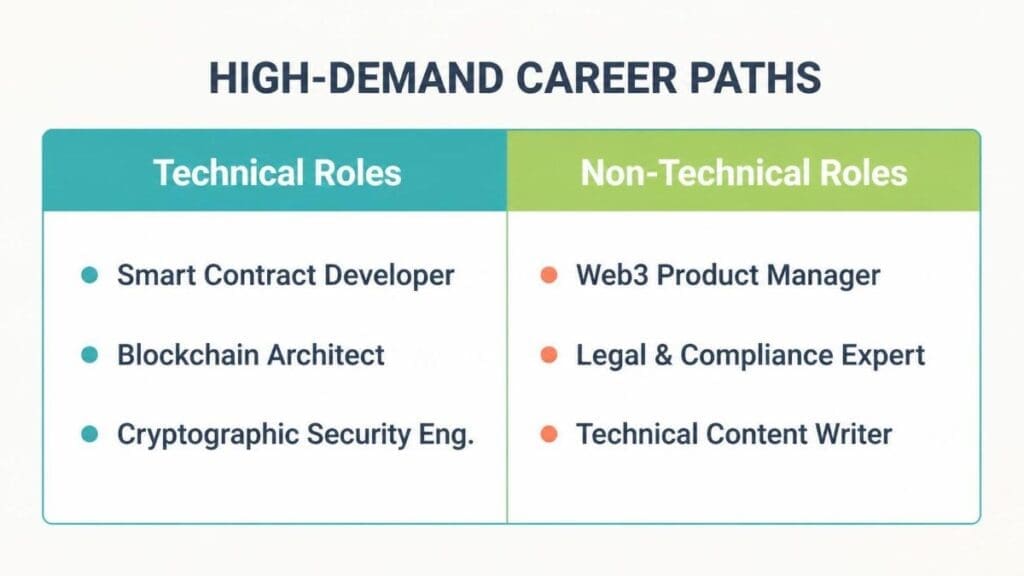
The growth of this field creates excellent opportunities for students and professionals. The demand for skilled individuals outpaces the supply of talent.
Technical Career Paths
If you enjoy coding, you can become a blockchain developer. You can learn languages like Solidity for Ethereum or Rust for newer chains. Security auditing is another vital area, as companies need experts to check smart contracts for bugs.
Non-Technical Career Paths
You do not need a computer science degree to enter this space. Companies need product managers, marketing specialists, and also legal consultants who understand the tech. Understanding how decentralized networks operate makes you valuable to employers exploring Web3 solutions.
Introduction to Blockchain Technology: Conclusion
This introduction to blockchain technology covers the essentials. To sum up, blockchain is a decentralized ledger. All in all, it offers security, transparency, and trust. On the other hand, it faces challenges like scalability and regulation. But its potential is immense.
To sum up, getting started requires curiosity and continuous learning. Focus on understanding the basics of cryptography and network consensus first, as this foundation provides the perfect introduction to blockchain technology. From there, you can explore specialized niches like smart contracts and also decentralized finance.
The decentralized future is being built right now, and anyone can join the movement.
Additionally, to stay updated with the latest developments in STEM research, visit ENTECH Online. Basically, this is our digital magazine for science, technology, engineering, and mathematics. Further, at ENTECH Online, you’ll find a wealth of information.
References:
- Yaga, D., Mell, P., Roby, N., & Scarfone, K. (2018). Blockchain technology overview. NISTIR. https://doi.org/10.6028/nist.ir.8202
- Tan, Y., Cheng, Y., Ding, L., & Zhao, Y. (2025). The optimization of batch processing and micro-payment systems in account-based anonymous blockchain systems. Blockchain Research and Applications, 7(2), 100334. https://doi.org/10.1016/j.bcra.2025.100334
- Author
- Latest Posts

Akanksha Ghodke is a passionate Computer Science graduate from Walchand Institute of Technology, Solapur, with a strong foundation in web development, software engineering, and emerging technologies. She has a deep interest in crafting innovative and impactful digital solutions that enhance user experiences and optimize performance.
With hands-on experience in both front-end and back-end development, Akanksha is proficient in Java, Python, C/C++, ReactJS, NodeJS, WordPress, and database technologies like MySQL, MongoDB, and PostgreSQL. She specializes in designing and optimizing websites, ensuring seamless navigation, responsiveness, and high-performance functionality. Her expertise in UI/UX design, digital marketing, and SEO enables her to build web applications that are not only efficient but also visually appealing and search-engine optimized.
Beyond web development, Akanksha has a strong inclination toward data engineering, cloud computing, and DevOps. She has worked with Docker, Kubernetes, CI/CD pipelines, and data migration, gaining hands-on experience in developing scalable, secure, and automated systems. She continuously explores new trends and technologies, staying up to date with advancements in the tech world.
Her passion for technology extends to her writing, where she simplifies complex topics into informative and engaging content. Some of her favorite subjects include Database Management Systems (DBMS), Java programming, Operating Systems, STEM (Science, Technology, Engineering, and Mathematics), Artificial Intelligence, Blockchain, and emerging innovations in the digital landscape. She actively writes blogs, articles, and guides to share her insights and knowledge with the broader tech community.
Apart from her technical pursuits, Akanksha is an avid reader with a love for biographies and motivational storytelling. She enjoys exploring the lives of inspiring individuals who have made significant contributions in various fields. These stories fuel her determination and drive to make a meaningful impact in the tech industry. In her free time, she also enjoys painting, drawing, and watching web series, balancing her analytical mindset with creativity.
With a strong belief in continuous learning, Akanksha strives to enhance her expertise and contribute to the ever-evolving world of technology. She aspires to develop cutting-edge solutions that empower businesses, improve efficiency, and drive innovation. Her journey in tech is fueled by curiosity, perseverance, and the desire to create a positive impact in the digital world.