The combination of precise orbital insertion, quick turnaround between missions, and successful technology demonstrations strengthens India's commercial and scientific prospects.
ISRO Satellite Launch: LVM3-M6 Delivers Bluebird Block-2 with Precision
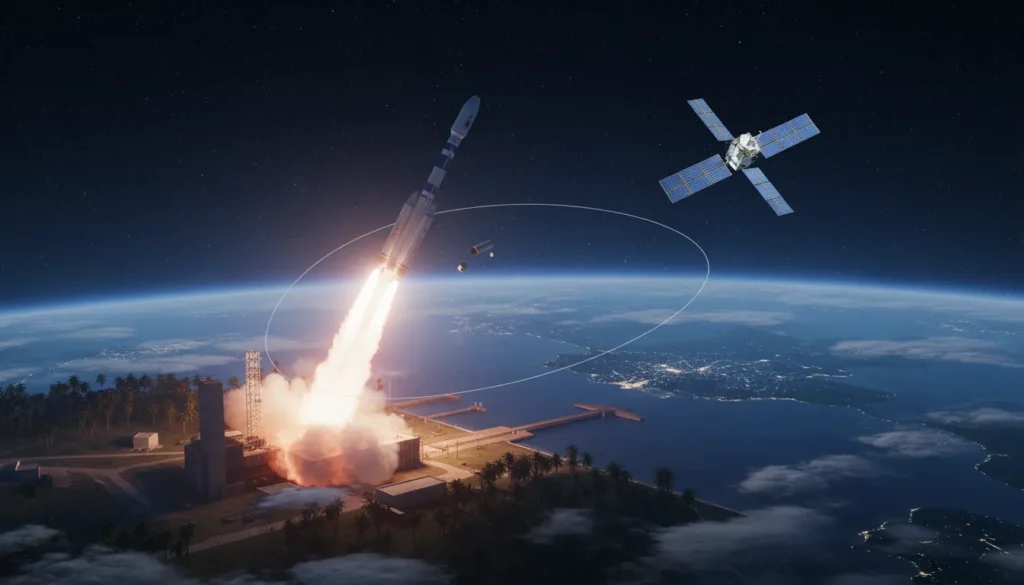
The latest ISRO satellite launch demonstrated both technical maturity and commercial reach as the LVM3-M6 placed the Bluebird Block-2 communications satellite into a near-perfect 520-kilometer circular orbit. This mission marks a significant milestone for India’s commercial launch services and reinforces the Indian space program’s reputation for precision and reliability.
🚀 ISRO Satellite Launch Mission highlights
The LVM3-M6 mission achieved a few compelling firsts. It was the first dedicated commercial launch for a US-based customer, AST Space Mobile. It also carried the heaviest satellite ever lifted from Indian soil on an indigenous launcher. The launch came only 52 days after the previous LVM3 mission, showing an impressive operational tempo and coordination across ISRO centers, industry partners, and the launch complex.
- Payload: Bluebird Block-2 communications satellite
- Orbit targeted: 520 km circular; achieved ~518.5 km
- Launch vehicle: LVM3-M6 (also called Bahubali M6)
- Launch site: Sriharikota
- Reliability record: Ninth successful LVM3 mission and 104th launch from Sriharikota
🛠 Technical achievements and innovations
The mission benefited from tight systems integration and a robust review mechanism. Vehicle performance produced less than 2-kilometer dispersion from the intended orbit, a level of accuracy that places the launch among the best-performing vehicles globally. That level of precision reduces satellite on-board fuel use for orbital adjustments and extends mission life.
A notable engineering milestone was the first use of an electro-mechanical actuation control system for the S-200 solid stage. Successfully demonstrating this system provides confidence for future heavy-lift and crewed programs and highlights steady technological evolution within the launch vehicle fleet.
🌍 Commercial significance and global partnerships
This ISRO satellite launch is an example of how national launch capability translates into global commercial opportunity. It is the third fully commercial mission for the LVM3 family and contributes to India’s standing as a reliable provider of launch services. With this mission, India has launched 434 satellites for 34 countries, an indicator of growing international trust.
Industry collaboration played a central role. New Space India Limited and several industrial partners worked alongside ISRO teams to meet timelines and technical requirements, illustrating a maturing ecosystem capable of supporting repeatable commercial missions.
🔭 Operational excellence and program momentum
The mission team emphasized discipline and systematic program execution. With multiple programs underway, ISRO stressed the need to sustain the same rigor and quality across future launches. As one succinct observation from leadership put it:
“The reward for hard work is more work.”
That outlook captures a culture that couples success with readiness for the next challenge, whether that is more commercial flights, lunar exploration, or human-rated systems.
📈 What this means for the future
The combination of precise orbital insertion, quick turnaround between missions, and successful technology demonstrations strengthens India’s commercial and scientific prospects. Operators seeking reliable, cost-effective access to orbit will find a compelling option in the LVM3 family, particularly for large communications payloads.
Continued investments in propulsion, avionics, and ground infrastructure will further enhance performance and repeatability. Demonstrations like this ISRO satellite launch help attract international customers and build long-term partnerships across industry and academia.
❓Frequently asked questions
What orbit did the LVM3-M6 place Bluebird Block-2 into?
The mission targeted a 520-kilometer circular orbit and achieved approximately 518.5 kilometers, reflecting a highly accurate orbital insertion with less than 2 kilometers dispersion.
Why is the orbit precision important?
Greater precision reduces the amount of satellite fuel needed for orbit correction, prolongs operational life, and lowers overall mission cost. It also validates the guidance and control performance of the launch vehicle.
What new technology was demonstrated on this flight?
The flight featured the first operational use of an electro-mechanical actuation control system on the S-200 solid rocket motor, a step forward for actuator reliability and maintainability in heavy-lift stages.
How does this mission impact commercial launch services from India?
It reinforces India’s credibility as a commercial launch provider by showing repeatable performance, handling heavier payloads, and delivering on tight schedules—qualities that attract international customers.
How many satellites has India launched commercially to date?
Including this mission, India has launched 434 satellites for 34 countries, demonstrating sustained demand for Indian launch capabilities.
- Author
- Latest Posts

Charudatta Pathak was a student at St. Aloysius High School in Bhusawal, established in 1874, making it one of India’s oldest convent institutions. He earned his bachelor’s degree in mechanical engineering from SSVPS College of Engineering, Dhule in 1995, demonstrating exceptional academic achievement. Thereafter, he launched his career as a CNC programmer in a toolroom. He has utilized FANUC, Deckel, Maho, and Mikron controllers to operate 2-axis and 3-axis machines for the fabrication of jigs, fixtures, dies, and molds. He commenced his career as an academic in 1996, when he assumed the role of lecturer at SSVPS College of Engineering, Dhule. Additionally, he earned his post-graduate degree in CAD/CAM from L. D. College of Engineering, Ahmedabad, in 2000, and then acquired a Ph.D. from COEP in 2011 while concurrently engaged in teaching. Until 2023, he occupied many academic roles, including lecturer, assistant professor, professor, dean, principal, director, and vice chancellor at both public and private universities throughout India. From 2008 to 2010, he served as the project lead in the CAE department of a European multinational firm. During his 28-year professional tenure, he identified a need for dependable books targeted at students in grades 8 to 12, particularly for nascent career planning. He founded ENTECH Digital Magazine, a free monthly publication available on entechonline.com and magzter.com. Teens with a strong interest in Science, Technology, Engineering, and Mathematics (STEM) who aspire to pursue careers in these fields may find ENTECH Digital Magazine beneficial.