Malaria parasite cell division discovery reveals ARK1’s role and offers new hope for future malaria treatments.
Malaria Parasite Cell Division: New Hope for Treatment
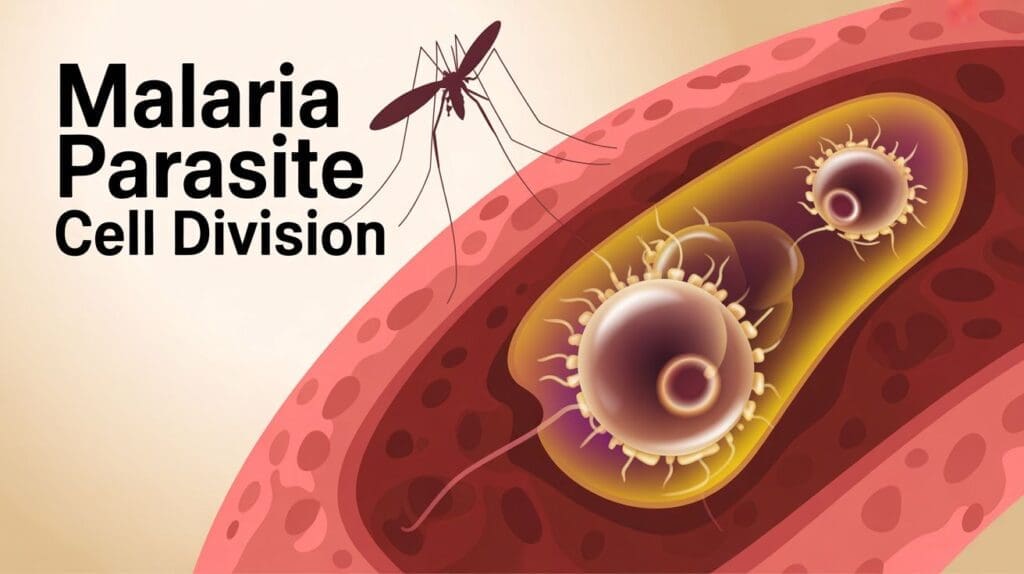
Malaria is a dangerous disease caused by tiny parasites called Plasmodium. These parasites infect human blood cells and spread through mosquito bites. Malaria affects millions of people worldwide and remains a major global health problem. Understanding Malaria parasite cell division is important because it explains how the parasite multiplies inside the body. Scientists are always searching for better ways to stop the parasite and reduce malaria cases.
A new research study published in Nature Communications shows exciting progress in understanding Malaria parasite cell division and how the parasite multiplies inside the body. Moreover, this discovery could help scientists develop new strategies to fight malaria using advanced biological research. Ultimately, these findings could contribute to better prevention and treatment methods.
How Malaria Parasite Cell Division Allows Rapid Multiplication
The malaria parasite has a unique way of cell division during different life stages. Unlike most organisms, the parasite creates multiple copies of itself simultaneously through a process called schizogony in human blood. It also undergoes rapid DNA replication during male gametogony inside the mosquito to produce swimming gametes.
To manage this rapid growth, malaria parasite cell division relies on specialized structures known as microtubule organizing centers (MTOC) and spindles. These parts ensure that each new daughter cell receives the correct amount of DNA. Without these precise tools, the parasite cannot successfully multiply or infect a new host.
ARK1 Protein and Its Role in Malaria Parasite Cell Division
Researchers found that a protein called Aurora-related kinase 1 (ARK1) acts as a master regulator of malaria parasite cell division. ARK1 helps organize chromosomes and forms the spindles necessary for the parasite to split its genetic material. When scientists used genetic tools to reduce ARK1 levels, the parasites failed to divide their DNA properly and stopped growing.
This study further reveals that ARK1 functions within a unique “chromosomal passenger complex” (CPC) during division of malaria parasite. This complex differs significantly from those found in humans because it utilizes two specific proteins, INCENP-A and INCENP-B. Because this machinery is so distinct, drugs targeting ARK1 could kill the parasite without harming human cells.
Why Understanding Malaria Parasite Cell Division Matters
Understanding Malaria parasite cell division is important for developing new treatments. The study shows that malaria parasites divide in ways that are very different from human cells. Because of these differences, scientists may be able to design medicines that specifically target the parasite.
Targeting ARK1 and its associated proteins could stop parasites at multiple stages of their life cycle. This would prevent them from multiplying inside humans and mosquitoes.
Another advantage is that ARK1 is very different from proteins found in humans. Therefore, drugs designed to block ARK1 could stop division of malaria parasite without harming human cells. This makes ARK1 a promising target for future antimalarial medicines.
STEM Opportunities Linked to Malaria Parasite Cell Division Research
For high school students interested in science, the study of Malaria parasite cell division provides a fascinating example of how biology, genetics, and chemistry work together to solve real-world problems.
Students interested in fighting diseases like malaria can explore several fields:
- Biology and Microbiology: Learn how cells function and how infectious diseases spread.
- Genetics and Molecular Biology: Study genes and proteins to understand how organisms grow and reproduce.
- Biomedical Engineering: Develop innovative technologies that help diagnose and treat diseases.
- Pharmaceutical Sciences: Design and test medicines that target parasites and other harmful microbes.
Exploring these fields can help students contribute to global health research and disease prevention in the future. All in all, STEM education is a powerful path to fighting diseases like malaria and making a positive difference worldwide.
Conclusion:
In summary, the discovery of ARK1’s role in division of malaria parasite provides a promising new target for medicine. By interrupting the parasite’s ability to multiply, scientists can effectively stall the disease at multiple stages of its life cycle. This research proves that a deep understanding of cellular biology remains our strongest weapon in the fight against global health crises.
Additionally, to stay updated with the latest developments in STEM research, visit ENTECH Online.
Reference:
- Nagar, A., Yanase, R., Zeeshan, M., Ferguson, D. J., Abel, S., Pashley, S. L., … & Tewari, R. (2026). Plasmodium ARK1 regulates spindle formation during atypical mitosis and forms a divergent chromosomal passenger complex. Nature Communications, 17(1), 1598. https://doi.org/10.1038/s41467-026-69460-7
Disclaimer: This article is for informational and educational purposes only. It is not intended as medical advice, diagnosis, or treatment. Always consult a qualified healthcare professional for medical concerns related to malaria or other health conditions.
- Author
- Latest Posts

A Master’s-qualified Zoologist with a focus on Limnology, I combine hands-on laboratory experience with a sophisticated background in science communication. My career is defined by an interdisciplinary approach to the life sciences, merging technical research skills with a proven ability to teach and engage diverse audiences. I am committed to lifelong learning and the creative dissemination of medical and biological research, ensuring scientific literacy and inspiration remain at the forefront of the field.