The world is eagerly anticipating a scientific breakthrough that could revolutionize disease prevention: a universal vaccine. Imagine a single shot protecting you from multiple strains of the flu, or even different types of coronaviruses!
New Advances in Universal Flu Vaccine Technology

Every year, scientists try to predict which flu strains will spread. Then, they develop a seasonal vaccine to match those forecasts. However, the match is not always accurate, and protection can vary. As a result, researchers continue seeking a more lasting approach. A universal flu vaccine could potentially protect against a wider range of influenza strains. In this article, we’ll explore progress described in a recent paper published in Vaccines and consider its possible implications for public health. Ultimately, the goal is to reduce reliance on yearly strain predictions and provide broader protection for people and families.
Key Takeaways
- A universal flu vaccine targets stable parts of the virus, not the variable head of the hemagglutinin protein.
- Recent human trials show promising results for long-term protection against multiple influenza subtypes.
- This vaccine could eliminate the need for yearly shots and improve protection for high-risk groups.
- The research highlights the use of new technology, such as mRNA and nanoparticle platforms
Why We Need a Universal Influenza Shot
Seasonal vaccines can work well when they closely match circulating strains. However, influenza viruses change quickly through a process called antigenic drift. As a result, manufacturers update vaccines regularly, based on predictions about which strains will spread. Sometimes, those predictions are less accurate, and vaccine effectiveness varies from season to season. Consequently, some people may have less protection than hoped.
In addition, a new influenza strain could emerge from animals and spread among people. Because people may have little existing immunity to it, such a strain could pose a serious public-health threat. In that situation, seasonal vaccines might not provide a close match. A universal influenza vaccine aims to target viral features that change less often. Therefore, it could potentially offer broader protection against seasonal strains and emerging threats. If successful, this approach would shift prevention toward more durable protection, rather than relying only on yearly strain updates.
The Science Behind Broad-Spectrum Flu Vaccine Protection
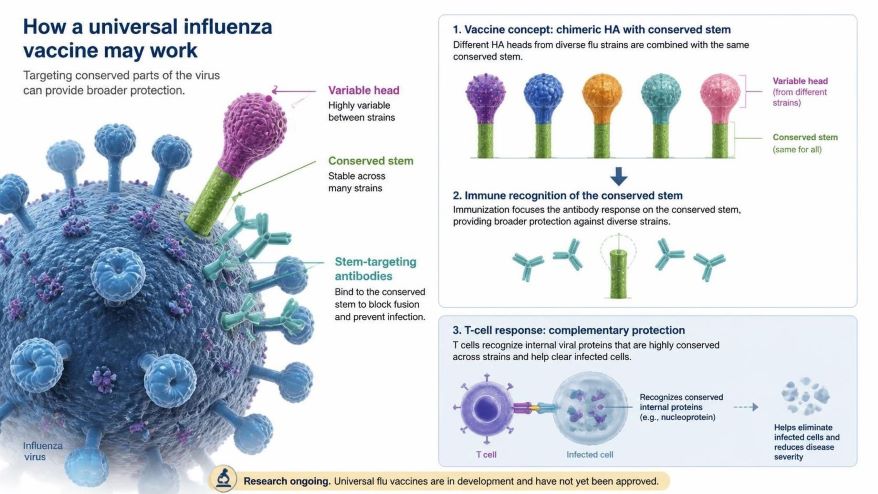
So, how might a universal flu vaccine work differently? To understand this approach, consider hemagglutinin (HA), a protein on the influenza virus. It resembles a lollipop: the head changes often, while the stem is more conserved. Because seasonal vaccines commonly target the changing head, researchers are also exploring ways to direct immune responses toward the stem.
For example, the 2025 paper in Vaccines discusses chimeric hemagglutinin designs. These designs pair a stem with different heads. Through repeated exposure, researchers aim to encourage the immune system to recognize the more stable stem. In animal studies, this approach has produced broadly neutralizing antibodies and protection against multiple influenza subtypes. Although these findings are promising, they do not yet establish how well the strategy will work in people.
Meanwhile, researchers are also studying T-cell responses. T-cells can recognize internal viral proteins that tend to change less than surface proteins. As a result, they may help limit illness severity, even if infection occurs. Together, stem-directed antibodies and T-cell responses could provide complementary defenses. However, further research is needed to determine whether this combination can deliver broad, lasting protection in humans.
Key Research Findings From the MDPI Paper (2025)
The study published in Vaccines, Volume 13, Issue 8, provides concrete data. The team tested a novel vaccine candidate. They used a ferret model, which is standard for flu research. The results were very encouraging. The vaccine induced high levels of broadly neutralizing antibodies. Protection extended to group 1 influenza A viruses. This includes H1 and H5 subtypes, which pose pandemic risks.
The vaccine also protected against group 2 viruses in some cases. This is a significant achievement. Group 2 includes H3N2, a common and dangerous seasonal strain. The researchers observed no signs of disease enhancement. Safety profiles looked good. The paper highlights the potential for a phase 1 human trial soon.
To enumerate the main points from the paper:
- The vaccine used a chimeric HA approach.
- It induced strong stem-directed antibody responses.
- It provided protection against both homologous and heterologous viral challenges.
- Homologous means the same strain.
- Heterologous means a different strain.
- No adverse effects were noted in the animal model.
This research builds on years of work. It confirms that a stem-based target is viable. The data supports moving forward into human testing.
Implications for Global Health and Seasonal Strategy
A successful universal influenza vaccine could have wide-ranging benefits. For example, older adults may have weaker responses to some seasonal vaccines, so researchers are studying whether broader vaccine designs could help them. Similarly, young children sometimes need two doses when receiving influenza vaccine for the first time. If a universal option proves effective and safe, it might eventually simplify vaccination schedules.
In addition, broader protection could benefit communities where annual vaccination campaigns are difficult to deliver. However, a single dose lasting five years remains a goal—not an established outcome. If future studies support such durability, it could ease pressure on healthcare systems and potentially reduce severe illness. Meanwhile, the World Health Organization identifies influenza as an important public-health concern, making vaccine research a global priority.
Economically, a longer-lasting vaccine could reduce some costs associated with frequent vaccine updates, missed work, and hospital care. Still, its actual costs and benefits would depend on effectiveness, manufacturing, access, and duration of protection. In this context, the 2025 Vaccines paper represents a research step, rather than proof that influenza will cease to be a major health threat
Frequently Asked Questions
.
What exactly is a universal flu vaccine?
It is a vaccine that targets stable parts of the flu virus. These parts change very little over time. This allows the vaccine to protect against many different strains. You would not need a new shot every year.
When will a universal flu vaccine be available to me?
A few candidates are in late-stage clinical trials. If successful, a product might be available in 3 to 5 years. The research paper from 2025 shows promising human data.
Will I still need the annual flu shot?
Yes, for now. Seasonal shots are still the best available protection. Once a universal vaccine is approved, your doctor will advise you on the transition.
Reference
Wang, L., Xie, Q., Yu, P., Zhang, J., He, C., Huang, W., Wang, Y., & Zhao, C. (2025). Research Progress of Universal Influenza Vaccine. Vaccines, 13(8), 863. https://doi.org/10.3390/vaccines13080863
Disclaimer: We do not intend this article/blog post to provide professional, technical, or medical advice. Therefore, please consult a healthcare professional before making any changes to your diet or lifestyle. In fact, we only use AI-generated images for illustration and decoration. Their accuracy, quality, and appropriateness can differ. So, users should avoid making decisions or assumptions based only on the text and images.
- Author
- Latest Posts

Neha Adikane holds a Master’s degree in Environmental Science from Pune University, bringing a unique blend of scientific expertise and creative writing skills to her craft. She specializes in creating engaging, insightful, and impactful content across various niches. With a passion for translating complex ideas into simple, relatable narratives, she excels at crafting blogs, articles, website content, and social media posts that captivate readers and drive engagement. Neha’s background in environmental science adds depth to her writing, allowing her to effectively cover topics related to sustainability, eco-awareness, and scientific innovations.
- Author
- Latest Posts

I completed my Master of Science from the University of Allahabad in 2017 with a strong academic background in life sciences and chemistry. My specialization included Molecular Biology, Microbiology, Genetics, Plant Breeding, Phycology, Paleobotany, and Bioinformatics, along with Organic Chemistry, Inorganic Chemistry, and Physical Chemistry. This multidisciplinary training provided me with a comprehensive understanding of biological systems and analytical scientific approaches.
After completing my postgraduate studies, I gained valuable professional experience in both the education and social development sectors. I worked at A.M. Oxford Public School, where I was actively involved in guiding students toward academic excellence. In this role, I focused on creating an engaging learning environment, encouraging critical thinking, and nurturing students’ curiosity for scientific learning. My experience as an educator strengthened my communication, mentoring, and classroom management skills.
In addition to my teaching experience, I worked with Jeevan Jagriti Foundation, where I contributed to community-based initiatives aimed at improving educational access and awareness among underprivileged sections of society. Through this work, I participated in programs designed to support social development and promote the value of education in marginalized communities.
These professional experiences helped me develop strong interpersonal, leadership, and organizational skills while reinforcing my commitment to education and community service.


