The automotive sector is currently undergoing a significant transformation, driven by the need for environmental sustainability and energy efficiency. Concerns over climate change are increasing. As a result, there’s a trend to find replacements for the traditional internal combustion engine. This engine is known for causing a lot of pollution.
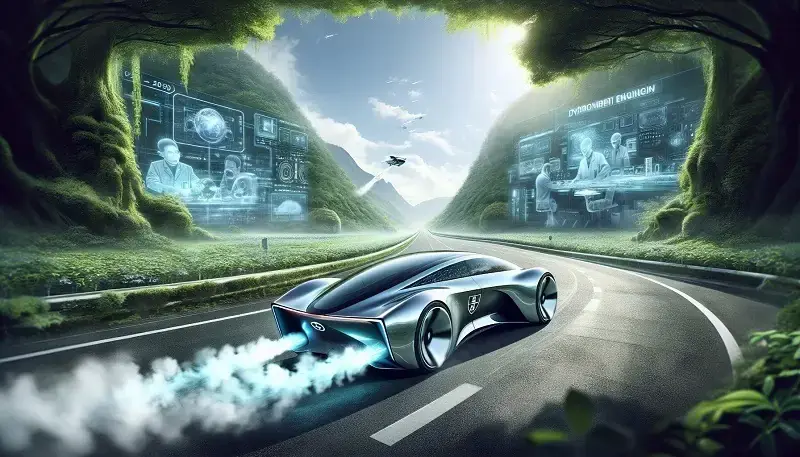
As the world moves towards electric vehicles, a Japanese company has made a big impact. They’ve created a combustion engine that doesn’t pollute. It only releases water vapor. This new engine could change how we travel. It might also transform the entire car industry.
Yamaha has created a new engine. It’s not just a substitute for traditional combustion and electric engines. It may stop our need for fossil fuels. This could lead to cleaner, sustainable ways of getting around.
Yamaha has made a daring decision. They launched a V8 engine that is powerful and fuel-efficient. It also greatly lowers its harm to the environment. With this new technology, hydrogen takes center stage.
This engine uses Toyota’s trusted 2UR design. It has a five-liter displacement and delivers 442 horsepower at 6,800 RPM. What makes it special are its exhaust manifolds. They have ducts of the same length coming from each cylinder head. So, water flows the same distance at the same speed from each cylinder.
Yamaha has introduced a new innovation. It challenges what people expect. It shows that a strong, fuel-efficient engine can be environmentally friendly.
The Collaborative Efforts Towards a Sustainable Future
Yamaha’s non-polluting combustion engine is not just a product of their own research and development. It is also a result of their partnership with other leading automotive companies – Kawasaki, Suzuki, and Honda – through the HySE (Hydrogen Society of Europe) initiative.
This joint effort aims to develop hydrogen-powered engines for various vehicles and contribute to reducing emissions in the transportation sector. With approximately a year since its inception, HySE has already made significant progress in innovating clean and sustainable propulsion technology in the automotive industry.
This technological advancement in non-polluting combustion engines marks a significant milestone on the path towards implementing sustainable solutions in the automotive industry. With continued efforts and collaborations like these, we can look forward to a greener and more environmentally responsible future for transportation.
Charudatta Pathak was a student at St. Aloysius High School in Bhusawal, established in 1874, making it one of India's oldest convent institutions. He earned his bachelor's degree in mechanical engineering from SSVPS College of Engineering, Dhule in 1995, demonstrating exceptional academic achievement. Thereafter, he launched his career as a CNC programmer in a toolroom. He has utilized FANUC, Deckel, Maho, and Mikron controllers to operate 2-axis and 3-axis machines for the fabrication of jigs, fixtures, dies, and molds. He commenced his career as an academic in 1996, when he assumed the role of lecturer at SSVPS College of Engineering, Dhule. Additionally, he earned his post-graduate degree in CAD/CAM from L. D. College of Engineering, Ahmedabad, in 2000, and then acquired a Ph.D. from COEP in 2011 while concurrently engaged in teaching. Until 2023, he occupied many academic roles, including lecturer, assistant professor, professor, dean, principal, director, and vice chancellor at both public and private universities throughout India. From 2008 to 2010, he served as the project lead in the CAE department of a European multinational firm. During his 28-year professional tenure, he identified a need for dependable books targeted at students in grades 8 to 12, particularly for nascent career planning. He founded ENTECH Digital Magazine, a free monthly publication available on entechonline.com and magzter.com. Teens with a strong interest in Science, Technology, Engineering, and Mathematics (STEM) who aspire to pursue careers in these fields may find ENTECH Digital Magazine beneficial.