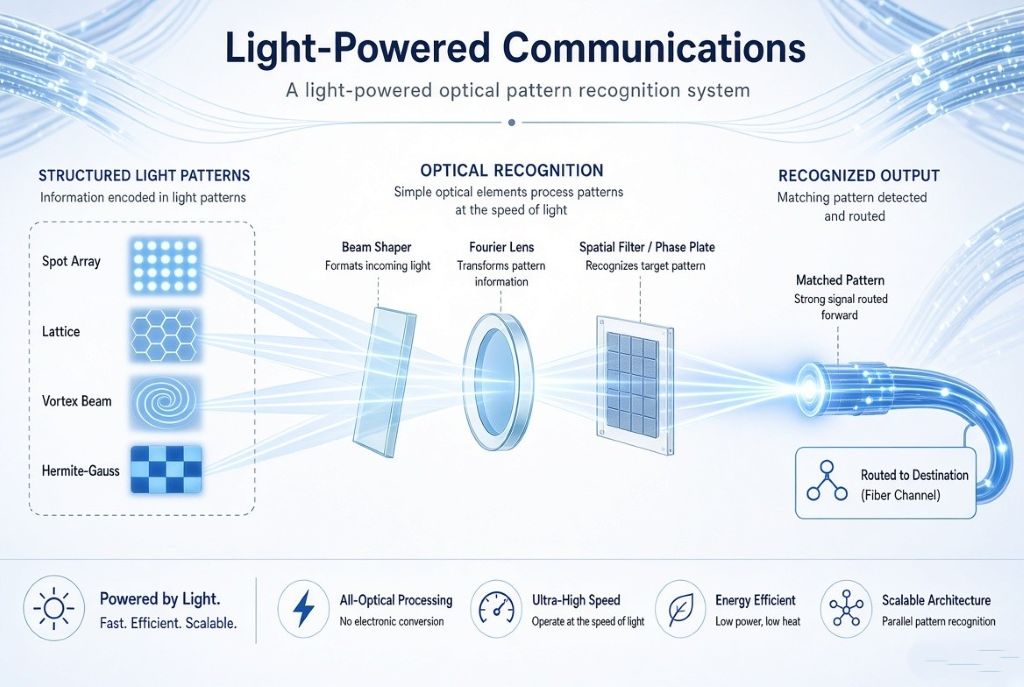
You send a photo to a friend. The data travels as pulses of light through a thin glass fiber. Those pulses carry special shapes that hold extra information. Current systems must capture a full picture of each shape and then run software to decode it. That step slows the network and uses power. The latest research in optical brain communications aims to optimize data links using shaped light patterns for speed. Researchers at the University of the Witwatersrand built a setup that lets light identify the shapes itself. The system needs only a few training examples. It still works when noise appears. This approach could speed up future data links and lower the computing load on network equipment.
Visual Representation of optical brain communications Key Takeaways
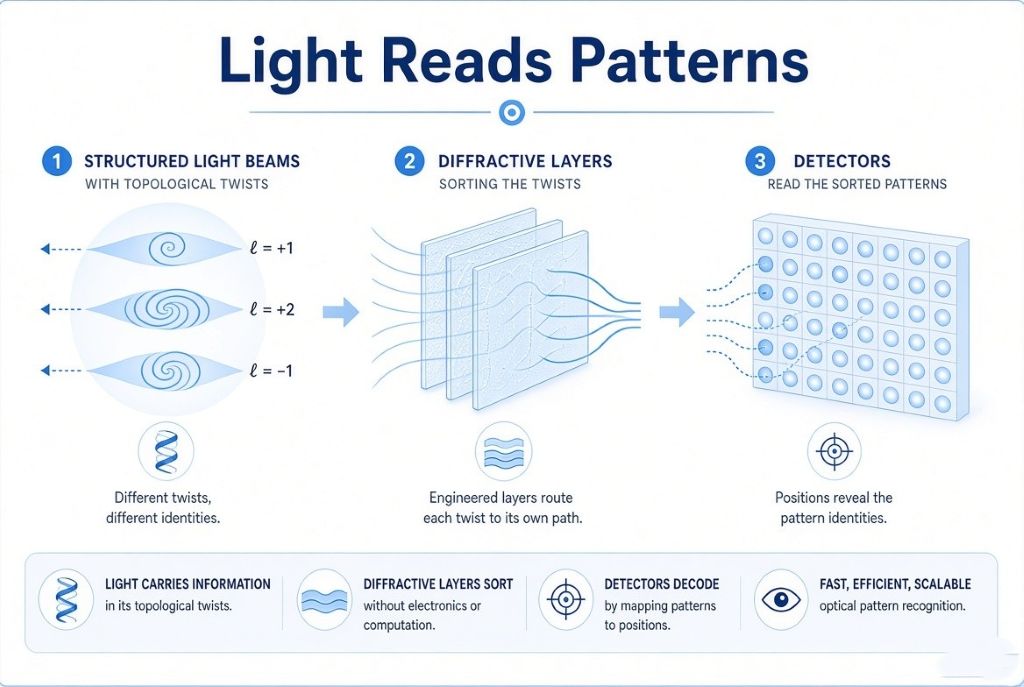
Fig. 1: Key elements of the light-based system that recognizes topological patterns without full imaging.
How Light Carries Hidden Messages in Everyday Networks
Fiber-optic cables already move most internet traffic. Each pulse of light can hold more data when scientists shape it into special patterns. These patterns contain topological features that remain the same even if the light bends or stretches. For example, consider the number of twists in a ribbon. Even if you fold the ribbon in different ways, the twist count does not change.
In the lab, researchers use vector beams built from Laguerre-Gaussian modes. Each mode has a specific orbital angular momentum value. The difference between two such values gives a skyrmion number. That number stays constant under many distortions. Standard detectors struggle because the states are not orthogonal. They need full Stokes polarimetry or detailed images. Those methods fail when noise rises.
The new system avoids that step. It routes light through designed layers so the topology lands on separate detectors. Students in an optics lab often see this idea first with simple interference setups. One group watched how a twisted beam kept its charge after a mirror reflection. That classroom moment shows why topology matters for robust data carriers.
Building Optical Brain Communications with Diffractive Layers
The team created a deep diffractive optical neural network. It uses two separate channels, one for each polarization. Each channel contains five phase layers. Light passes through these layers and free space between them. The layers sort the orbital angular momentum modes. The system then reads the skyrmion number from the sorted modes.
Training happens in real time with a hybrid optoelectronic loop. A camera measures the output intensity. An algorithm adjusts the phase masks. The researchers cut the number of training parameters by about one thousand times. They used Fourier basis modes instead of pixel-level control. This choice keeps the hardware simpler. Channel efficiency stays above 70 percent for the sorted modes. Overall transmission efficiency reaches about 15 percent after extra gratings. The design still classifies 81 different topologies with roughly 93 percent accuracy.
It keeps perfect accuracy even when noise reaches levels that break conventional polarimetry. The approach turns the detection problem into feature extraction rather than full reconstruction. Engineers can later move the same idea onto metasurfaces for compact devices.
Why This Matters for Future Data Networks
High-capacity links need ways to pack more bits into each light pulse. Topological encodings offer a large alphabet that resists many transmission errors. The missing piece has been a fast, robust reader. The diffractive network supplies that reader. It works without capturing a detailed image of every pattern. Network operators could place such detectors at fiber ends or inside switches. The result would be higher throughout with less digital processing.
The same tools may help quantum networks. Single photons carry even less light, so efficient feature extraction becomes critical. The Wits group notes that the measurement toolbox for topology is still growing. This detector adds one practical piece. Interdisciplinary teams that combine photonics and machine learning will likely lead the next steps. Companies that build optical modules already look for engineers who understand both light design and simple training algorithms.
Careers in Photonics and Optical Computing
Students who like physics and coding can enter this field through several routes. University programs in physics, electrical engineering, or applied optics cover the needed foundations. Undergraduate research often starts with laser alignment, mode generation, and basic data collection. Internships at telecom labs or photonics startups give hands-on time with fiber setups and detectors. Python skills for instrument control and simple analysis help early on. Later roles include designing phase masks, testing noise resilience, or integrating optical layers with electronic control.
National labs and university groups also hire people who can run experiments and write clear reports. Early projects might involve measuring orbital angular momentum or training a small diffractive model. The work sits at the meeting point of quantum science and artificial intelligence. That combination matches strengths already present at places such as the Wits Structured Light Laboratory and the MIND Institute.
How This News Article Was Compiled
The article draws only from the open-access Nature Communications paper and the official Wits University research announcement. Both sources were reviewed in full. Technical numbers, training details, and quotes come directly from those documents. Career notes reflect standard educational pathways in photonics and are not tied to specific job postings.
Mahi Shitut is a Science Communicator at ENTECH STEM Magazine, with a BSc in Physics from Fergusson College, Pune, and an ongoing MSc in Mathematics at the Indian Institute of Science Education and Research (IISER), Kolkata. Her areas of interest include theoretical physics, pure mathematics, astronomy, space science, set theory, asymptotic series, and science education. She completed the National Initiative in Undergraduate Science (NIUS) Physics Programme at the Homi Bhabha Centre for Science Education, TIFR, Mumbai, where she carried out a 1.5-year research project at the UM-DAE Centre for Excellence in Basic Sciences. She was also a top scorer in the Madhava Mathematics Competition and was selected for the Madhava Nurture Camp at IIT Bombay, and she attended the IWM Winter School for Young Women in Mathematics.
Mahi specializes in explaining advanced physics and mathematics in simple, clear, and easy-to-understand language for teenagers and school students. Drawing on everyday examples and practical analogies, she helps readers make sense of ideas like infinity, space missions, telescopes, and how the universe works, without losing scientific accuracy. Her skill comes from hands-on experience. She has explained models of Chandrayaan-3 to more than 3,000 visitors at IUCAA’s National Science Day open day, volunteered at SPPU’s National Space Day celebrations, presented at Fergusson College’s Astro Club Poster Exhibitions, and delivered undergraduate lectures on countability and uncountability, the infinite hotel paradox, and asymptotic series through the Synectics Math Club. With earlier experience in editorial work and content strategy, including editing a newsletter and writing for digital audiences, she aims through ENTECH STEM Magazine to bridge the gap between advanced science and public understanding, making physics and mathematics engaging, accessible, and relevant for young minds.