Persistent organic pollutants (POPs) are organic compounds that are resistant to degradation through chemical, biological, and photolytic processes.
Organic Pollutants: Demerits and its green remediation

Estimated reading time: 7 minutes
The Persistent Threat of Organic Pollutants
There are lots of undesirable end-products in agriculture which has the potential to bio-accumulate. These are also capable of long-range transport. These end products are termed as Organic pollutants. These pollutants are also called persistent organic pollutants (POPs), like pesticides and other harmful chemicals. They build up in living things. This causes bad health problems, such as infertility and cancer.
Industrial Sources and Environmental Impact
Organic pollutants such as dyes are broadly used by many industries such as textile, leather, food, and paper. According to a report given by Mashkoor and Nasar, 2021, Above 7 lakh tons of dyes are produced per annum around the world out of which 20% of these dyes are discharged into water without proper treatment. These dyes are persistent owing to their structural stability. These are carcinogenic, mutagenic and toxic. The dyes obstruct sunlight penetration into the water as a result of which aquatic life suffer. It causes abruption of the photosynthetic process that brings toxicity to aquatic life. Kadhom et al., 2020 asserted that smaller quantities of dyes impart significant colouration to the water that makes it unfit to drink. Apart from dyes, Lapworth et al., 2012 enunciated that organic pollutants such as pharmaceuticals, herbicides pesticides, aromatics, etc. pour into water bodies causing serious health concerns.
The Need for Low-Cost Remediation
Thus, it is very important to elucidate a low-cost and eco-friendly strategy to proficiently eradicate these organic pollutants. Many technologies exist, but in 2019, one study suggested adsorption methods. This technique use hydrochars from agro wastes. It has been successfully working as a low-cost and eco-friendly substitute.
Organic Pollutants: Advanced Strategies for Degradation
Researchers use Biotic and Abiotic catalysis in the degradation of Organic pollutants. Enzymes are biotic catalysts and mineral colloids are abiotic catalysts. But it is a herculean task to assess the kind of organic pollutants that are being degraded either abiotically or biotically. Important abiotic and biotic catalytic reactions take place simultaneously in the most instances.
Biotic Catalysis: Utilizing Extracellular Enzymes
The use of extracellular enzymes in the degradation of organic pollutants is broadly accepted. For example, Malathion is hydrolyzed to a monocarboxylic acid through loss of an ethyl group by a carboxyl esterase isolated from soil. Enzymes commonly occurring in soil, such as esterases, amidases, phosphatases, and proteases, catalyze the hydrolysis of the respective chemical bonds in xenobiotic molecules.
Abiotic Catalysis and Mineral Influence
Most organic chemicals, including xenobiotics, show a strong affinity to humic substances. However, transformation of xenobiotics in terrestrial systems is greatly influenced by mineral components of soil. Mineral colloids, which are abundant in soil and have large specific surface and relatively high-charge density, contribute to the overall xenobiotic transformation at least as much as does the organic matter.
Phytoremediation: The Plant-Endophytic Bacteria Approach
The application of the plants-endophytic bacteria relationship is a mounting approach for the absolute removal of OPs. Endophytic bacteria are a set of microorganisms that establish their healthy colonies in the plant tissues without causing any impairment to the host plant and show mutualistic relationships with plants.
Endophytic bacteria get nutrient and safe habitat from the host plant and in return, it produces several types of growth-promoting substances and bioactive compounds that enhance the degradation of OPs. However, the combined application of plants and endophytic bacteria gives new perceptions to increase phytoremediation potential. Engineered endophytic bacteria have a large potential to degrade OPs and increase plant growth and ultimately improve phytoremediation efficiency.
How to check the severity of Organic pollutants
The presence of organic pollutants in water are one of the most reliable parameters to check the quality of water. These pollutants have natural or anthropogenic sources. Also there is also a broad spectrum of OP (Organic Pollutants) in municipal, industrial, and agricultural waste water.
Traditional Quantification Methods (BOD and COD)
BOD (Biological Oxygen Density) and COD (Chemical Oxygen Density) are the terms we use to determine OP in waste water. BOD and COD check the quantities of chemical and biological oxygen consumed in the oxidation of organic pollutants.
On the contrary, the determination of these parameters through customary methods consists of complex procedure, which is time-consuming and reduced detection observance. The conventional procedure needs expensive and unsafe reagent. Likewise, BOM (biodegradable organic matter) is another method we use to determine the proportion of OP in waste water. BOD is the key parameter for the quantification of BOM of waste water. However, the BOD test requires 5–7 days for the analysis, trained manpower, and careful sampling in conventional systems. Thus, it is essential to use alternative solutions to avoid unnecessary delays due to conventional techniques.
Rapid Detection via Biosensors and BES
Nowadays a rapid detection techniques known as bio sensors came to light and it is appreciably applied in waste water treatment industries. Based upon the principle of photo catalytic and electrochemical theory various bio sensors have been analyzed for waste water observation. These biosensor techniques are proved to be very effective and efficient for observance.
On the other hand, Bio- Electrochemical System (BES) based biosensors are more effective and popular in organics detection in waste water. The organic detection in BES is based on a linear relationship between amount of organics and current output. The operational stability of over 5 years has been found in BED-based bio sensors with minimum maintenance. There are three different formulations to be modified in order to determine electrical signals in BES-based biosensors according to Gao et al.
Persistent Organic Pollutants (POPs): Definition and Scope
Persistent organic pollutants (POPs) are organic compounds that are resistant to degradation through chemical, biological, and photolytic processes. They are toxic and adversely affect human health and the environment around the world.
Global Impact and Regulatory Response
Wind and water carry most POPs. So, POPs made in one country harm people and animals far away. In 2001, world leaders met at the Stockholm Convention. They talked about POPs’ harm to humans and nature. They aimed to stop or greatly limit making POPs.
The ‘Dirty Dozen’ and Beyond
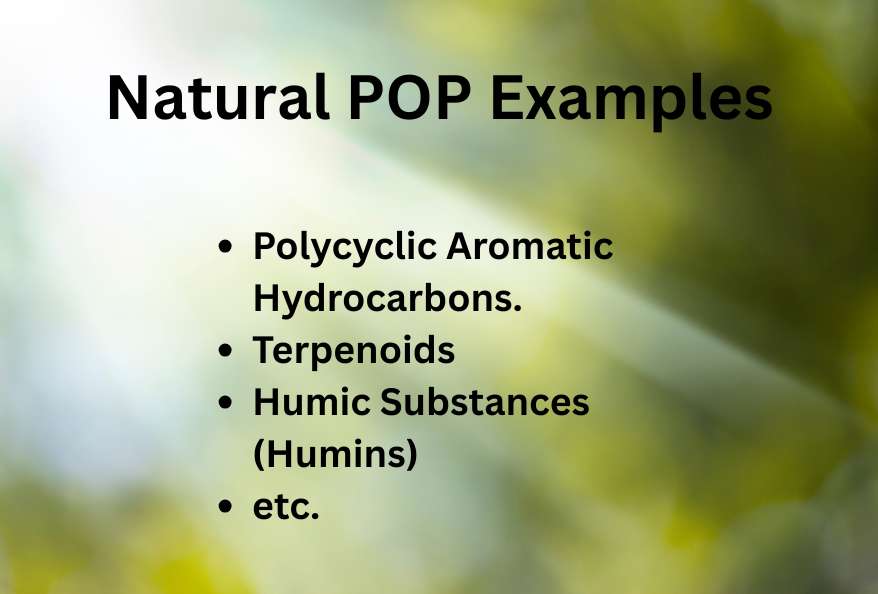
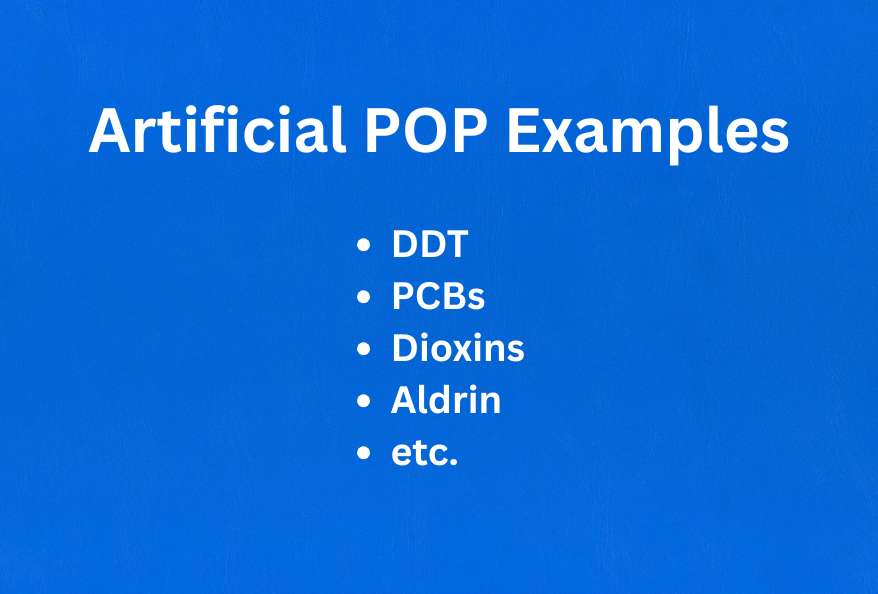
Most POPs are pesticides or insecticides, though some are also solvents, pharmaceuticals, and industrial chemicals. Although some POPs arise naturally (e.g., from volcanoes), most are artificial. The original “dirty dozen” POPs identified by the Stockholm Convention include:
- Aldrin
- Chlordane
- Dieldrin
- Endrin
- Heptachlor
- HCB
- Mirex
- Toxaphene
- PCBs
- DDT
- Dioxins
- Polychlorinated dibenzofurans
But we have added many new POPs since then (like PFOS). Scientists keep studying the world’s contaminants to learn more.
Classification of POPs A/C to its Origination
Generally, POPs come from two main sources.
Natural Origin
Artificial Origin
Properties of POP (persistent Organic pollutants)
POPs are either present as vapors in the atmosphere or bound to the surface of solid particles (aerosols). A key factor in long-range transport is the portion of a POP that sticks to aerosols. In adsorbed form it is – as opposed to the gas phase – protected from photo-oxidation, i.e. direct photolysis as well as oxidation by OH radicals or ozone.
They do not dissolve much in water but stick easily to solid particles. They dissolve in organic liquids like oils, fats, and liquid fuels. POPs do not break down easily in the environment because they are stable and decompose slowly. This ability to travel far spreads POP pollution widely, even in places where POPs have never been used. POPs stay in these areas for years after bans because they resist breakdown.
Career Prospects
It is highly appreciable that any entrepreneur advancing in the field concerned to the green remediation of organic pollutants creates lots of carrier opportunities. Government agencies around the globe used to encourage and promote this endeavor in order to maintain a pollution-free environment. This initiative also assists in the growth of clean and sustainable environment for all. Besides this, diseases from widespread organic pollutants end. They save crores of rupees on medicine. People use the money for other useful tasks. Entrepreneur set up infrastructure for the lessening the ill-effect of organic pollutants. Government supports this initiation with every resource like funding, availing area for establishing set-up.
Additionally, to stay updated with the latest developments in STEM research, visit ENTECH Online. Basically, this is our digital magazine for science, technology, engineering, and mathematics. Further, at ENTECH Online, you’ll find a wealth of information.
References:
- Yan, Z., Li, Z., & Du, J. (2024). Effects of environmental organic pollutants on environment and human health: the latest updates. Toxics, 12(4), 231. https://doi.org/10.3390/toxics12040231
- STOCKHOLM CONVENTION ON PERSISTENT ORGANIC POLLUTANTS SET FOR SIGNATURE ON 22-23 MAY | Meetings coverage and press releases. (2001, May 9). https://press.un.org/en/2001/unep89.doc.htm
- Author
- Latest Posts

Nagendra Sharma is a chemistry researcher and Doctoral Scholar at Babasaheb Bhimrao Ambedkar (B.R.A.) Bihar University, Muzaffarpur. Conducting his research at Langat Singh (L.S.) College under the mentorship of Dr. Pankaj Kumar Chaurasia, Nagendra specializes in environmental chemistry and green technology, with a primary focus on the degradation of organic pollutants.
With multiple research papers published in peer-reviewed journals, Nagendra’s academic work explores advanced chemical and catalytic strategies to neutralize persistent industrial contaminants and water pollutants. His efforts aim to contribute to sustainable chemical practices, environmental remediation, and eco-friendly waste management solutions.
As an author for ENTECH Magazine, Nagendra breaks down complex chemical processes, environmental conservation methods, and emerging green chemistry innovations to inspire students and foster environmental awareness within the scientific community.
- Author
- Latest Posts

He has been pursuing Ph.D under the mentorship of Dr. Pankaj Kumar Chaurasia, Assistant Professor, P.G. department of chemistry, Langat Singh College, B.R.A. Bihar University, Muzaffarpur, He has written 10 research papers and five articles that are based on degradation of unused dyes and its effect on biological environment. These research papers and articles are published in reputed journals and magazine.