Discover how personalized learning with AI adapts education to individual student needs. Learn how systems analyze performance to tailor unique paths.
Personalized Learning with AI: Unique Path for Every Student
Estimated reading time: 6 minutes
Personalized Learning with AI: Introduction
The transformation of education is occurring rapidly through the introduction of technology. The skills required in the modern workforce are rapidly evolving as well. As previous classroom scope makes it’s increasingly difficult to prepare every student efficiently. Personalized Learning with AI has emerged as a vital solution. This approach ensures that no student is left behind in a rapidly changing world.
As it is typical in an educational setting, one teacher works with the same students and provides the same content to them all, at the same pace. Therefore, students learn in different ways; they have varying degrees of interest and ability and learn at an individual speed. While some students learn quickly and require only limited practice to comprehend, others will require more time and practice. Therefore, most students are not getting an education to meet their unique requirements due to a “one-size-fits-all” method.
The application of artificial intelligence (AI) can provide educators with the data needed to personalize their students’ learning experiences. By taking different parts of the students’ work and actions, the tool for creating personal learning plans will open up. This lets them move forward in school at their own speed. They will also get tailored help. So, personalized learning with AI will not replace teachers. Instead, it will help them by giving the information, resources, and feedback students need to progress.
AI-Powered Personalized Learning in Education
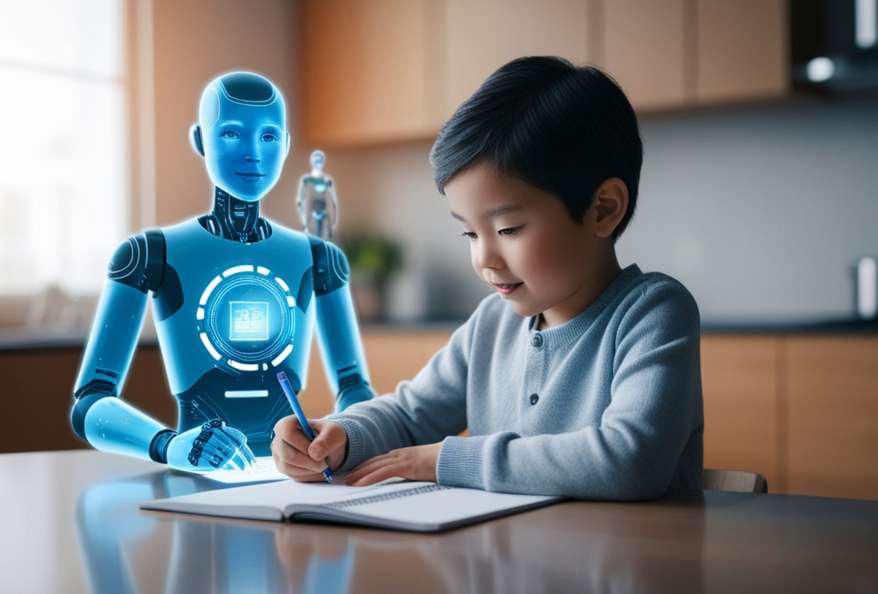
AI helps create a personalized learning experience for every student by improving education to suit each student’s abilities, limitations, and interests.
AI can help deliver a student-centered learning experience by collecting information about how many times students interact with lessons and assessments, identifying patterns in student learning and suggesting activities or lessons suitable for that student. Additionally, AI allows students to learn at their own pace (by moving quickly through areas where they are strong and receiving additional support in areas where they need more work) by allowing flexible options for learning paths.
Data-Driven Insights and Adaptive Assessments
Teachers receive helpful data about students’ learning gaps, so they can provide more support while providing additional mentoring and opportunities for in-depth learning. In addition, AI allows teachers to use adaptive assessments that adjust difficulty based on the correct or incorrect response of a student. The AI also provides teachers with accurate and meaningful evaluation of their students’ work.
Interactive Support and Engagement Tools
AI also provides instant feedback to students through the use of tutors and chatbots, which help them to correct their mistakes in a timely manner. Moreover, interactive tools that simulate real life, like games and virtual reality, make the learning process more interesting for students and therefore will be easier for the student to understand. At the same time, the AI makes sure to help students learn the important academic skills they need while still being able to explore their own interests.
Personalized learning focuses on tailoring educational experiences according to each student’s strengths, weaknesses, and interests. Artificial Intelligence makes this possible by analyzing large amounts of learning data and adjusting educational content accordingly.
One key feature of AI in education is student-centered learning. AI systems track how students interact with lessons, quizzes, and assignments. This information helps identify learning patterns and allows the system to recommend activities suited to each learner.
Another important feature is the creation of flexible learning paths. Students no longer need to move through lessons at the same pace as the entire class. For example, a student who understands mathematics quickly can move to more advanced topics, while another student may receive additional explanations and exercises to strengthen their understanding.
Educational Opportunities in Personalized Learning with AI
AI technology is reshaping the way students learn by giving them the ability to go through a course at their convenience by working on areas that they need to improve and also working more quickly in areas they already know.
Furthermore, AI makes it possible for students to have personalized media based upon what they enjoy, in areas like robotics or coding, through videos, simulations, and projects. Additionally, AI enables new styles of teaching and learning (such as project-based, inquiry-based, and competency-based) that will aid students in developing critical thinking skills and solving problems that may exist in today’s world.
AI also includes many forms of Interactive Media such as games, visual content, and other interactive tools, so students can find learning more engaging and motivating. Ultimately, AI supports the movement of education from an environment based upon memorization to one that focuses upon active engagement with learning and developing skills.
Personalized Learning with AI: Career Path

One of the great uses of AI in education is giving students career advice on their education and employment paths.
Because the workforce keeps changing, many future jobs will involve building new skills. By using AI-based systems, students can have their performance analyzed to provide career suggestions for their future career paths. For example, a student with good math grades as well as problem-solving mindset, may get career recommendation to study data science and/or engineering.
Likewise, a student who has indicated that they are interested in design, creativity, etc. may receive career recommendations in an area such as digital design, media technology, and/or product development.
In addition to assisting in the decision-making process, AI can also recommend courses and certifications, along with activities that will provide students with skills that will be relevant to their eventual career goals. Students can gradually acquire expertise in subjects they are passionate about while still maintaining a balanced academic foundation.
Using both academic data and career knowledge, AI can assist students in making an informed decision about their future career path.
Conclusion: Personalized Learning with AI
Artificial Intelligence will change education by offering more direct, flexible, and immersive ways to learn. Through personalized learning with AI, systems can analyze student data, to create customized learning plans. These will tailor to individual student needs, and may turn out to be game changer.
AI will rather improve the capabilities of teachers and not replace them. It will give them useful information, tools that change to fit, and smart ways to get feedback. This will help them meet student needs.
As technology grows and changes, personalized learning with AI can help students. It will enable them to learn skills they need to succeed in the 21st century. It can also let them explore interests, get advice on future jobs, and do more. When AI tools join with skilled teachers, learning can become personal. In this setup, every student can reach their full ability.
Additionally, to stay updated with the latest developments in STEM research, visit ENTECH Online. Basically, this is our digital magazine for science, technology, engineering, and mathematics. Further, at ENTECH Online, you’ll find a wealth of information.
References:
- Vorobyeva, K. I., Belous, S., Savchenko, N. V., Smirnova, L. M., Nikitina, S. A., & Zhdanov, S. P. (2025). Personalized learning through AI: Pedagogical approaches and critical insights. Contemporary Educational Technology, 17(2), ep574. https://doi.org/10.30935/cedtech/16108
- Farhood, H., Nyden, M., Beheshti, A., & Muller, S. (2025). Artificial intelligence-based personalised learning in education: a systematic literature review. Discover Artificial Intelligence, 5(1). https://doi.org/10.1007/s44163-025-00598-x
- UNESCO. (2021). Artificial intelligence and the future of learning. https://www.unesco.org/en/digital-education/ai-future-learning
- Author
- Latest Posts

I am Raj Kumar Mahto, a Learning Experience Designer (LXD) and STEAM Educator at Tan90, Bengaluru, India, where I design innovative learning experiences that integrate science, mathematics, and emerging technologies such as Artificial Intelligence. My work focuses on developing curriculum frameworks, assessments, and interactive learning environments that enhance student engagement, conceptual understanding, and curiosity for STEM subjects.
My professional interests lie at the intersection of education, technology, and learning design. As a Learning Experience Designer, I work on creating learner-centered educational content that combines pedagogical principles with digital tools to make learning more effective and engaging. I believe that modern education should go beyond traditional classroom instruction and provide students with opportunities to explore concepts through hands-on activities, real-world applications, and inquiry-based learning.
A significant part of my work involves exploring how Artificial Intelligence can support personalized learning. With the rapid evolution of skills required in today’s world, it has become challenging for traditional classrooms to address the diverse learning needs of every student. AI-driven learning systems can help create adaptive learning paths, intelligent assessments, and data-driven insights that support both students and educators. My goal is to leverage such technologies to make education more accessible, flexible, and responsive to individual learning needs.
As a STEAM educator, I am passionate about promoting interdisciplinary learning, where science, technology, engineering, arts, and mathematics work together to foster creativity, innovation, and problem-solving skills. I strongly believe that integrating these disciplines helps students develop the mindset required to address real-world challenges and prepares them for future careers in technology-driven fields.
Through my work and writing, I aim to contribute to discussions on the future of education, particularly how thoughtful learning design and emerging technologies can transform classrooms into more engaging, personalized, and future-ready learning environments.