Recent advances in quantum-inspired computing are transforming how astronomers observe the cosmos. A new quantum method time delay promises more precise detection of tiny light arrival differences, pushing telescope limits further.
Quantum Method Boosts Precision in Astrophysical Time Delay Measurements
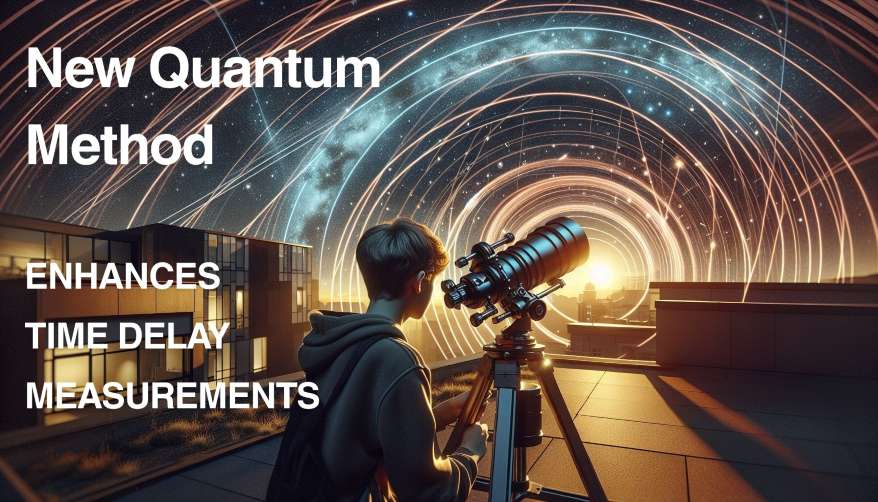
New Quantum Method Enhances Astrophysical Time Delay Measurements
Recent advances in quantum-inspired computing are transforming how astronomers observe the cosmos. A new quantum method time delay now promises to make one of astronomy’s most difficult measurements—the detection of tiny differences in the arrival times of light from distant objects—far more precise and efficient. By integrating quantum algorithms into astrophysical observations, scientists are pushing the limits of what current telescopes can achieve.
Understanding quantum method time delay
Astrophysical bodies create gravitational fields that bend light passing near them. This bending forms multiple paths for light from distant stars or galaxies to reach Earth. The timing difference between photons arriving via these paths is known as the time delay. Scientists measure this delay to estimate the mass of the lensing object, a task otherwise difficult and indirect.
For microlensing events, where light images cannot be individually separated, existing methods struggle. They require a high number of photons and lose accuracy if the light source is large. Consequently, detecting time delays in microlensed systems remains a huge challenge for astronomers.
A New Quantum-Inspired Approach
A recent study introduces a groundbreaking technique that drastically reduces the photon count required for measuring these time delays. This method uses a quantum-inspired algorithm combined with quantum information processing technologies.
The researchers demonstrated that their approach saturates a provable lower bound on the number of photons needed. It means their scheme works near the theoretical best limit possible in efficiency. Thus, observations inaccessible before may now become feasible with current and near-future telescopes.
Applications and Implications
This technique has multiple applications. Firstly, it can calibrate optical interferometric telescopes more precisely. Secondly, it enables direct mass measurements of ongoing microlensing events, such as stellar flares in our Galactic Bulge. Despite these flares producing few photons, the new method can still accurately find time delays.
Our photon-efficient scheme opens new doors for astrophysical observations using existing technology, explained lead researcher Zhenning Liu.
This development enhances our ability to study dark matter, black holes, and other celestial phenomena hidden through gravitational lenses.
Also Read :https://entechonline.com/quantum-memory-for-x-rays/
The Future of Time Delay Measurements
The proposed approach promises advancements in both observational convenience and scientific accuracy. Since it requires exponentially fewer photons, astronomical studies will need less observation time under varying conditions.
This leap benefits not only astronomers focused on microlensing but also those working across many fields within astrophysics looking to probe cosmic mass distributions deeply.
Additionally, to stay updated with the latest developments in STEM research, visit ENTECH Online. Basically, this is our digital magazine for science, technology, engineering, and mathematics. Also, at ENTECH Online, you’ll find a wealth of information.
Reference:
- Yang, S., Yuan, H., & Barnes, C. H. W. (2025). Experimental demonstration of the PBR test on a superconducting processor. arXiv.org. https://doi.org/10.48550/arXiv.2510.11213
- Author
- Latest Posts

Ashwini Kshirsagar holds a graduate degree in Chemistry and a postgraduate degree in Environmental Science from Shivaji University, Kolhapur. With a strong foundation in scientific principles and a creative flair, she blends her expertise in environmental science with skills in technical writing, graphic design, and video editing. Proficient in Adobe software, Ashwini excels at transforming complex scientific concepts into clear, engaging, and visually compelling content. Her unique ability to merge science and storytelling allows her to create impactful communication materials that are both informative and accessible to a wide audience.